Finding the right photo shoot model is probably the single most important decision you'll make for your entire campaign. This person is the bridge between your brand and your customer. They don't just wear your product; they have to embody its entire story and personality. When you get this right, you create an emotional connection that turns casual browsers into loyal fans.
Why the Right Model Is a Game Changer
Before we even touch on cameras or lighting, let's talk about the one thing that truly makes or breaks a product photoshoot: the model. This isn’t just about finding an attractive face. It’s a critical business decision that directly shapes how customers see your brand and, ultimately, how much you sell.
A great model takes all your abstract brand values and makes them real, human, and relatable.
Aligning the Model with Your Brand Identity
Think of your model as a brand ambassador in stills. Their look, energy, and overall vibe must be a perfect match for your core identity. A brand selling edgy, urban streetwear needs a completely different presence than one promoting serene, organic skincare. Any mismatch here creates confusion and can turn off your ideal customer before they even look at your product.
It all comes down to the feeling you want to convey:
Youthful and energetic? You’ll want models with dynamic expressions and an active, vibrant presence.
Sophisticated and luxurious? Focus on finding someone with an elegant, poised demeanor.
Approachable and relatable? A model with a warm, genuine smile is probably your best bet.
Your photo shoot model isn’t just a person in a picture; they are the visual representation of your customer’s aspirations. When a shopper sees someone who looks like the person they want to be, wearing your product, the connection is instantly made.
The Financial Impact of a Great Model
The demand for professional visuals has turned modeling into a massive global business. The industry was valued at roughly $8 billion in 2023, which shows just how much brands are willing to invest to get their visual identity right. You can discover more modeling industry statistics to see how this reflects the growing need for high-quality on-model photography.
It's an investment that absolutely pays off. A model who genuinely connects with your audience can boost conversion rates significantly. They aren’t just showing off a product; they’re selling the lifestyle and feeling that comes with it. That emotional resonance is what justifies the cost and makes the right photo shoot model a true game-changer.
Finding and Casting Your Ideal Talent
Once you’ve nailed down the vibe your brand is going for, it's time to find the person who can actually bring it to life. This whole process kicks off with a solid, compelling casting brief. Think of it as your brand’s matchmaking profile—the more specific and detailed you are, the better your odds of attracting the perfect model for your shoot.
Vague briefs just lead to a sea of generic applicants. You need to go way beyond basic stats like height and hair color. What role is the model playing in your brand’s story? Are they an adventurous spirit exploring the city, or a calm, focused professional in their element? I always tell clients to describe the personality traits they're looking for, the level of experience needed, and even include a few mood board images to really drive the aesthetic home.
Where to Find Your Photo Shoot Model
With your brief polished and ready, the hunt begins. You really have two main paths to go down: working with a professional modeling agency or sourcing freelance talent yourself. Each has its own set of pros and cons, and the right choice usually comes down to your budget, timeline, and how hands-on you want to be.
Modeling Agencies: These are the traditional gatekeepers for a reason. Agencies offer a curated roster of vetted, professional models. They handle all the messy paperwork—contracts, payment, the works—and give you a layer of reliability you can't always get elsewhere. If a model calls in sick last minute, a good agency will have backups ready to roll.
Freelance Platforms and Social Media: Places like Instagram have completely changed the game for scouting. You can find incredible up-and-coming talent with authentic, niche looks who might not be signed to a big agency yet. This route can definitely be easier on the wallet, but be prepared to put in more legwork on vetting, negotiation, and drawing up contracts.
Agency Model vs Freelance Model Comparison
So, how do you decide? Choosing between an agency model and a freelancer often comes down to a classic trade-off: cost versus convenience and control. There's no single "best" option; it all depends on what your specific project needs and the resources you have at your disposal.
Here’s a quick breakdown to help you weigh your options:
Factor | Agency Model | Freelance Model |
|---|---|---|
Cost | Generally higher rates since the agency takes a cut. | Often more budget-friendly with room for negotiation. |
Reliability | High. Contracts are standardized and they usually have backups. | Can be a mixed bag. Requires careful vetting and rock-solid agreements. |
Workload | Lower for you. The agency handles the booking and logistics. | Higher for you. You're on the hook for casting, contracts, and payments. |
Talent Pool | Vetted, professional, and experienced talent. | A huge range of diverse and unique looks, but experience levels vary widely. |
At the end of the day, both routes can lead you to amazing talent. It just depends on how much of the process you want to manage yourself.
The demand for professional models has sent the agency market soaring. In 2024, the global modeling agency market hit a valuation of $7.09 billion and is expected to keep climbing. This just shows how vital these services are for brands that need top-tier, reliable talent. You can explore more modeling agency market trends if you want to dig deeper into the industry's growth.
Pro Tip: When you're flipping through portfolios, keep an eye out for versatility. A truly great model can telegraph a whole range of emotions and adapt to different styles on the fly. I always make sure to look at their unretouched digital photos (often called digitals or Polaroids) to get an honest sense of their natural look. It's the best way to avoid surprises on shoot day.
Preparing for a Flawless Shoot Day
You’ve booked your model. Awesome. Now the real work starts. The difference between a chaotic, stressful shoot and a smooth, creative one all comes down to what you do in the days leading up to it. This pre-production phase is your game plan, making sure everyone on set—from the photographer to the photo shoot model—is on the exact same page.
It all starts with a solid shot list and a mood board. And a mood board is so much more than just a collection of pretty pictures; it’s the visual soul of your campaign. It’s how you communicate the specific lighting, the emotional tone, and the energy you're trying to capture. When you send this out to your team ahead of time, the photographer can start planning their lighting rig, and the model can start thinking about the expressions that will hit the right note.
This process is the bedrock of a successful shoot, flowing logically from one stage to the next.
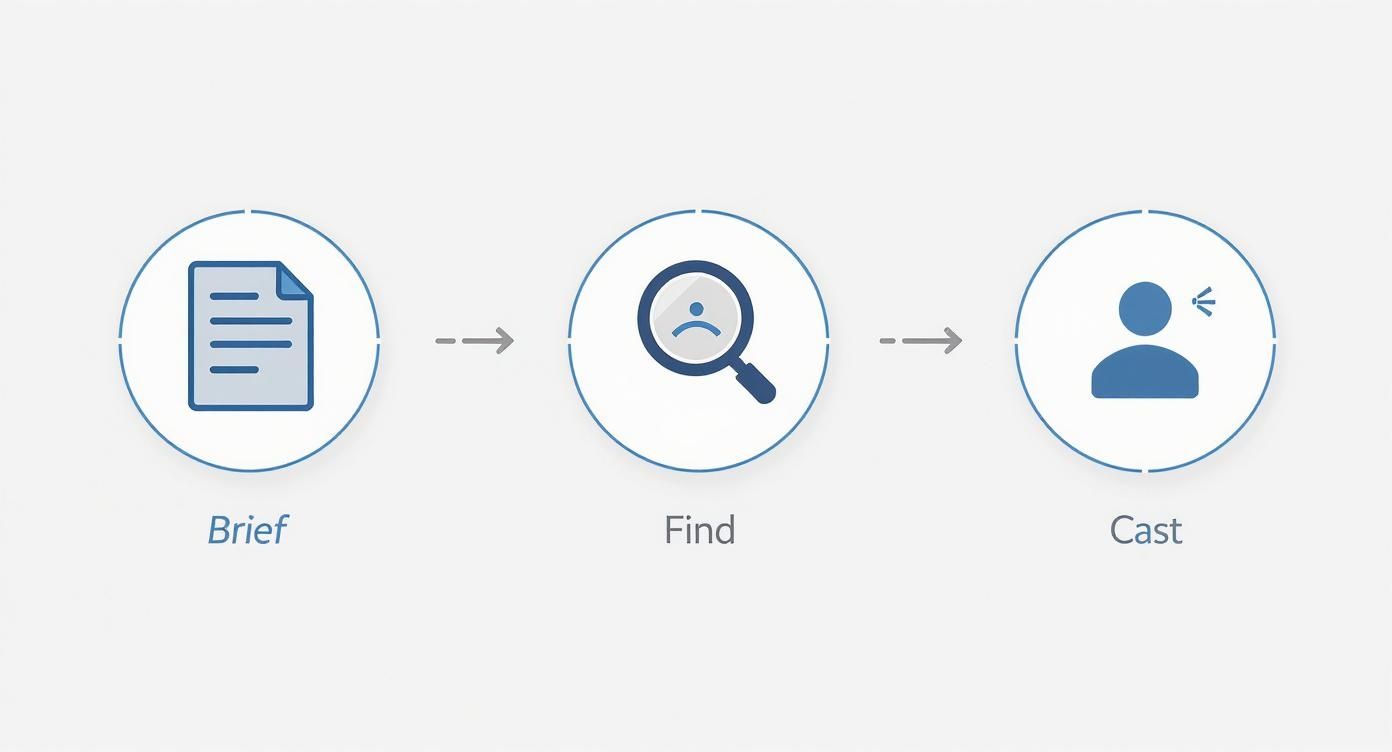
It’s a simple workflow—Brief, Find, Cast—but getting it right is what sets the stage for a perfectly executed shoot day.
The Power of Styling and Fit Sessions
I can't stress this enough: never, ever skip a pre-shoot fitting session. It might feel like one more thing to schedule, but it will save you an incredible amount of time (and money) on the day. Trust me, there’s nothing worse than discovering a key piece doesn’t fit when the clock is ticking and you’re paying a full crew by the hour.
A dedicated fit session lets you get ahead of potential problems.
Confirm Garment Fit: This is your chance to make sure everything hangs just right, with no weird bunching or pulling that will ruin a shot.
Finalize Looks: You can play with different combinations and lock in the exact outfits for each shot. No more last-minute indecision on set.
Build Rapport: It’s also a great, low-pressure way for your model and stylist to connect and build a little chemistry before the shoot.
This is absolutely essential for apparel brands. You might even find that certain fabrics look totally different in motion, which could inspire a few new ideas for your shot list. For more ideas on matching garments to concepts, our guide on choosing the best dresses for a photoshoot has some great, practical tips.
Securing the Rights with a Model Release
Finally, let’s get into the most critical legal document of the entire process: the model release form. This contract is 100% non-negotiable. It’s the legal agreement that gives you the right to use the model's image and likeness in your marketing.
Let me be clear: without a signed model release, you technically don’t own the rights to use the images from your photoshoot—even if you’ve paid for everything. This document protects your brand by spelling out usage rights and heading off any legal headaches down the road.
Your release form needs to be airtight. Make sure it explicitly states:
Usage Rights: Where can you use the photos? Be specific. Think website, social media, paid ads, print, etc. It's always best to secure the broadest rights possible, like "in perpetuity" and "all media known and unknown."
Compensation: The payment terms you’ve already agreed on should be clearly detailed.
Exclusivity: If it's part of the deal, this is where you outline any agreement that prevents the model from working with your direct competitors for a specific timeframe.
Always, always get the model to sign the release before a single photo is taken. It’s a simple step that secures your investment and gives you the legal freedom to use your stunning new assets to grow your brand.
Directing Models for Authentic Poses
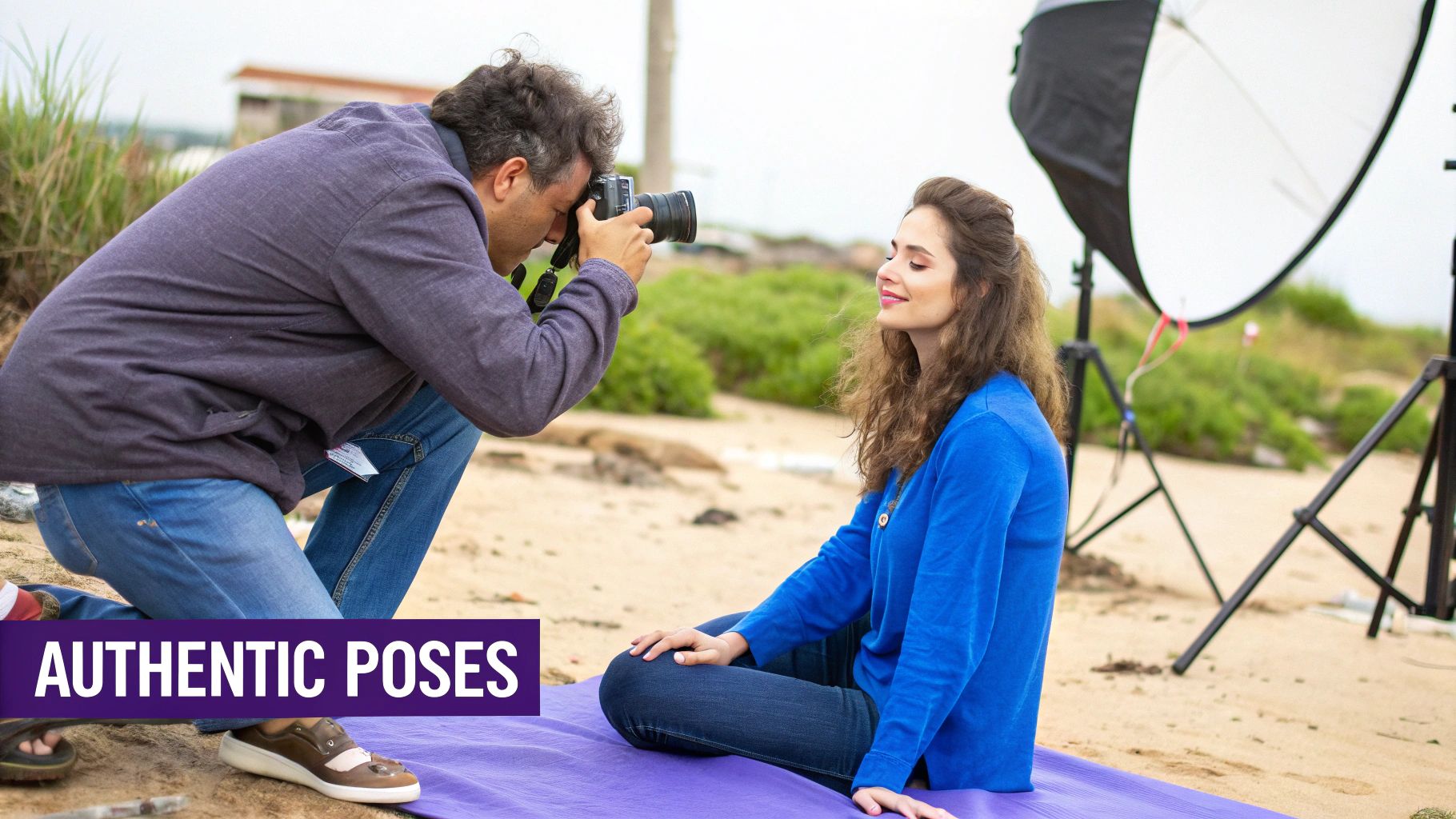
Even the most seasoned photo shoot model relies on good direction to nail the specific vision you have in mind. Your job on set is to coax out poses that feel genuine and full of life, not stiff or overly rehearsed. The secret sauce? Great communication. It’s what bridges the gap between your concept and the final image that connects with customers.
A positive, collaborative vibe on set is non-negotiable. I always start by walking the model through the mood board and shot list. When they understand the story and emotion we're trying to capture, they can do more than just strike a pose—they can embody the character of your brand.
Using Clear and Actionable Cues
Telling a model to "look natural" is probably the least helpful direction you can give. The same goes for "be more energetic." These instructions are too vague. Instead, you need to provide concrete, action-oriented cues they can actually work with.
Think about giving them small scenarios to play out. For example, rather than asking for a generic smile, try something more specific:
"Picture yourself laughing with a good friend who’s just off-camera."
"Walk towards the camera like you're heading to your favorite cafe on a sunny morning."
"Fiddle with your sleeve cuff like you’re getting ready for an important meeting."
These tiny narratives give the pose a purpose, which almost always translates into more authentic expressions and body language. You're directing the action, and the authentic emotion will follow.
Key Takeaway: The best directions inspire movement and interaction. Give your model a simple task or a mini-story, and you’ll get natural shifts in posture and expression that make for much more compelling photos.
Fostering a Collaborative Environment
A photo shoot is a team sport, not a one-person show. Make sure your model feels empowered to share their own ideas. Honestly, some of the best shots I’ve ever gotten came from a model's spontaneous movement or a suggestion we hadn't planned.
Make it a habit to check in with them throughout the day. A simple, "Does that pose feel okay?" can make a world of difference. When a model feels comfortable and respected, they relax, and that confidence shines through in the final shots. It’s all about building that trust and rapport.
For more inspiration on building a library of compelling looks, our guide on fashion model poses has tons of ideas you can bring to your next shoot. Remember to mix still poses with more active shots. Have your model walk, interact with props, or engage with the scenery to create images that feel less like a picture and more like a moment caught in time.
Exploring AI as a Photoshoot Alternative
While there's an undeniable magic to a live photoshoot, the world of product photography is definitely evolving. Artificial intelligence now offers a powerful way for brands to create hyper-realistic on-model images without ever setting foot in a studio.
This isn't just about cutting corners. The tech has gotten remarkably good. Advanced algorithms can take your product and digitally place it onto a model, realistically mimicking the lighting, shadows, and even the way fabric drapes. You can essentially generate an entire campaign's worth of on-model shots from a single flat-lay photo, giving your whole catalog a polished, cohesive feel.
The Big Wins with AI Models
For any brand, but especially those scaling up, the advantages of AI are pretty compelling. Cost and speed are the two biggest game-changers.
A traditional shoot has a long list of expenses: the model, photographer, stylist, hair and makeup, studio rental, catering, and post-production work. AI sidesteps nearly all of that, transforming a project that could cost thousands into something far more accessible.
Then there's the timeline. What normally takes weeks of planning, casting, shooting, and editing can now be done in a matter of minutes or hours. This kind of agility means you can react to trends, test out new product concepts, or refresh your website visuals almost on a whim.
For many brands, the most exciting part is the creative freedom. AI opens the door to unlimited diversity and inclusivity. You can showcase your product on models of every ethnicity, age, and body type with a few clicks, ensuring your brand truly reflects its audience.
Knowing When to Choose AI
So, should you scrap all your photoshoots and go all-in on AI? Not necessarily. It's about knowing where the technology shines.
AI is an absolute powerhouse for producing clean, high-volume e-commerce imagery—think classic studio shots on a simple background. If you need to populate a large online catalog with consistent product detail shots quickly and affordably, it’s the perfect tool for the job.
However, for more complex lifestyle campaigns that rely on authentic human interaction and a specific environment—a model hiking a mountain trail or laughing with friends in a busy café—a real photoshoot often captures an emotional resonance that AI is still learning to replicate. Those subtle, genuine expressions are where a professional human model still has the edge.
The smartest approach isn't always about replacement, but integration.
For E-commerce: Lean on AI to build a comprehensive and diverse catalog of on-model studio images.
For Campaigns: Save your budget and invest in a traditional shoot for those key hero images that tell a deeper story about your brand.
For Post-Production: Don't forget that AI can also improve the photos you already have. Our guide on how to upscale images with Photoshop AI shows just how powerful it can be for enhancing existing assets.
This hybrid strategy gives you the best of both worlds: the incredible efficiency of AI for volume and the unique storytelling power of a traditional shoot for impact.
Frequently Asked Questions About Hiring a Model
If you're hiring a photo shoot model for the first time, it can feel like you're learning a whole new language. Don't worry, it's completely normal to have questions about how rates, usage rights, and industry standards work. Getting these details sorted out from the start will save you a world of trouble later on.
We've pulled together the most common questions we hear from brands. Think of this as your cheat sheet to confidently manage your photoshoot budget and logistics.
How Much Should I Expect to Pay for a Model?
There's no single price tag for a model. The cost can swing wildly depending on a few key things. For instance, a new face or a freelance model just starting out will have a much lower day rate than an established agency model with years of experience and a killer portfolio.
Here's what really drives the cost:
Experience Level: A pro model who knows how to move and needs very little direction costs more, but they can make your shoot day incredibly efficient and productive.
Agency vs. Freelance: Agencies take a lot of the logistical work off your plate, but they typically add a 20% booking fee on top of the model’s rate.
Usage Rights: This is often the biggest variable. Where and for how long will you use the photos? A global billboard campaign will cost exponentially more than images for a small brand’s website.
Shoot Duration: Most models work on a half-day (4-5 hours) or full-day (8-10 hours) basis. Anything beyond that usually gets billed as overtime, often at a premium rate.
For a standard e-commerce shoot, you can expect a professional model's day rate to be anywhere from $500 to over $2,500. That's before you add in any agency fees or usage buyouts, so always ask for a quote that breaks down every single cost.
A classic rookie mistake is only budgeting for the model's day rate. You have to account for the other pieces of the puzzle—usage rights, agency fees, travel, and potential overtime—to understand your actual total investment.
What Exactly Are Usage Rights and Why Are They So Important?
Think of usage rights as the license agreement for your photos. They legally define how, where, and for how long you're allowed to use the images from your photoshoot. Honestly, this is the most critical part of any model agreement. If you get the rights wrong, you could find yourself in a serious contract breach.
It’s just like licensing software; you're not buying the content outright, you're paying for permission to use it under very specific conditions.
Decoding Common Usage Terms
When you're working out the details with an agency or model, you'll hear a few key terms over and over. Getting a handle on what they mean is essential for protecting your brand.
Usage Term | What It Means | Best For |
|---|---|---|
Term Length | This is the lifespan of your license—how long you can use the images. It could be 1 year, 3 years, or "in perpetuity," which means forever. | Brands that want to use campaign assets for years to come should push for perpetuity. |
Territory | This defines the geographic regions where you can use the photos, like North America only, or Worldwide. | If you're an e-commerce brand selling internationally, you absolutely need to secure worldwide rights. |
Media | This specifies the platforms where the images can live. Examples include your website, social media, print ads, or paid digital marketing. | Getting rights for "all media, known and unknown" is the gold standard. It gives you the most flexibility as new marketing channels emerge. |
Not getting broad enough rights from the get-go can be an expensive mistake. Imagine your campaign is a smash hit, and you want to run it again next year. If you only licensed the images for one year, you have to go back to the negotiating table—and you can bet the price will be much higher the second time around. Always try to secure the broadest usage rights your budget can handle right from the start.
Ready to sidestep the headaches of traditional photoshoots? With Look Atlas, you can generate incredible on-model imagery in just a few minutes. You get total creative control without the high costs and logistical nightmares. Create your first AI-powered product photo today.
