So, you want to be a male model? The good news is the path is clearer than you might think. It really boils down to three things: figuring out where you fit in, getting professional photos that show you off, and then finding a legitimate agent who can get you work.
Forget the old clichés. Success today isn't just about being a six-foot-two runway god; it's about understanding your unique look and knowing exactly where it sells.
Understanding the Modern Male Modeling World
When people hear "male model," their minds usually jump straight to chiseled jawlines on a Paris runway. And sure, that world exists. But high fashion is just one small slice of a massive, diverse industry. For most guys starting out, the real money and opportunities are found far from the catwalk.
Today's market is hungry for authenticity. Brands want models who look like their actual customers, which has blown the doors wide open for men of all different shapes, sizes, ages, and backgrounds. This shift is huge. It means your personality, your unique features—even what you're doing on social media—are now part of your professional toolkit.
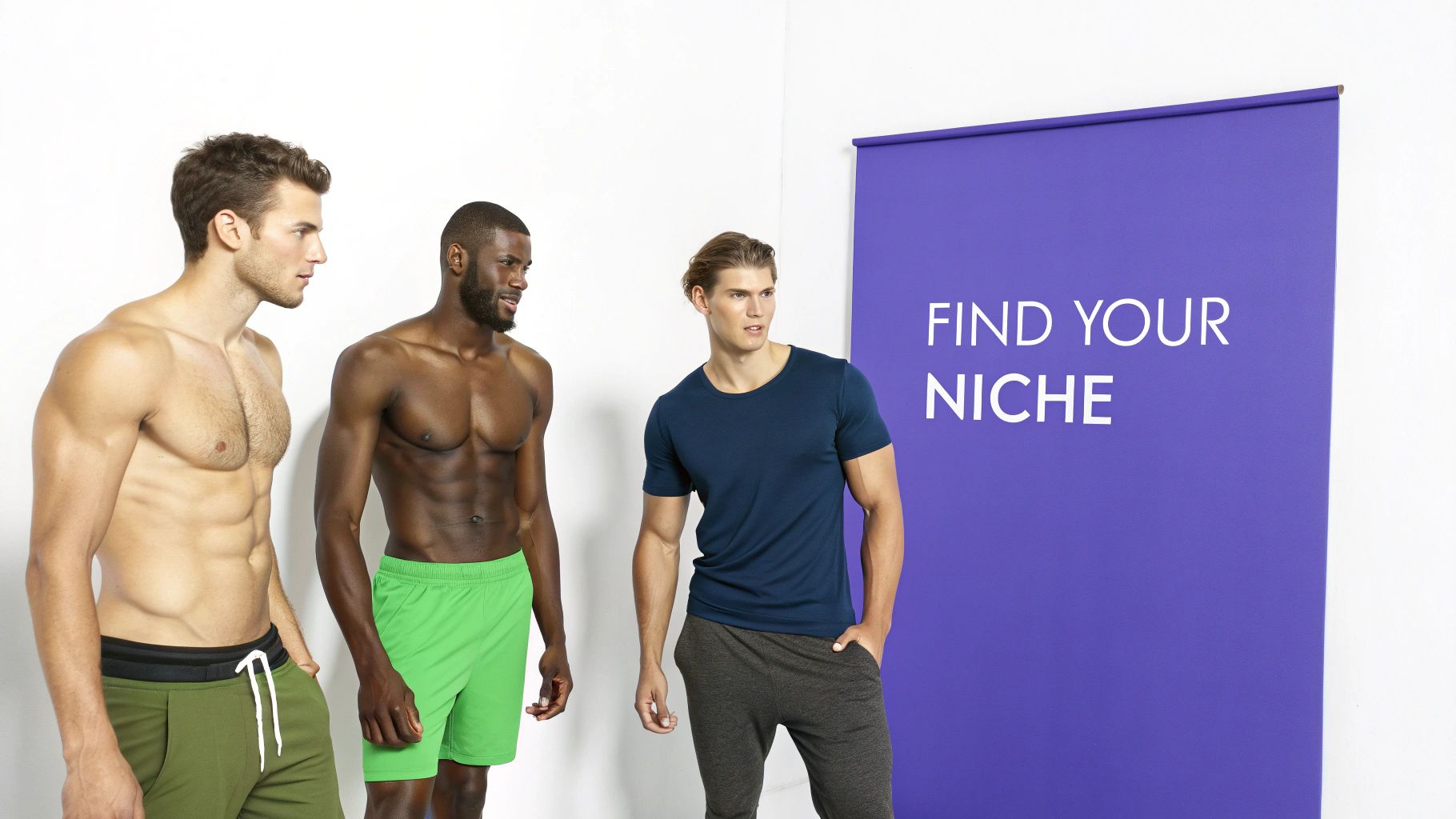
Finding Your Niche in the Market
This is where you need to start. Honestly. The single biggest mistake I see new models make is trying to be everything to everyone. It’s a fast track to a folder full of rejection emails.
Your first job is to get real about your look and figure out which modeling niche you naturally fit into. Once you know your lane, you can build a portfolio and approach agencies with a clear, targeted strategy. It shows casting directors you've done your homework and you understand the business.
The modeling world isn't about fitting one perfect mold anymore. It's about finding the specific mold you fit perfectly. Success comes from knowing your lane and owning it, whether that's in a magazine spread or a department store catalog.
A Breakdown of Male Modeling Categories
The industry is broken down into several key areas, and each one has its own rules and standards. It’s worth noting that the commercial side of the business is where most of the work is. In fact, around 60% of male models build their careers primarily on commercial campaigns, not high fashion. If you want to dive deeper, you can find more modeling industry statistics that paint a clear picture of the market.
Let's look at the main types of modeling for men:
Commercial Modeling: This is the bread and butter of the industry. It’s all about relatable, “everyday” looks for print ads, TV spots, and online catalogs. Think about the guys you see in ads for Target, Ford, or your bank. That's commercial modeling.
Fashion (Editorial & Runway): This is the high-concept, artistic end of the spectrum. Editorial models are the faces you see in magazines like GQ or Vogue, while runway models walk for designers during Fashion Week. The physical requirements here are notoriously strict, especially for height (typically 6'0" to 6'3").
Fitness Modeling: This is exactly what it sounds like. It’s for guys with healthy, athletic, and well-defined physiques. Fitness models land jobs with sportswear brands like Nike, supplement companies, and men's health magazines.
Parts Modeling: Got great hands? Perfect teeth? Well-defined calves? Parts models specialize in showcasing a specific body part for products like watches, toothpaste, or shoes. It's a surprisingly lucrative corner of the industry.
Plus-Size/Big & Tall Modeling: This is a rapidly growing market. More and more brands are looking for models with larger body types to connect with a broader customer base. It's all about body positivity, confidence, and a strong presence.
Male Modeling Niches at a Glance
This table breaks down the main modeling categories to help you pinpoint where you'll have the best shot. Think of it as a cheat sheet for finding your place in the industry.
Modeling Type | Typical Height Range | Key Attributes | Common Work |
|---|---|---|---|
Commercial | 5'9" - 6'2" | Relatable, great smile, clear skin, versatile look | Print ads, catalogs, TV commercials, lifestyle shoots |
Fashion/Runway | 6'0" - 6'3" | Lean build, strong jawline, unique features, specific measurements | High-fashion editorials, runway shows, designer campaigns |
Fitness | 5'10" - 6'3" | Athletic, toned, muscular but not bulky physique | Sportswear ads, gym promotions, supplement campaigns |
Parts Modeling | Varies | Symmetrical and well-groomed hands, feet, or other parts | Jewelry ads, shoe campaigns, close-up product shots |
Take a hard, honest look at yourself and see where your physical traits and personality line up. This self-awareness is the absolute foundation for everything else you’ll do on your journey to becoming a professional model. Get this right, and you're already ahead of the game.
Building Your Essential Modeling Toolkit

In modeling, your look gets you in the door, but your professional materials are what actually get you noticed. Before you even think about approaching an agency, you absolutely need two things: a solid set of digitals and the start of a real portfolio.
Think of these as your resume and your first impression all rolled into one. Agents and casting directors are slammed—they flip through hundreds of submissions a day. Your photos have to immediately grab them, showing who you are, what you look like naturally, and your potential on camera. Anything less gets deleted. It’s that simple.
Mastering Your Digitals at Home
Digitals, often called Polaroids in the industry, are the single most important photos you'll take at the beginning. They are just simple, unedited snapshots that show agencies your raw, natural look. No fancy lighting, no styling, no retouching. An agency needs to see the real you—the blank canvas they can project a client's vision onto.
You don't need a professional photographer for this. In fact, it's better if you don't use one. All you really need is a smartphone, a plain wall, and good natural light.
Here's your quick checklist for an at-home digital shoot:
Find Your Light: Stand facing a big window. That soft, even, natural light is what you want. Stay out of harsh, direct sunlight, which creates weird, unflattering shadows. Getting the best lighting is everything, even when you're just using a phone.
Keep It Simple: Wear plain, form-fitting clothes. A simple black or white t-shirt and a good pair of jeans are perfect. The focus here is on your face and physique, not your sense of style.
Get the Essential Shots: Have a friend help you out. Stand against a plain, clutter-free background (a white or gray wall is ideal) and knock out these specific shots:
Headshot (shoulders up), smiling
Headshot (shoulders up), not smiling
Full-body shot, facing the camera
Full-body shot, from the side (profile view)
And that’s it. These images need to be 100% natural. No hair products, no makeup, no filters, and definitely no editing. This is exactly what agents want to see first.
Your Portfolio and Comp Card: The Next Level
Once you have your digitals squared away, it's time to start building a professional portfolio. While digitals show your raw potential, a portfolio shows your versatility and proves you can work with a photographer to create a finished, polished image.
A portfolio is your curated collection of best work—usually 8-12 high-quality images. It needs to demonstrate your range by showing different looks, emotions, and styles. For instance, you might have a clean, smiling commercial shot, a more serious editorial photo, and a solid fitness shot.
A composite card, or comp card, is basically a model's business card. It's a double-sided card with your best headshot on the front and 3-5 of your most versatile portfolio images on the back. It also includes your name, stats (height, chest, waist, shoe size), and your agency's contact info once you have one. You’ll leave this behind at castings.
Your digitals get an agent's attention. Your portfolio proves you have what it takes. Don't confuse the two; one shows who you are, the other shows what you can do.
Finding Photographers for Test Shoots
Building that initial portfolio doesn't have to break the bank. The secret is finding photographers for "test shoots." You'll hear this called TFP, which stands for "Trade for Print" or "Trade for Portfolio."
It's a pretty standard industry practice where a model, photographer, and sometimes a stylist or makeup artist collaborate for free. Nobody gets paid, but everyone gets to use the final images to build their own professional portfolios. It’s the perfect way to get experience and pro-quality photos without the hefty price tag.
So, how do you find these opportunities?
Use Social Media: Instagram is your best friend here. Search for local photographers using hashtags like
#LAphotographeror#NYCTFP(just swap in your city). Look for photographers whose style matches the kind of modeling you want to do.Join Online Groups: Facebook is full of groups dedicated to TFP collaborations in specific cities. Jump in, network, and look for legitimate opportunities.
Reach Out Professionally: When you find a photographer you’d like to work with, send them a polite, professional message. Introduce yourself, mention you're a new model looking to build your book through TFP, and attach your digitals so they can see your look.
With these first few test shoots, your goal is to walk away with a handful of powerful images that show you can pull off different looks. Aim for a clean commercial headshot, a more serious fashion-style shot, and a full-body shot that highlights your physique and posture. This core set of photos will become the foundation of your entire modeling toolkit.
Developing Your Look and Personal Brand
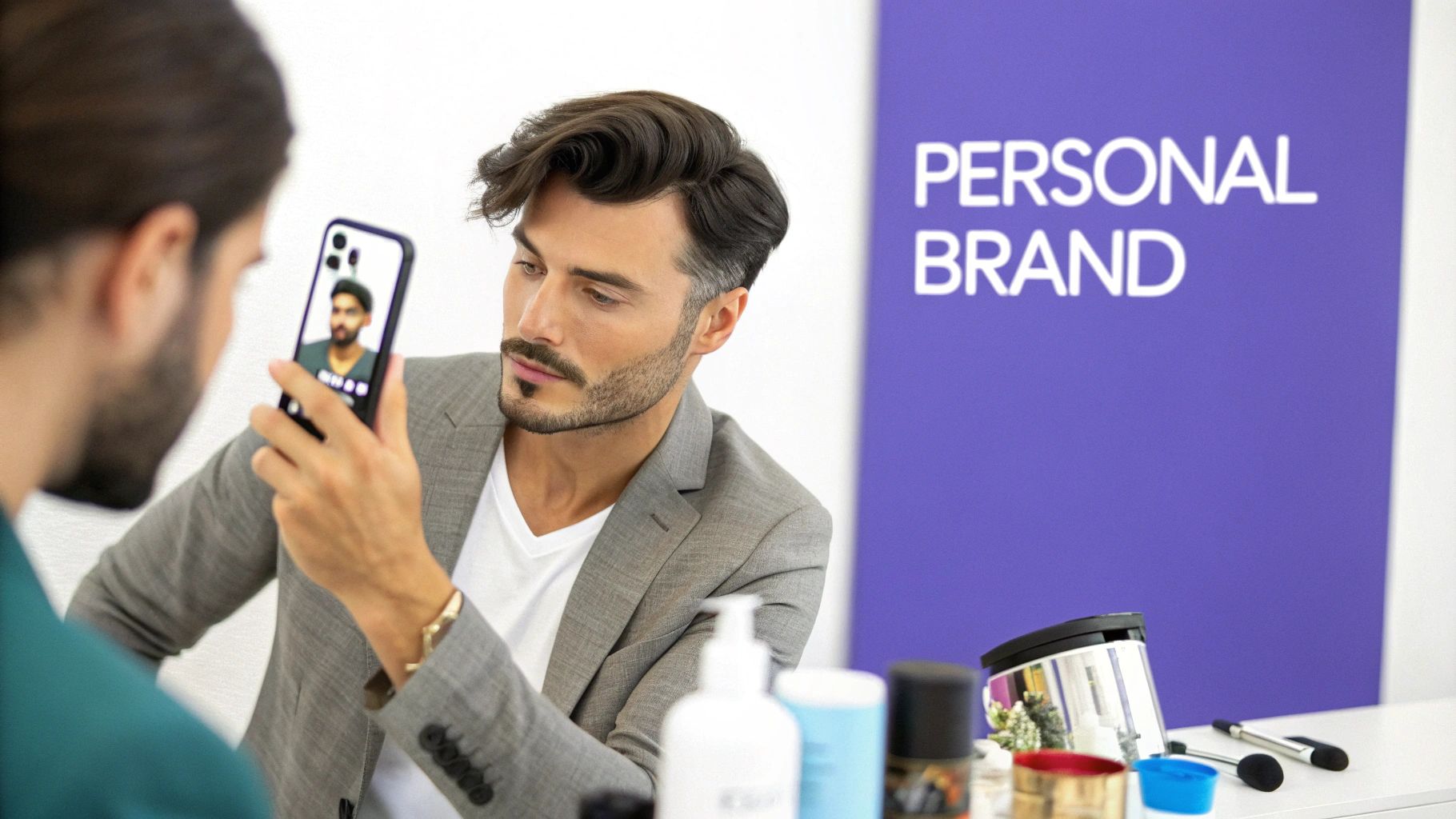
Sure, the right measurements might get you on an agent’s radar, but it’s your total package—your look, your grooming, your brand—that seals the deal. Getting ahead in male modeling is about more than just having a certain build; it's about being a versatile, professional canvas.
This doesn't mean changing who you are. It’s about refining what you have and presenting the most marketable version of yourself. From your skincare routine to what you post on Instagram, every detail tells a story about the kind of model you are.
Mastering the Grooming Essentials
Let’s be clear: agencies and clients expect a polished, well-maintained look. If you show up to a meeting with bad skin or a messy haircut, you’re signaling that you aren't serious. These details are non-negotiable—they’re the foundation of your career.
Here’s what you need to have dialed in:
Skincare: A clear complexion is everything. You don't need a crazy 10-step routine, just a consistent one. Find a simple cleanser, moisturizer, and sunscreen that works for your skin and use them every single day.
Hair: Keep your hair healthy and versatile. Avoid that super trendy, extreme cut that might look cool for a month but limits your range. A classic, well-maintained style that a stylist can easily adapt on set is far more valuable.
Hands and Nails: You might not think about them, but your hands will end up in close-up shots for watches, phones, and countless other products. Keep your nails trimmed, clean, and filed. Use a moisturizer so your skin doesn't look dry or cracked.
Building the Right Physique
When it comes to fitness, modeling has a different goal than bodybuilding. The industry standard is almost always a lean, toned, athletic build—not massive bulk. This is a practical matter. Models need to fit into standard sample sizes, which are cut for a slimmer frame.
Focus your workouts on a solid mix of cardio and strength training. Think more like a swimmer or a soccer player. This approach builds functional strength and definition without adding too much size, making sure you’re a good fit for a wide range of clothing brands.
A model's body is part of their professional toolkit. The goal is a lean, healthy physique that complements the clothing, not one that overpowers it. Think tone and definition, not sheer mass.
Crafting Your Digital Identity
In today’s industry, your social media is just as important as your portfolio. It's your living, breathing book. Agents and casting directors will absolutely check your Instagram to see the real you—your personality, your style, and how you carry yourself outside of a professional shoot.
A well-curated feed can show off your marketability in a way a static headshot never could.
To build a powerful personal brand online, focus on these four things:
Define Your Vibe: Figure out your niche. Are you the outdoorsy, adventurous type? Or more polished and urban? Maybe you're artistic and a bit edgy. Whatever it is, your content should have a consistent theme that lines up with the kind of modeling you want to do.
Post High-Quality Content: Not every shot needs to be from a professional photographer, but every picture should be clear, well-lit, and thoughtfully composed. Mix in your best digitals, shots from test shoots, and authentic lifestyle photos.
Showcase Your Versatility: While consistency is key, you also need to show your range. Post photos that display different expressions, angles, and styles. This is your chance to practice new looks and show agents what you're capable of. For inspiration, check out this guide on essential fashion model poses to elevate your content.
Engage Authentically: Don’t just post and ghost. Interact with photographers, stylists, and other models. Building real connections in the industry is just as important as growing your follower count.
For guys trying to figure out their style, a tool like an AI outfit maker for men can be surprisingly helpful for experimenting with new looks and refining your personal brand. By staying on top of your grooming, fitness, and online presence, you create a professional package that makes you an undeniable asset for any agency.
How to Find and Secure an Agency
Alright, you've got your digitals and you're starting to build a book. Now for the most important step: landing an agent. This isn't just about finding someone to get you jobs. A great agent is a career architect—they guide you, fight for your rates, and open doors you didn't even know existed.
But let’s be real, the industry can be a minefield. For every top-tier agency, there are dozens of scams and low-level outfits looking to take advantage of new talent. Your mission is to cut through that noise with smart research and a professional approach. This is where you prove you’re serious.
Researching Reputable Modeling Agencies
Jumping on Google and blasting your photos to every "modeling agency" you find is a rookie mistake. You need a targeted strategy.
Start by looking at the major markets. If you've got the stats for high fashion, your focus should be on agencies in New York, London, Paris, and Milan. For commercial work, the big hubs are cities like Los Angeles, Chicago, and Miami. Even if you're not local, you need to know who the key players are.
Study the agency boards. Go to the websites of legitimate agencies like Ford, IMG, Next, Wilhelmina, and Elite. Click on their "Men" or "Main Board" sections. Do you see guys with a similar look to yours? If an agency’s board is full of edgy, runway-only models and you have a classic, commercial look, it’s probably not the right fit.
Dive into industry resources. Websites like Models.com are your new best friend. They have verified lists of top agencies and are the definitive source for who’s who in the business.
Use social media strategically. Follow agencies and their bookers on Instagram. It’s a great way to get a feel for their brand, see the kind of work they book, and sometimes even find out about open calls or specific submission requests.
The goal here isn't to create a massive list. You're trying to identify a curated group of 10-15 agencies that feel like a genuinely good match for your look and goals.
Submitting Your Application Professionally
When you hit 'send,' remember that agents see hundreds of submissions every single week. Yours has about five seconds to make an impression.
Following instructions is non-negotiable. If their website says to submit four photos and your stats, don't send eight photos and forget your measurements. That's the quickest way to get your email deleted.
Keep your submission clean and direct.
The Photos: Attach 3-4 of your best digitals. They must be clear, well-lit, and completely unedited. At a minimum, include a headshot and a full-body shot. Keep the file sizes small—no agent wants to download a 50MB email.
The Cover Note: Keep your email short. Introduce yourself, state that you're seeking representation, and list your stats right in the body of the email.
Your Stats: Always include your height, chest/jacket size, waist, and shoe size. For U.S. agencies, use imperial measurements (e.g., 6'1"); for European agencies, use metric (e.g., 185cm).
A Quick Tip on Following Up Once you submit, the hardest part is waiting. If an agency is interested, they will find you, usually within a few weeks. Do not pester them with calls or emails. A single, polite follow-up after two or three weeks is the absolute maximum. Anything more looks desperate and unprofessional.
Spotting and Avoiding Common Scams
This is critical, so read this carefully. A legitimate modeling agency never asks you for money upfront. Period. They make their money by taking a commission—typically 20%—from the paying jobs they book for you. If you get paid, they get paid. It's that simple.
Run the other way if an "agency" or "scout" does any of the following:
Demands payment for photos. They’ll often pressure you into buying an expensive "portfolio package." A real agency might recommend good photographers, but they will never force you to shoot with someone or pay them directly for photos as a condition for signing.
Guarantees you work. No one can guarantee work in this business. It's a huge red flag if they promise you fame and fortune.
Charges for classes or "development." While acting classes can be great, a real agency won't require you to pay them for training before they’ll sign you.
What to Expect at an Open Call
Some agencies still hold "open calls," which are basically in-person auditions where anyone can walk in and meet an agent. It’s a fantastic way to get seen, but you have to go in prepared.
An open call is usually a very quick, no-nonsense affair. You'll likely wait in line, and when it's your turn, an agent will take a quick look at you, maybe snap a few digitals on their own camera, and ask for your stats. The whole thing might be over in 90 seconds.
Don't get discouraged by how brief it is. These agents are experts and can see potential in an instant. Dress simply in form-fitting clothes (think your digital shoot outfit), be polite and confident, and bring a comp card or at least a couple of printed photos with your contact info and stats on the back. That short, face-to-face meeting could be the moment that kicks off your entire career.
Navigating Castings and the Business of Modeling
Landing that agency contract might feel like you've crossed the finish line, but it’s really just the starting gun. Now the real work begins. Your life is about to become a whirlwind of castings, go-sees, and getting a handle on the financial side of your new career. This is where true professionalism separates the models who build a lasting career from those who are just a flash in the pan.
The casting call will become your daily reality. Your agent will buzz you with a time and place, and you're expected to be there, ready to go, no excuses. Casting directors can see dozens, sometimes hundreds, of models for a single job. You'll get maybe two minutes to make a lasting impression.
Mastering the Audition Process
How you carry yourself in that casting room is everything. Punctuality isn't just a suggestion; it's the bare minimum. Showing up late is the fastest way to get blacklisted by a casting director. I always tell new models to aim to be 10-15 minutes early.
Your appearance should be a clean slate. Think simple, form-fitting clothes that show your physique—much like your digitals. A plain t-shirt and a good pair of jeans are the industry standard. Walk in with your comp card and portfolio in hand, a positive attitude, and be ready to listen and take direction on the spot.
You are going to face rejection. A lot of it. It’s almost never about you personally. You might be an inch too tall, a bit too short, not quite the vibe they're after, or the client simply had a different picture in their head. The single most important skill you'll develop is learning to brush it off and walk into the next casting with the same confidence you had walking into the last one.
This visual guide breaks down the key steps to securing agency representation, which is your gateway to getting these professional casting calls in the first place.
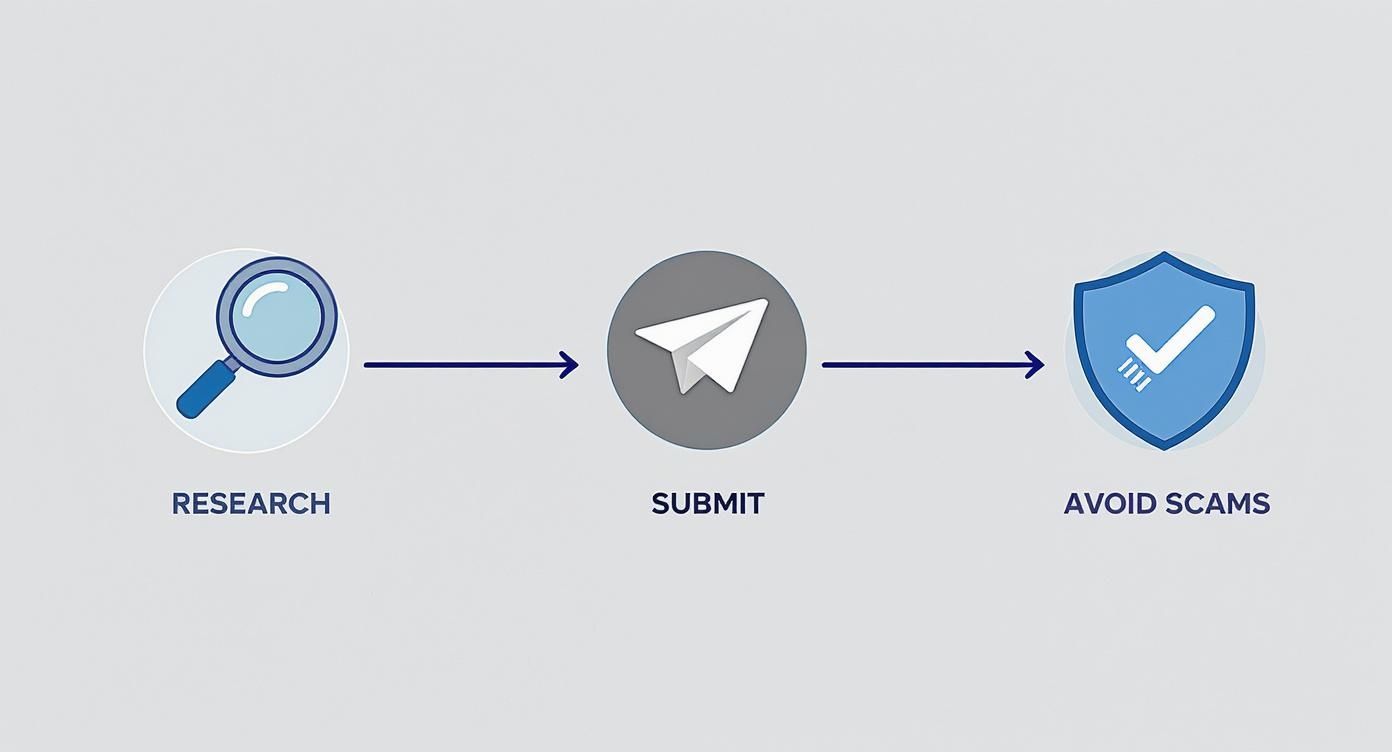
The same skills you use to research and submit to agencies—professionalism and preparation—are exactly what you’ll need to nail your castings.
Understanding the Business Side
Modeling is a business, and you are the CEO of your own brand. You have to understand how the money works to protect yourself and build a sustainable career. Think of your agent as your business partner, not your boss.
The standard agency commission is 20% of your earnings from any job they book for you. This fee is taken directly from the client's payment before the check ever gets to you. Some agencies might also deduct expenses for things like printing new comp cards or courier fees, so read your contract inside and out to understand exactly what you're agreeing to.
Professionalism is your greatest asset. Being on time, easy to work with, and prepared will get you rebooked far more often than just having a great look. Clients remember the models who make their job easier.
Being a pro extends well beyond the casting room. When you're on set, you're there to work. That means listening to the photographer, taking direction without ego, and keeping the energy positive, even on a long shoot day. Your reputation for being reliable and a team player will follow you everywhere—and it can be the deciding factor in a long, successful career. The photos from these shoots will be professionally edited, and knowing a bit about that process can be a huge advantage. For anyone curious, our course on photo editing offers some really valuable insights.
Got Questions About Male Modeling? We've Got Answers
Stepping into the modeling world can feel like navigating a maze. There are a lot of unwritten rules and insider terms that can leave you scratching your head. It’s completely normal to have a long list of questions.
Let's clear the air. Getting straight answers to these common questions will give you the confidence to move forward and help you sidestep some of the rookie mistakes many aspiring models make.
Do I Have to Pay for Anything Upfront?
This is probably the most important question you'll ask, and the answer is a hard no. Let me be clear: legitimate modeling agencies do not charge you money to represent you.
They make their money by taking a commission—usually around 20%—from the paid modeling jobs they book for you. Think of it this way: they are investing in your potential. Their success is tied directly to yours.
If an "agency" or "scout" asks you to pay for any of the following, it’s a massive red flag. Walk away.
Expensive Portfolio Packages: Scammers love to push pricey photoshoots. A real agency might recommend photographers you could work with, but they will never force you to buy a package as a condition for a contract.
"Registration" or "Website" Fees: There's no official registry you need to pay to be a part of. This is a classic scam.
Mandatory "Modeling Classes": While classes can be helpful, a legitimate agency won't force you to pay them for training before they’ll agree to sign you.
Key Takeaway: A genuine agency only gets paid when you get paid. If their business model requires you to open your wallet first, it’s almost certainly a scam designed to take your money, not make you a model.
What Are My Chances If I'm Not Super Tall?
Look, height is a big deal in certain parts of the industry—no pun intended. But it’s not the only thing that matters, especially once you step outside the world of high-fashion runway.
The industry standard for runway is pretty strict, typically landing somewhere between 6'0" and 6'3". However, for commercial, fitness, or parts modeling, the rules are much more relaxed. In those areas, your look, personality, and professionalism are far more valuable than an extra inch or two of height.
Plenty of successful commercial models are in the 5'9" to 5'11" range. If you have a unique, relatable look and can connect with the camera, you’ll find plenty of opportunities. It’s all about finding the right market for your specific look.
How Long Does It Realistically Take to Get Signed?
This is the million-dollar question, and there's no single answer. The timeline is different for everyone. Some guys get scouted on the street and signed within a week. For others, it can take months—or even a year or more—of sending submissions and building their book.
Getting signed is a mix of things: having a strong look, submitting professional materials, timing, and a bit of plain old luck. An agency might not be looking for your type right now, but that could change in a month.
The best thing you can do is stay patient and productive. Send out your submissions to a well-researched list of agencies, and then use the waiting time to shoot with new photographers and improve your portfolio. Consistent, professional effort is what separates the hopefuls from the signed models.
Ready to create stunning, on-model visuals without the cost and complexity of traditional photoshoots? With Look Atlas, you can generate ultra-realistic product images and videos in minutes. Transform your ecommerce store and see why brands report up to 2x more sales. Explore the future of product photography and start creating at https://www.lookatlas.com.
