Great fashion model poses aren't just about memorizing a list of positions. The real magic comes from understanding the fundamentals—the posture, body lines, and angles that can turn a simple stance into a powerful image that truly sells the garment.
Building the Foundation for Unforgettable Poses
Before we get into specific standing, sitting, or movement poses, let's nail down why certain poses work so well. A great pose isn’t just about where you put your hands or feet; it’s about using body language to create a specific feeling or tell a story. Think of it as the grammar of fashion photography. Once you know the rules, you can start creating your own compelling statements.
Everything starts with posture. A straight spine, shoulders that are relaxed but still engaged, and a long neck signal confidence on camera. This alignment doesn't just look better—it ensures the clothing hangs exactly as the designer intended, showing off the true fit and drape.
Mastering Angles and Creating Lines
Angles are your best friend in fashion photography. Posing completely square to the camera rarely works; it tends to look flat and confrontational. Instead, a simple turn of the hips or shoulders to about a 45-degree angle instantly creates depth and dimension, making the shot far more dynamic.
From that simple turn, you can start creating interesting lines with your body. The most famous and versatile of these is the classic 'S-curve'. Here’s how to nail it:
Shift all your weight onto one leg.
Push the hip of that weight-bearing leg out to the side.
Let your shoulders naturally counterbalance, leaning slightly in the opposite direction.
This one technique creates a flattering, natural curve that looks both relaxed and totally intentional. It's the starting point for countless other poses you'll see everywhere.
A core principle every pro model knows is to always create space. That little gap between your arm and your waist? It’s what defines your silhouette and keeps your limbs from disappearing into your torso. Remember the rule: if a joint can bend, bend it. This goes for elbows, wrists, knees, and ankles.
The Role of Body Language and Intention
Beyond the physical shapes, the intention behind the pose is what truly connects with the audience. The pose has to match the mood of the clothing and the brand's identity. A strong, wide-legged stance feels right for a sharp power suit, while a softer, more fluid pose is a much better fit for a breezy sundress.
Every single part of the body helps tell this story—especially the hands. Hands can look incredibly awkward if you don't give them a job to do. Instead of just letting them hang, give them a purpose. Gently touch a lapel, rest a hand on your hip, or casually run your fingers through your hair. These small, motivated actions make any pose feel more authentic and lived-in.
Getting these fundamentals right is just as crucial as having the best lighting for product photography for the final shot. Once these principles become second nature, you’ll be able to adapt, improvise, and create unique, professional poses with total confidence.
Essential Standing Poses for Lookbooks and Ecommerce
Standing poses are the absolute bread and butter of any fashion photoshoot. For e-commerce, where you're trying to sell a product without the customer touching it, a model's stance is everything. It’s what shows off the garment’s cut, communicates a certain vibe, and ultimately connects with the shopper. We're not talking about stiff, mannequin-like positions here. The best standing poses feel alive, natural, and full of personality.
If you can master just a few core standing poses, you’ll have a surprisingly versatile toolkit for any shoot. Think of them as foundational stances. From one solid base, a simple shift in weight, a different hand placement, or a change in gaze can create dozens of unique shots. That kind of efficiency is a lifesaver on fast-paced lookbook and e-commerce sets.
The secret to a great pose really boils down to three things: posture, angles, and lines.
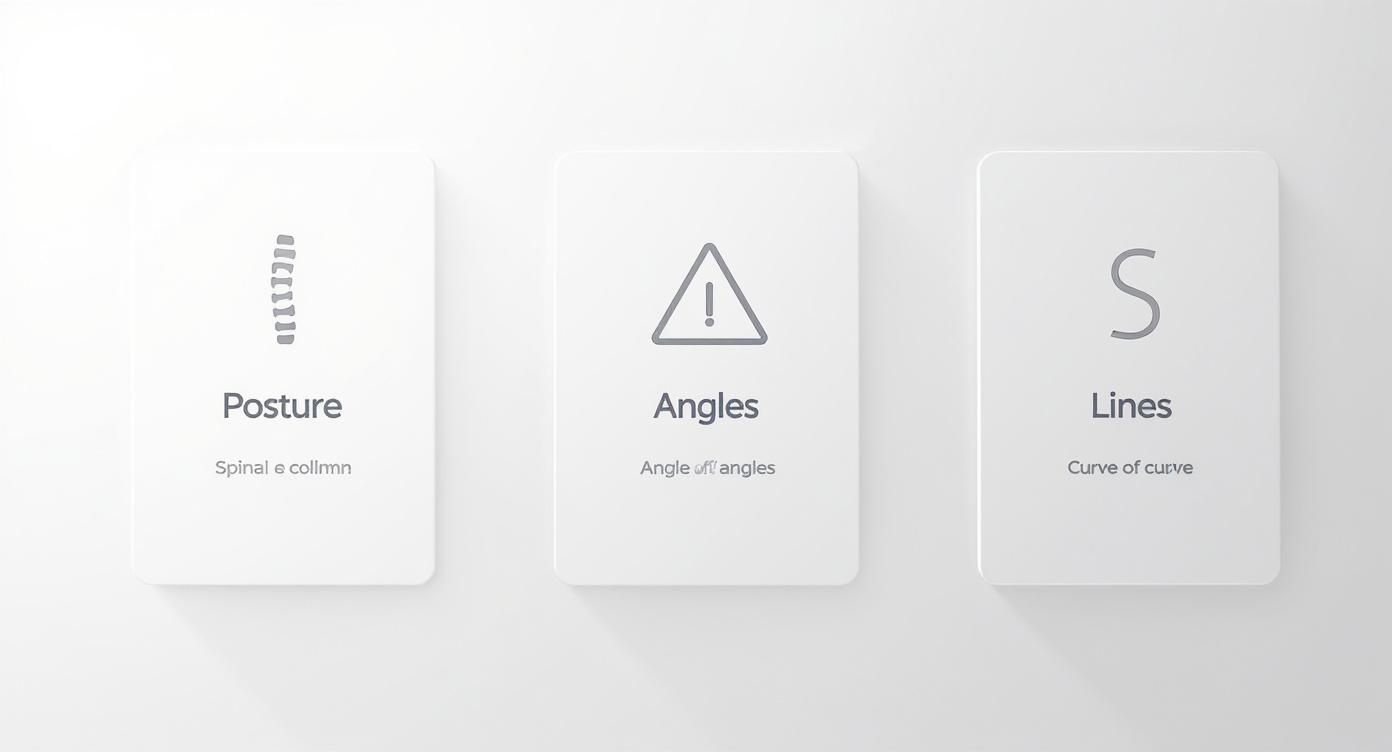
This little visual is a great reminder. Strong posture gives you a confident foundation, playing with angles adds depth and interest, and creating elegant lines guides the viewer's eye right where you want it.
The Classic Contrapposto
There's a reason the contrapposto has been around for centuries—it just works. The concept is simple: shift your weight onto one leg, letting the other relax and bend. That subtle shift is what creates the flattering, gentle S-curve in the body. It instantly breaks up a boxy silhouette by pushing one hip out, which feels both elegant and relaxed. It’s the perfect starting point for almost any standing shot.
You can easily make this pose your own by playing with small details:
Hands: Rest one hand on the popped hip while letting the other arm hang naturally at your side.
Feet: Try placing the relaxed foot just in front of or behind the foot you're balancing on.
Gaze: Looking straight into the lens creates a powerful connection. Gazing just off-camera gives the shot a more candid, thoughtful vibe.
The Casual Leg Cross
Another absolute go-to is the leg cross. Simply crossing one leg over the other, either at the ankle or the shin, creates a long, slender line through the body. It’s a pose that feels effortlessly chic and is fantastic for showing off trousers, jeans, or any kind of long skirt. It just radiates a sense of easy sophistication.
The key here is to stay relaxed. If you tense up, it can look awkward. Keep your shoulders down and allow a soft bend in your standing knee to maintain balance. You want to look poised, not like you're about to fall over. This one pose can add a real editorial edge to otherwise standard product shots.
The best poses often feel like you’ve caught someone in a moment of transition. Instead of thinking about hitting a static, final position, imagine it as a brief pause in a continuous movement. That mindset is what creates images that feel authentic and truly alive.
The Dynamic "Walking" Shot
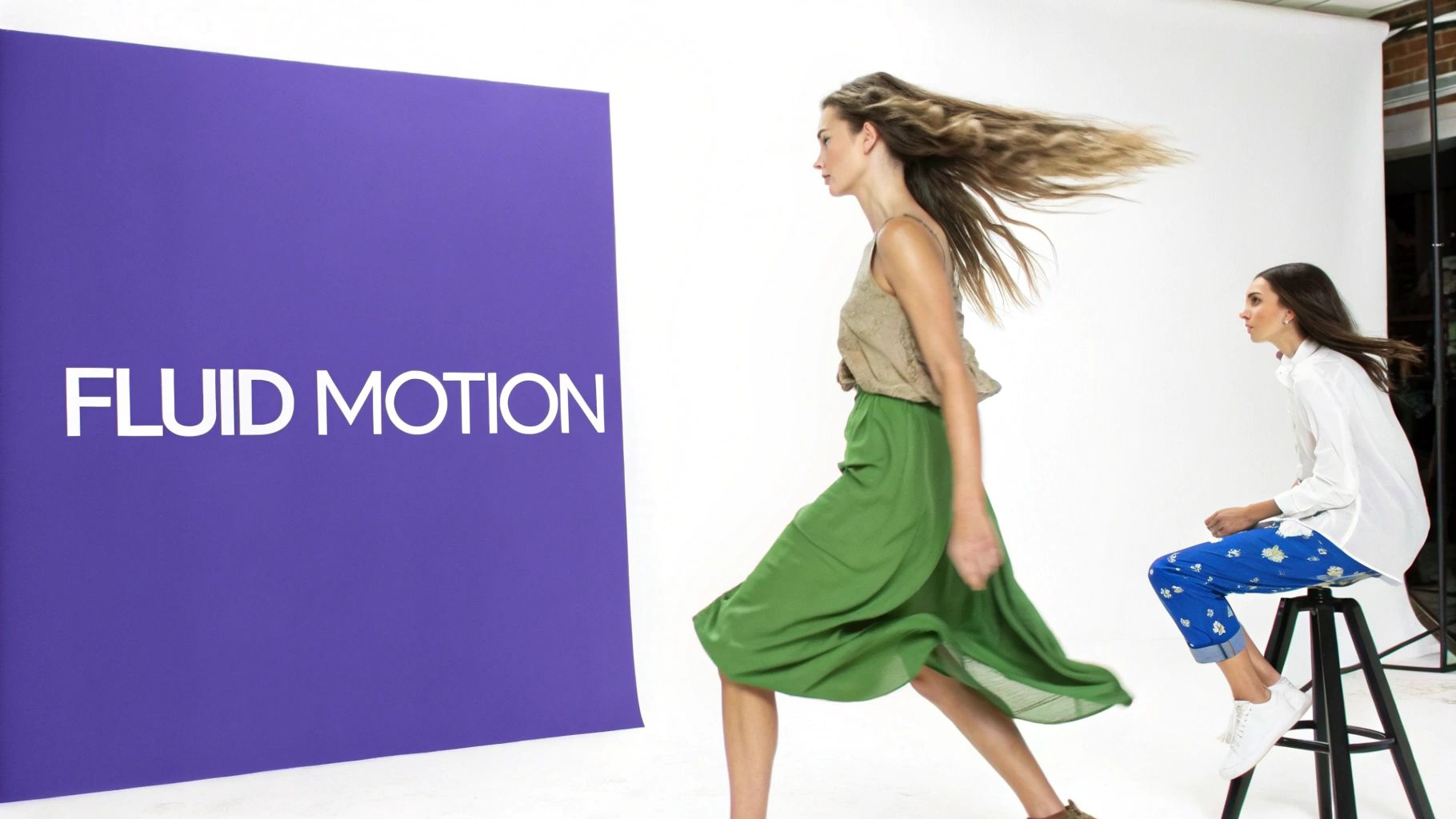
Nothing sells clothing quite like showing it in motion. The walking shot isn't really about walking from one spot to another; it's about faking a natural stride to create energy. You start with your feet apart, as if you’ve just taken a step, with the back leg extended and the front knee bent.
Leaning your torso slightly forward really sells the sense of motion. Let your arms swing naturally, just as they would if you were actually walking down the street. This pose is a game-changer for showing how fabric flows and drapes, which makes it perfect for dresses, coats, and wide-leg pants. It injects so much life into the frame, helping customers truly imagine themselves wearing the piece.
It's interesting to see how we got here. Early 20th-century fashion photography was all about static, formal postures meant to highlight a garment's structure. But by the 1950s, as culture and fashion shifted, poses became more fluid and informal. Showing movement suggested a modern, liberated lifestyle. You can dive deeper into this evolution in a fascinating history of the fashion photograph.
Here’s a quick-glance table to help you remember which standing pose works best in different situations.
Core Standing Poses and Their Applications
Pose Name | Key Action | Best For Showcasing | Common Mistake |
|---|---|---|---|
Contrapposto | Shifting weight to one leg, popping a hip | Almost anything; great for dresses, tops, and skirts | Locking the knees, making it look stiff instead of relaxed |
Casual Leg Cross | Crossing one leg in front of the other | Trousers, jeans, long skirts, fitted dresses | Tensing up the shoulders and losing balance |
Walking Shot | Simulating a natural stride | Coats, flowing dresses, wide-leg pants | Overly exaggerated arm swings that look unnatural |
Leaning Pose | Leaning against a wall or prop | Casual wear, outerwear, denim | Slouching instead of maintaining a strong core and long spine |
Each of these poses serves as a fantastic starting point. The real magic happens when you start to experiment with variations in hand placement, head tilts, and expressions to make each shot feel unique.
Bringing the Shot to Life: Movement and Seated Poses
Static shots are the foundation, but movement is what gives a fashion story its soul. While a standing pose can perfectly showcase a garment's cut and structure, bringing in motion and different levels—like sitting, leaning, or walking—tells a much richer story. It creates an undeniable energy, shows how the fabric drapes and flows, and makes the entire scene feel more authentic and aspirational.
Injecting this kind of life into a shoot isn't always about big, theatrical gestures. More often than not, the real magic is found in those subtle, "in-between" moments. A genuine laugh, a confident stride down a hallway, or a simple toss of the hair can elevate a standard product photo into a lifestyle image that truly connects with the viewer. The art is in directing the model to a place where their movements feel completely natural, not stiff or overly rehearsed.
Mastering Seated and Leaning Fashion Model Poses
Seated poses are a fantastic way to switch up the perspective, but they bring one major challenge to the set: slouching. The secret is to treat sitting as an active, engaged position, not just a chance to rest. Whether the model is on a stool, leaning against a wall, or sitting on the floor, a strong, elongated spine is absolutely essential for a powerful shot.
Here are a few go-to directions for strong seated poses:
Create Angles: Sitting square to the camera rarely works. Have the model turn their body slightly, experimenting with crossing their legs at the ankle or knee to create interesting, leading lines.
Use Your Limbs: Arms and legs are your best tools for creating compelling shapes. Try having the model rest an elbow on a knee, drape an arm over the back of a chair, or extend one leg out to lengthen their entire silhouette.
Engage the Core: The easiest trick to prevent a slumped posture is to have the model sit right on the edge of the seat. It instantly forces them to engage their core, which naturally straightens their back and drops their shoulders into a more flattering position.
Leaning poses work on the same principles. When a model leans against a wall, have them push their hips away from it while keeping their shoulders connected. This carves out a dynamic diagonal line through the body that feels both casual and visually striking.
The most effective seated and leaning poses use the environment as a partner. Instead of just occupying a space, interact with it. The way a hand rests on a windowsill or a foot presses against a stair riser adds a layer of authenticity that makes the image feel real.
Capturing Natural Movement and In-Between Moments
Shooting movement is all about capturing raw energy. For the model, the goal is to perform an action without overthinking it. For the photographer, the job is to anticipate the peak of that action and nail the perfect, fleeting moment.
The classic "walking" pose is a perfect example of simulated movement, but you can get just as much impact from other actions:
The Turn and Look: Have the model walk away from the camera and then, on your cue, turn their head back over their shoulder. It creates a beautiful twist in the torso and a feeling of candid intrigue.
The Fabric Play: Ask the model to interact with the clothing itself. A hand swishing a long skirt, thoughtfully adjusting a collar, or pulling on a cuff makes the garment look lived-in and far more desirable.
The Genuine Laugh: A real laugh is pure gold. Tell a joke or ask an unexpected question to get an authentic reaction. Those shots always feel joyful and incredibly relatable.
The connection between posing and movement runs deep, especially when you look at the runway. The iconic walks of runway models have actually been studied and broken down into distinct types. One study used pose detection technology on 69 fashion models and found five different walking styles that changed over the years. For example, an exaggerated leg-crossing gait has become much less common as tastes have shifted. You can dive into the full research on the evolution of runway walking styles to see how pose preferences evolve to meet modern fashion demands.
Mastering Close-Ups and Beauty Shots
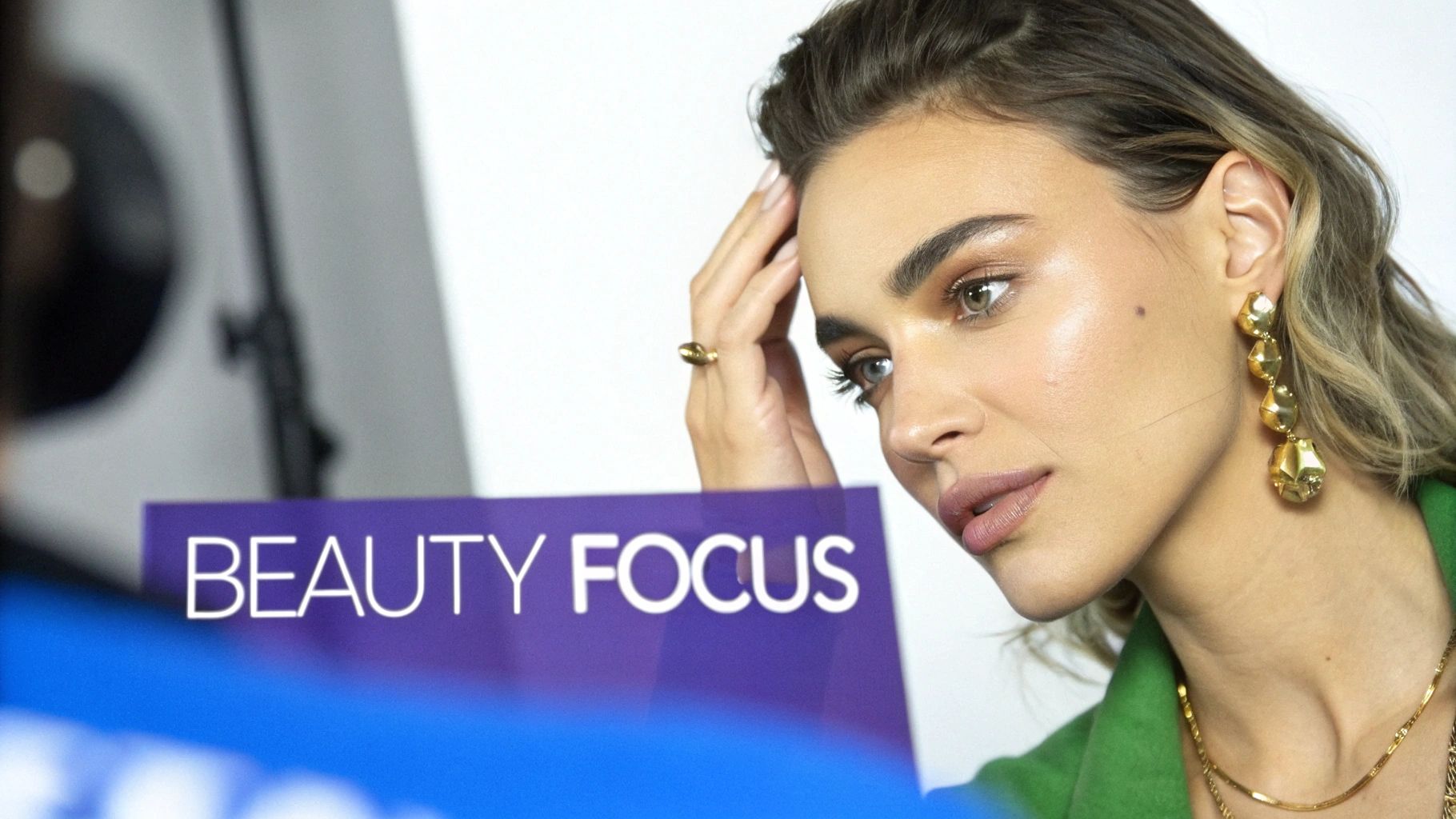
When the camera gets tight for a close-up or a beauty shot, the whole game changes. Forget the big, sweeping body movements. Suddenly, it's all about the micro-expressions and subtle details. The slight tilt of your head, the intensity in your eyes, or the way your lips part just so—these are the things that sell makeup, jewelry, or skincare.
This is where your connection with the lens has to be rock-solid. A great close-up is more than just a pretty picture; it's a direct conversation with the person looking at it. You're aiming to create a mood that feels real, not staged. That means you need to know your face inside and out—how to project confidence, calm, or intensity without ever saying a word.
Defining Your Angles and Jawline
Nailing your close-up starts with knowing your best angles. Seriously, spend some time in front of a mirror and just play. See how the light hits you as you turn your head. You’ll notice that tilting your chin down just a fraction can instantly sharpen your jawline. Another trick is to push your forehead gently toward the camera, which helps create a more defined silhouette and gets rid of any hint of a double chin.
A go-to technique in the industry is often called the "turtle." It sounds weird, but it works. Gently extend your neck forward, like a turtle poking its head out, and then drop your chin slightly. It feels completely unnatural, I know. But on camera? It creates that sharp, elegant jawline photographers go crazy for. This one tiny adjustment can make a significant difference in the final shot.
Hands as a Framing Tool
In beauty photography, your hands aren't just there to hang out; they're props. The trick is to make their placement look deliberate and graceful, not clumsy. Don’t just plop your hand on your face—give it a reason for being there.
Highlighting Jewelry: To show off an earring, you might casually brush your hair back or let your fingertips lightly touch your earlobe. For a necklace, resting your fingers on your collarbone draws the eye right to it.
Framing the Face: A hand resting gently along the jawline can create a beautiful frame. For something softer, try cupping your chin or letting your fingers trail down from your temple.
Creating Asymmetry: Often, using just one hand in the shot is more powerful than using both. It creates a more interesting, asymmetrical composition that directs the viewer's gaze.
The secret to using your hands in a close-up is to keep them relaxed. Tense, claw-like fingers are a dead giveaway. Think of them as soft and fluid, almost like a dancer's, and let them add a touch of elegance.
Mastering Your Gaze and Expression
Your eyes are everything in a beauty shot. The difference between a soft, inviting gaze and a direct, powerful stare can completely alter the mood. Looking just slightly past the lens can create a dreamy, approachable feeling. Making direct eye contact, on the other hand, creates an immediate, confident connection.
Parting your lips just a little can also soften your entire expression and keep you from looking tense. The idea is to look relaxed and authentic, like you’ve been caught in a moment of quiet contemplation. Get in front of that mirror again and practice. Try to communicate different emotions—joy, curiosity, confidence—using only your eyes and mouth. The more you do it, the more muscle memory you build, making it second nature on set.
Of course, the stunning quality of these shots is only possible if the gear can capture all those fine details. Knowing the best camera for product photography helps photographers select equipment that truly does justice to a model's skillful performance.
Posing Inclusively for Every Body Type
Truly great posing isn't about forcing everyone into the same rigid mold. It’s about celebrating what makes each person unique and using angles, lines, and body language to tell their story. We've moved past the outdated, one-size-fits-all standards. Today, the goal is to create authentic, empowering images that connect with people.
This all starts with a collaborative approach. When a model feels confident and seen, it shines through in every single shot. Forget trying to "fix" or "hide" features. Instead, let's focus on creating powerful shapes that feel true to the person in front of the lens.
Posing for Petite and Shorter Models
When working with petite models, the goal isn't just to make them look taller—it's to create a commanding presence within the frame. We do this by playing with specific techniques that elongate the body's natural lines.
Here are a few tricks I always use on set:
Shoot from a Lower Angle: Getting the camera just a bit lower naturally lengthens the legs and torso. It’s a simple shift that adds an instant sense of stature.
Extend the Limbs: Any pose that involves reaching, pointing the toes, or extending the arms overhead creates a long, unbroken visual line that draws the viewer’s eye upward.
Style Smart: Don't underestimate the power of wardrobe. High-waisted pants and monochromatic outfits are fantastic for creating a streamlined, elongated silhouette.
By using these techniques, the focus stays squarely on the model's confidence and the fashion they're wearing.
Techniques for Tall and Athletic Builds
For tall models, the art lies in using their height to create elegant, sweeping lines without overwhelming the frame. With athletic builds, it's all about showcasing strength in a way that feels both powerful and graceful—highlighting muscle definition without looking stiff.
For Tall Models: Sometimes, you need to break up those long lines to create more dynamic compositions. Bending a knee, leaning against a wall, or incorporating seated poses can manage proportions beautifully.
For Athletic Builds: Angling the body slightly away from the camera can soften broader shoulders. S-curves and poses that involve a twist at the torso are perfect for adding fluidity while gracefully highlighting a strong physique.
Celebrating Curves with Confidence
Posing curvy models is about one thing: celebrating their shape. The key is to create definition and highlight the body's natural contours, not hide them.
Posing for curves isn't about making someone look smaller; it's about showcasing their shape with power and elegance. The right pose celebrates the body, creating beautiful silhouettes that feel authentic and strong.
This isn't a new idea. Back in the late 1980s, Vogue's "Fashion Plus" editorial was a game-changer, reaching over 40 million American women who were size 14 and up. The plus-size models in those shoots deliberately used empowered, sultry poses to reframe larger bodies as desirable and high-fashion, directly challenging the industry's narrow beauty standards. You can dive deeper into how these poses helped redefine body image in fashion.
To create dynamic poses that flatter curves, try these go-to techniques:
Define the Waist: Placing a hand on the hip—or just above it—instantly cinches the waist and creates that classic hourglass figure. It's a classic for a reason.
Create Space: A little bit of space between the arms and the torso prevents the silhouette from looking compressed. Gently lifting an arm or bending an elbow makes a huge difference.
Play with Angles: Having the model stand at a three-quarter angle to the camera and shift their weight to the back leg is universally flattering. It highlights curves while creating a strong, dynamic line.
At the end of the day, the best fashion model poses are born from a partnership between the photographer and the model—one built on communication and a genuine respect for every body type.
Frequently Asked Questions About Model Poses
Even with the best prep, questions always pop up on set. Here are some quick, real-world answers to the problems that trip up models and photographers the most, from fighting that initial awkwardness to making every shot feel genuine.
How Do I Stop Looking So Awkward on Camera?
This is the number one thing new models worry about, and honestly, even pros have off days. The trick is to stop thinking about "posing" and start thinking about "doing." Give yourself a small, simple action to focus on.
Instead of just freezing in place, try one of these little motivations:
Adjust the lapel on your jacket.
Tuck a stray piece of hair behind your ear.
Glance down at a real (or imaginary) watch.
Shift your weight from one foot to the other like you're waiting for a friend.
These tiny, purposeful movements are a fantastic mental trick. When your body has a job—even a small one—it forgets to be stiff and self-conscious. Your poses will instantly look more authentic.
The camera picks up on tension more than anything else. Your main goal should always be to find a sense of ease. A relaxed model in a simple pose will always look better than a tense model in a technically perfect but rigid one.
What Should I Do with My Hands?
Ah, "hand-nesia"—that moment you completely forget what your hands are for. It happens to everyone. The easiest fix is to give them a natural place to rest or a simple task to perform.
Pockets are your friend: Using front or back pockets is a classic for a reason. Just don't shove your whole hand in there. Hooking just a thumb or a few fingers looks far more effortless and cool.
Interact with the outfit: Lightly touch a button, fiddle with a collar, or run your hand along the fabric of a skirt. This not only solves the hand problem but also cleverly highlights the garment's details.
Frame your face: For close-ups, gently resting your fingers along your jawline or temple can add a touch of elegance. The key is to keep your fingers soft and relaxed, never stiff or splayed out.
Whatever you do, try to avoid pressing your hands flat against your body. Creating even a tiny bit of space by slightly bending your elbows helps define your silhouette and keeps your arms from looking like they've merged with your torso.
How Can I Make My Poses Look More Natural?
The real secret to natural-looking fashion model poses is capturing the "in-between" moments. Poses that are held for too long often look staged. The solution is to introduce continuous, slow movement into your posing flow.
Instead of hitting a pose and freezing like a statue, try to move fluidly from one position to the next. For instance, start with a hand on your hip, then slowly slide it up to brush through your hair, and finally let it drop naturally to your side. This flow gives the photographer countless opportunities to capture those candid, authentic shots that feel truly alive.
Another great technique is to just walk toward the camera, turn, and walk away. The simple act of turning and glancing back over your shoulder often produces the most dynamic and believable images you'll get all day.
Is It Better to Look at the Camera or Away?
There’s no single right answer here—it all comes down to the mood you and the photographer are trying to create. Your gaze is one of the most powerful storytelling tools you have.
Direct Eye Contact: Looking right down the lens creates a powerful, intimate connection with the viewer. It screams confidence and is perfect for strong commercial shots where the goal is to grab someone's attention immediately.
Looking Away: A gaze directed off-camera can create a sense of candidness, mystery, or deep thought. It makes the viewer feel like they're peeking into a moment in a larger story, which works beautifully for editorial and lifestyle content.
The Downward Glance: Tilting your head down slightly can communicate anything from humility and serenity to a touch of shyness, all depending on the rest of your body language.
Try to mix all three into a single posing sequence. This gives the client a rich variety of moods to choose from in the final edit. Speaking of which, after the shoot, the magic continues in post-production. Understanding the basics of professional ecommerce photo editing can make all the difference in ensuring the final images perfectly match the vibe you worked so hard to create.
Ready to create stunning on-model imagery without the hassle of traditional photoshoots? With Look Atlas, you can generate ultra-realistic, on-model images and videos in minutes. Transform your product photos into powerful, sales-driving assets today by visiting https://www.lookatlas.com.
