If you're serious about increasing your ecommerce sales, you need a plan that goes beyond just running a few ads. The real wins come from a focused strategy built on four pillars: getting the right people to your store, making it incredibly easy for them to buy, creating an experience that feels personal, and giving them a reason to come back again and again.
This playbook is all about a balanced approach—mixing smart data analysis with creative marketing and a relentless focus on the user.
Building a Strong Foundation for Sales Growth

Before you start tweaking product pages or launching a new marketing campaign, you have to know where you stand. It's tempting to jump straight into tactics, but that's like trying to navigate a new city without looking at a map first. You'll just end up wasting time and money.
The first, non-negotiable step is a full, data-driven audit of your store.
This means digging into your analytics to see what shoppers are actually doing on your site, not just what you assume they're doing. Once you have this baseline, every decision you make—from the ad you run to the button you change—becomes intentional, measurable, and far more likely to work.
Finding Your North Star: Key Ecommerce Metrics
Your analytics dashboard is probably overflowing with charts and numbers. The trick is to ignore the noise and focus on the handful of metrics that actually dictate your store's health. Focusing on these core numbers keeps you from chasing vanity metrics and helps you spot the biggest opportunities for growth.
I always tell my clients to start here. This quick-reference table breaks down the most critical KPIs you need to be tracking.
Essential Ecommerce Metrics for Your Growth Audit
Metric | What It Reveals | Why It Matters for Sales |
|---|---|---|
Conversion Rate (CR) | The percentage of site visitors who complete a purchase. | A low CR (below the 2-3% industry average) is a massive red flag. It often signals a problem with your user experience, product pages, or checkout flow. |
Average Order Value (AOV) | The average amount a customer spends in a single transaction. | Increasing AOV is one of the fastest ways to boost revenue without needing more traffic. It's all about getting each customer to spend a little more. |
Customer Lifetime Value (LTV) | The total revenue you can expect from a single customer over their entire relationship with your brand. | This is the ultimate health metric. A high LTV means you've cracked the code on customer loyalty and are building a sustainable business. |
Cart Abandonment Rate | The percentage of shoppers who add an item to their cart but leave without buying. | If this number is high, you're losing customers at the final hurdle. The culprit is often unexpected shipping costs or a clunky checkout process. |
These metrics aren't just numbers on a screen; they're the vital signs of your business. Monitoring them consistently is the only way to make informed decisions that actually move the needle on revenue.
Conducting a Practical Website Audit
With your core numbers in hand, it's time for a quick-and-dirty audit to find the most obvious roadblocks. We're not talking about a huge technical deep dive here—the goal is to spot the low-hanging fruit that's costing you sales right now.
Grab a notebook and go through your own site like you're a first-time customer.
Navigation: Is it dead simple to find what you're looking for? Can you get to a product category in two clicks or less?
Site Speed: Be honest. Does your site feel slow? Even a one-second delay in page load time can kill your conversion rate. Use a tool like Google PageSpeed Insights to get a real number.
Checkout Flow: Try to buy something. Is it a smooth, easy process? Do you force people to create an account? Is guest checkout an option?
Think of it this way: a high cart abandonment rate might point directly to a friction point you uncover during your checkout test. A low conversion rate could be tied to a slow-loading product page. Connecting the data to the real-world experience is where the magic happens.
This initial sweep gives you a clear starting line and a punch list of immediate fixes for all the optimization work we're about to dive into.
Getting the Right People to Your Store
It’s an old ecommerce myth that more traffic automatically means more sales. The truth is, you don’t just want more visitors; you want the right visitors. We're talking about high-intent shoppers—the people actively hunting for exactly what you sell.
The key is to stop casting a wide, generic net and start fishing with a spear. It’s about showing up where your ideal customers are already looking, speaking their language, and giving them the perfect solution right when they need it most.
Winning with Buyer-Intent SEO
Search Engine Optimization (SEO) is your secret weapon for capturing free, ready-to-buy traffic. The biggest mistake I see brands make is chasing broad, vanity keywords like "women's shoes." The real gold is in the long-tail keywords that reveal exactly what a shopper wants.
Think about the difference. Someone searching for "women's shoes" is just window shopping. But someone searching for "comfortable black heels for standing all day" or "waterproof trail running shoes for wide feet"? They have a specific problem and their credit card is practically out.
These longer phrases have less traffic, but the conversion rate is through the roof.
You can find these gems by digging into Google's "People Also Ask" section or using an SEO tool to see what your competitors are ranking for. Once you have a list, weave these phrases naturally into your:
Product Titles: Be descriptive and specific.
Product Descriptions: Don't just list features; explain how your product solves their specific problem.
Image Alt Text: Tell search engines what’s in your photos.
This isn’t about tricking Google. It’s about making it dead simple for a motivated buyer to find you.
Building Paid Ad Campaigns That Actually Make Money
Paid ads offer instant visibility, but they can burn through your budget in a heartbeat if you're not careful. To run profitable campaigns, especially on platforms like Google Shopping, you need a smart structure.
Don't just throw all your products into one giant campaign. Break them down. Group them by category, brand, or even by profit margin.
For instance, if you run a clothing store, you should have totally separate campaigns for "best-selling t-shirts" and "clearance outerwear." This lets you be strategic with your budget, bidding more aggressively on your winners and creating super-relevant ad copy for each product line.
And don't forget retargeting on social media. Someone who looked at a specific product on your site is a red-hot lead. Use platforms like Meta to run dynamic ads that show them that exact item again. Sometimes all it takes is a simple reminder about your free shipping or a small discount to get them over the finish line.
A great retargeting ad doesn’t feel creepy; it feels helpful. You're simply reminding someone about something they were already interested in, which is one of the easiest ways to recover a sale.
Using Content to Build Trust and Drive Sales
Content marketing isn't about the hard sell. It's about being genuinely useful and establishing your brand as the go-to expert in your niche. When you solve a customer's problem before asking for their money, you build incredible trust.
Let's say you sell high-end kitchen knives. Instead of just running ads, you could create a blog post titled "How to Choose the Right Chef's Knife for Your Cooking Style." Or maybe a downloadable guide on "Knife Skills 101." This attracts home cooks who are looking to level up their skills, and you can naturally feature your knives as the perfect tool for the job.
Gift guides are another fantastic play, especially around the holidays. A simple guide like "The 10 Best Gifts for the Coffee Lover in Your Life" is a magnet for shoppers with a clear goal. You can also repurpose these ideas into engaging short videos—a format that is crushing it right now. For a full breakdown, check out our guide on how to create product videos that stop the scroll.
When you lead with value, the sale becomes the easy, logical next step.
Optimizing Your Store for Maximum Conversions
Getting people to your website is one thing. Getting them to actually buy something? That’s the real game. This is where we shift focus from just driving traffic to mastering Conversion Rate Optimization (CRO). It’s all about turning those hard-won visitors into happy, paying customers.
Think of it this way: your online store needs to be so intuitive, so trustworthy, and so compelling that clicking “buy” feels like the most natural next step. It’s a mix of art and science—blending great design with a deep understanding of what makes shoppers tick. A few smart tweaks here and there can make a massive difference to your bottom line.
This whole process starts with a solid strategy for attracting the right kind of shoppers in the first place, using a mix of SEO, paid ads, and smart content to build a powerful inbound engine.
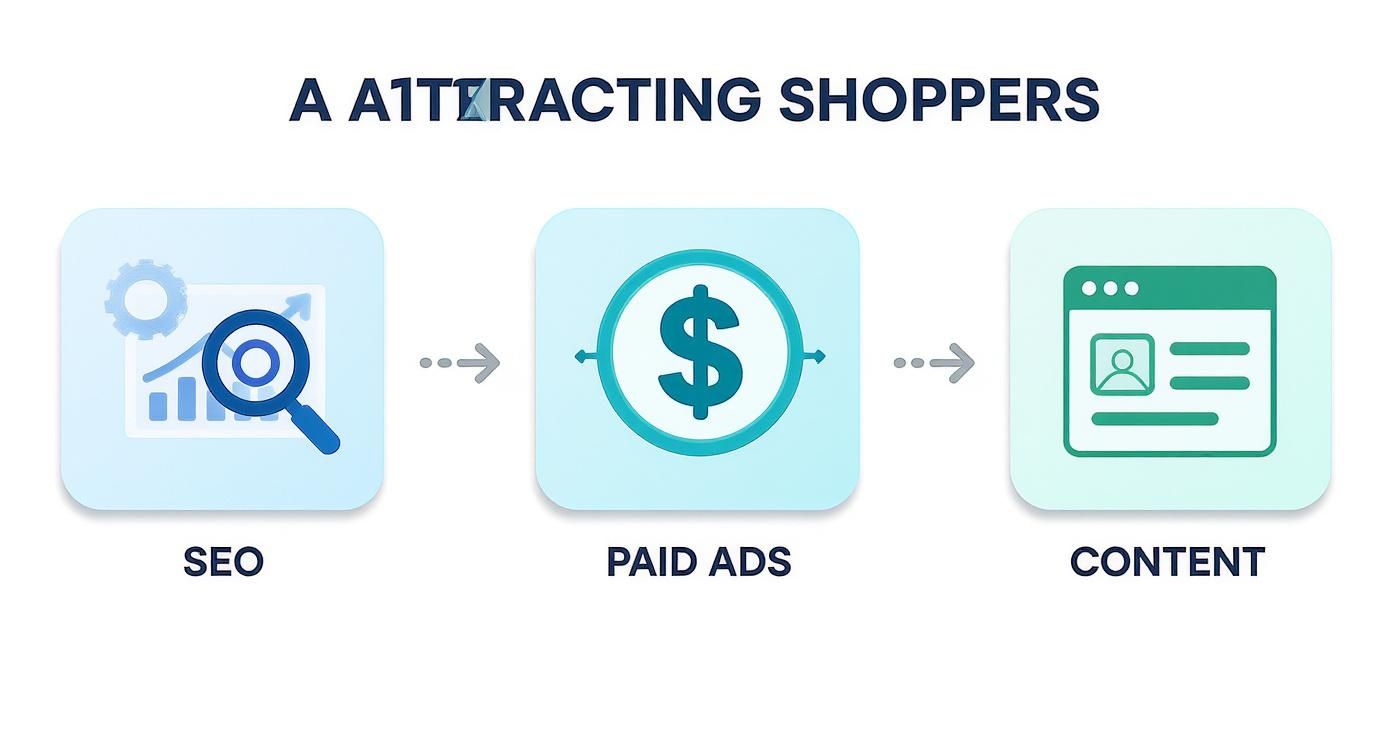
You can see how all these channels work together. Relying on just one is like trying to build a house with only a hammer—you're limiting your reach and leaving money on the table.
The Power of Visual Commerce
Let’s be honest: in e-commerce, your photos and videos are your star salespeople. Customers can’t touch, feel, or try on your products, so your visuals have to do all the heavy lifting. The data doesn't lie: a staggering 93% of customers say images are the most important factor when they’re deciding whether to make a purchase.
It's not just about showing what something looks like. It’s about helping a shopper visualize that product in their own life. A truly effective visual strategy builds both confidence and desire.
Here’s what you absolutely need to get right:
High-Quality On-Model Photos: For apparel, jewelry, or anything wearable, this is non-negotiable. On-model shots show fit, scale, and context in a way that a sterile product-on-white photo never can.
360-Degree Views: Let people spin it around! Giving customers the ability to see a product from every angle is the next best thing to holding it in their hands. It kills uncertainty.
Engaging Product Videos: A quick 15-second clip can show off features, demonstrate movement, and convey quality much more effectively than a static image ever could. We've seen pages with video get a serious bump in add-to-cart rates.
Of course, creating all this content traditionally costs a fortune and takes forever. This is where AI-powered tools are completely changing the landscape. Solutions like Look Atlas can generate photorealistic on-model imagery and videos from a single product photo, letting you build out a diverse, high-end visual catalog for a fraction of the cost and time. For a deeper dive, check out our guide on how to take professional product photos with or without a full studio setup.
Your goal should be to answer every visual question a customer might have before they even think to ask it. When you eliminate that friction, the path to purchase becomes clear.
Writing Product Descriptions That Actually Sell
Your amazing visuals got their attention. Now, your product description has to seal the deal. So many brands fall into the trap of just listing features. Don't do that. A great description sells the benefit—the experience.
Instead of saying, "Made from 100% cashmere," try something like, "Wrap yourself in the cloud-like softness of 100% pure cashmere, your new go-to for cozy weekends and effortless style." You’re not just selling a sweater; you’re selling a feeling of comfort and confidence.
Use bullet points to make key specs easy to scan, but also tell a little story. Where did the inspiration come from? What problem does it solve? If you're selling a waterproof jacket, paint a picture of them staying perfectly dry and happy on a rainy hike. Connect the dots between the features and real-life benefits.
Designing a Flawless User Experience
Nothing kills a sale faster than a clunky, confusing, or slow website. Your site’s user experience (UX) needs to be buttery smooth, especially on mobile, where most of your customers are probably browsing. A bad mobile site is like having a "closed" sign on your front door.
By 2025, mobile commerce is set to hit $2.51 trillion globally. That means nearly 59% of all e-commerce sales will happen on a phone. The brands that invest in a fast, responsive mobile experience often see conversion rates jump by up to 30%.
Here are the critical UX elements to obsess over:
Simplify Navigation: Keep your menu clean and intuitive. People should be able to find what they're looking for in three clicks or less. A prominent, smart search bar is your best friend.
Optimize for Speed: Every single second matters. A site that loads in under three seconds performs worlds better than one that takes longer. Compress your images, use a good host, and keep things lean.
Streamline the Checkout: This is where so many carts get abandoned. Offer a guest checkout option. Cut down the number of form fields to the absolute minimum. And for goodness' sake, show all the costs (especially shipping!) upfront. No one likes a nasty surprise at the final step.
Using AI and Personalization to Drive More Sales
In a world overflowing with choices, a one-size-fits-all shopping experience is the fastest way to get ignored. Today’s shoppers don’t just want options; they want to feel seen and understood. This is where personalization, supercharged by artificial intelligence (AI), becomes a game-changer for any brand serious about growing its sales.
Think of it less as a tech trend and more as a fundamental shift in how we connect with customers. The goal is to make every visitor feel like the store was designed just for them. It’s about creating a memorable journey that builds real loyalty, not just completing a transaction.
This isn’t a luxury anymore—it’s an expectation. A staggering 85% of consumers now expect personalized interactions when they shop online. And the businesses that get this right are reaping serious rewards.
Retailers who have woven AI-powered personalization into their strategy are seeing sales jump by an average of 10-15%. Some are even doubling their conversion rates. How? AI algorithms analyze everything from browsing patterns to purchase history, allowing you to serve up incredibly relevant product suggestions, content, and offers.
Intelligent Product Recommendations
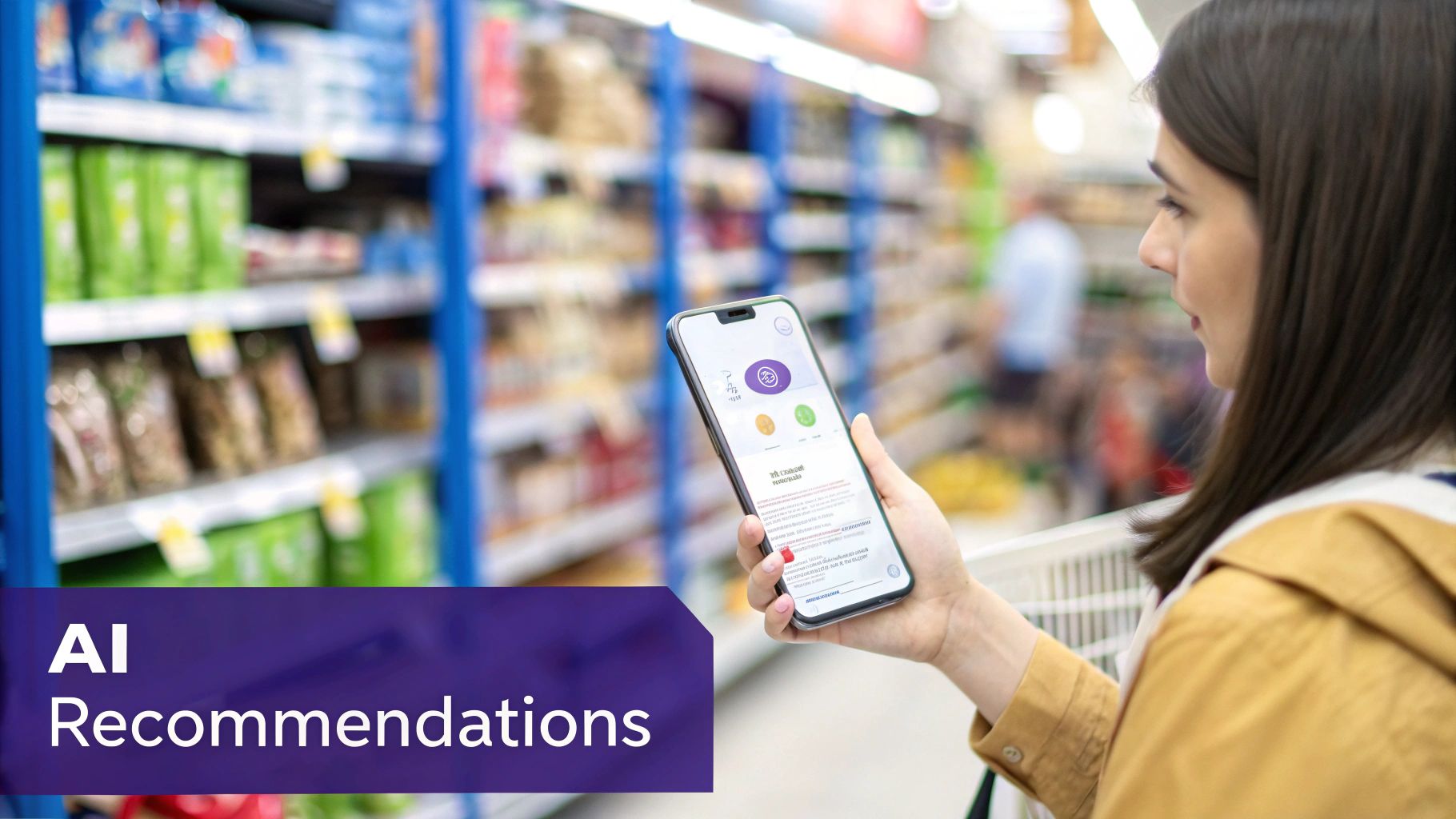
One of the most powerful ways to put AI to work is through a smart product recommendation engine. This is worlds away from just showing a "most popular" widget. A truly intelligent system watches a user's real-time behavior—what they click, what they cart, what they've bought before—to surface items they're almost certain to love.
It’s like giving every single customer their own personal stylist. If someone is looking at a particular dress, the engine can instantly suggest the perfect pair of shoes or a matching handbag. This doesn't just make for a better shopping experience; it’s a proven way to pump up your Average Order Value (AOV). Just look at Amazon, which attributes up to 35% of its total sales to these hyper-personalized recommendations. The potential is massive.
Smarter Communication with AI
Personalization shouldn't stop at your product pages. AI can completely overhaul your email marketing and customer support, making every touchpoint feel more human and genuinely helpful. When you connect customer data to your communication channels, you can automate relevant messages that actually drive action.
Here are a few ways to do it:
Personalized Abandoned Carts: Ditch the generic reminder. Send an email that shows the exact items they left behind, maybe with a small, time-sensitive incentive like free shipping to nudge them over the finish line.
Behavior-Triggered Emails: Notice a customer keeps browsing your running shoe category but hasn't bought anything? Automatically send them a curated email highlighting your best-selling runners or a new arrival.
AI-Powered Chatbots: Today's chatbots are far more than glorified FAQ pages. They offer instant 24/7 support, track order statuses, and can even guide shoppers to products that fit their specific needs, smoothing out friction points in the buying journey.
The key is to use technology to be more helpful, not more intrusive. When a customer feels like you’re anticipating their needs and providing solutions, their trust in your brand grows exponentially.
AI is also making huge strides in visual content creation. For brands looking to elevate their product imagery without the cost of a full-blown photoshoot, it's worth learning how to use Photoshop AI to upscale images for crisp, professional results. This helps you maintain a premium look across all your personalized marketing efforts. Ultimately, weaving AI into your strategy is all about building stronger relationships, one tailored experience at a time.
Turning Buyers Into Loyal Repeat Customers
Here's a number that should grab your attention: acquiring a new customer can cost five times more than keeping an existing one. Let that sink in. While we all get obsessed with bringing in new traffic, the most sustainable, profitable growth comes from maximizing your Customer Lifetime Value (LTV). It’s all about turning those one-time buyers into genuine, repeat fans of your brand.
The savviest brands know that the real work begins after the first sale. The customer journey doesn't just stop at the "thank you" page. That’s your chance to start a new relationship—one that could be far more valuable in the long run. This isn't about spamming them with sales pitches; it's about building a real connection through value and recognition.
Building a Community with Email Marketing
Your email list is pure gold. Forget social media algorithms for a second; these are people who have literally invited you into their inbox. Don't squander that privilege.
Treat your email list like an exclusive club, not just a broadcast channel for promotions. Your subscribers should feel like insiders. They get the first look at new products, access to content no one else sees, and deals that make them feel genuinely special.
Go Behind the Scenes: Share the story of how a product was made, introduce the team, or create "how-to" guides that help them get more out of their purchase.
Grant Early Access: Give your subscribers a 24-hour head start on big sales or new collection launches. It’s a simple way to create urgency and show them they’re a priority.
Check In Personally: Don't just send the order confirmation and disappear. A week later, send a quick email asking how they’re liking the product or offering a few tips. It shows you care beyond the transaction.
Your email strategy shouldn't just be about driving the next sale. It's about building a relationship that makes you the first brand they think of when they need what you sell.
Rewarding Loyalty and Generating Predictable Revenue
If someone keeps coming back to your store, they deserve to be recognized for it. A solid loyalty program is one of the best ways to encourage that repeat business and transform casual shoppers into brand advocates.
It doesn’t have to be complicated. A simple points-based system often works wonders. Maybe every dollar spent earns 10 points, and 1,000 points gets them a $10 discount. This small touch gamifies the experience and gives customers a tangible reason to choose you over a competitor.
Another game-changer, especially for consumable products, is subscriptions. If you're selling things like coffee, skincare, or supplements, a "subscribe and save" model is a no-brainer. You offer a small discount and major convenience, and in return, you get predictable, recurring revenue. It completely automates the repeat purchase and can dramatically boost your LTV.
Expanding Your Reach to a Global Audience
Ready for another powerful growth lever? Look beyond your own borders. The internet has made cross-border commerce easier than ever, and shoppers worldwide are hungry for unique products they can't find locally.
The numbers are staggering—global cross-border ecommerce is on track to hit $2.4 trillion by 2025. Brands that simply offer international shipping, display prices in local currencies, and provide some multilingual support can see conversion rates in new markets jump by as much as 40%. Tapping into a global audience diversifies your customer base and opens up entirely new streams of revenue. You can find more data on the growth of global ecommerce on tekrevol.com.
Common Questions About Growing an Ecommerce Store
When you're deep in the trenches of growing an online store, a lot of the same questions tend to crop up. You're not alone. Let's walk through some of the most common challenges and how to think about them from a practical, results-driven perspective.
What’s a Good Ecommerce Conversion Rate?
Everyone wants to know the magic number, but the honest answer is: it depends. You'll see 2-3% thrown around as a general industry benchmark, but that figure is almost meaningless without context. A "good" rate for a store selling $50 t-shirts will be vastly different from one selling $3,000 custom furniture.
Instead of chasing a universal average, focus on improving your number. A much healthier and more productive goal is to aim for a 10-20% lift from your current baseline. If you're converting at 1.5% right now, getting to 1.8% is a huge win. That's how you build momentum.
The key is to relentlessly test small, measurable changes. A/B testing new product photos, simplifying a checkout field, or rewriting a call-to-action can reveal what truly resonates with your audience. Always segment your data by traffic source—your conversion rate from organic search will likely be very different from your Instagram ad traffic.
How Can I Stop People from Abandoning Their Carts?
Cart abandonment feels personal, doesn't it? You got them all the way to the finish line, only for them to vanish. The good news is that this problem usually comes down to one of three things: surprise costs, a frustrating checkout, or a last-minute crisis of confidence.
First, kill the surprises. Unexpected shipping costs are the #1 reason people bail. Be upfront and transparent with all costs, right from the start.
Second, make it ridiculously easy to give you money. A long, clunky checkout process is a conversion killer. Always offer guest checkout, only ask for the information you absolutely need, and make sure browser auto-fill works flawlessly.
Finally, you need to build trust when it matters most.
Flash those security badges: Icons from Shopify Pay, PayPal, or Norton give shoppers peace of mind.
Show off your social proof: A small customer review or star rating right in the checkout can be the final nudge they need.
Make your return policy obvious: Knowing they can easily return an item removes a major psychological barrier to purchase.
And of course, an automated abandoned cart email sequence is non-negotiable. A friendly reminder an hour after they leave, maybe followed by another with a small free shipping offer, works wonders at bringing motivated buyers back.
Which Marketing Channels Actually Have the Best ROI?
The "best" channel is always the one that works for your brand, but a few consistently deliver the biggest bang for your buck in ecommerce.
SEO is the king of long-term value. It's an upfront investment of time and effort, but the reward is a steady, sustainable stream of high-intent organic traffic that doesn't cost you a dime per click. People who find you through search are actively looking for what you sell.
Email marketing is still an absolute powerhouse. It consistently generates one of the highest ROIs because you're talking to a warm audience—people who have literally asked to hear from you.
For lighting a fire under sales right now, it's hard to beat targeted paid ads on platforms like Google Shopping and Meta (Facebook & Instagram). This is especially true for retargeting campaigns where you can get your products back in front of people who have already visited your site. The winning strategy is always to test, track everything, and then pour your budget into what's actually working.
Ready to create stunning, high-converting product visuals without the cost and complexity of traditional photoshoots? Look Atlas uses AI to generate photorealistic on-model imagery and videos that stop the scroll and drive sales. See how leading brands are transforming their content pipeline and boosting conversions.
