If you're serious about increasing your Etsy sales, you need to concentrate on four fundamental areas. Think of it as a flywheel: strategic SEO gets you discovered, high-converting listings with incredible photos seal the deal, smart pricing and promotions motivate the purchase, and top-notch customer service turns one-time buyers into loyal fans. When you get these four pieces working together, you build a powerful, self-sustaining engine for your shop.
Your Blueprint for Growing Etsy Sales
Feeling like your Etsy shop has hit a wall? It’s a common frustration. You pour your heart into creating amazing products, but the sales just aren't matching your effort. The good news is that breaking through that plateau isn't about some secret hack; it's about systematically improving the core components of your shop.
This guide is your practical blueprint. We're going to move past the fluff and get straight to the strategies that actually work.
Mastering the Four Pillars
To build a thriving Etsy business, you have to nail the fundamentals. It all boils down to these four critical pillars:
Getting Found: This is your Etsy SEO strategy. If potential customers can't find your products when they search, you're invisible. It's all about getting inside their heads and using the exact keywords they're typing into the search bar.
Converting Browsers into Buyers: Once a shopper lands on your listing, the clock is ticking. You have seconds to convince them. This is where killer product photography and compelling, story-driven descriptions come in.
Smart Pricing and Promotions: Your price needs to do more than just cover costs—it has to reflect your skill, time, and brand's value while still being competitive. Strategic promotions can then provide that extra nudge to close the sale.
Building a Loyal Following: A single sale is great. A repeat customer is gold. Creating a memorable, positive experience is what keeps people coming back for more and recommending you to their friends.
Before we dive deep into each strategy, let’s quickly summarize how these pillars work together to fuel your shop's growth.
The Four Pillars of Etsy Sales Growth
This table gives you a quick snapshot of the essential strategies we'll be covering. Think of it as your cheat sheet for building a successful Etsy shop.
Pillar | Key Action | Why It Matters |
|---|---|---|
Get Discovered | Optimize your titles, tags, and descriptions with relevant keywords. | This is how you show up in Etsy search results when potential customers are looking for products just like yours. |
Convert Shoppers | Invest in high-quality, on-model product photography and write persuasive descriptions. | Shoppers buy with their eyes. Great visuals and compelling copy build trust and help them imagine the product in their life. |
Drive Action | Implement a pricing strategy that covers costs and profit, and run targeted sales or promotions. | Competitive pricing and timely offers create a sense of urgency, encouraging immediate purchases instead of "I'll think about it." |
Build Loyalty | Provide outstanding customer service, from answering questions quickly to thoughtful packaging. | A fantastic buying experience turns a one-time transaction into a long-term customer relationship, driving repeat sales and reviews. |
By consistently working on these four areas, you create a powerful, interconnected system that drives sustainable growth for your business.
The Opportunity Is Huge
If you're wondering if the customers are even out there, the answer is a resounding yes. The growth on Etsy has been absolutely massive. Between 2019 and 2024, the number of active buyers on the platform exploded from about 45.7 million to nearly 89.6 million—that's a 96% increase. The buyers are there, and they're actively searching for unique, handcrafted items.
The real challenge isn't a lack of buyers on Etsy; it's cutting through the noise to get their attention. Focusing on these fundamentals is how you do it.
While these principles are tailored for Etsy, many of them apply across the board in online retail. For an even broader look at these concepts, our deep-dive on how to increase ecommerce sales offers additional strategies you can adapt for your shop.
Alright, let's get started.
Get Found with Smart Etsy SEO
Before you can make a single sale, a shopper has to find your product among millions of others. This is where getting smart about Etsy's search engine becomes your secret weapon. Don't let the term "SEO" scare you off. It isn't some dark art—it's just about understanding what your ideal customers are searching for and then making sure your listings show up when they do.
Think of it this way: Etsy SEO is the bridge that connects your product to the exact person looking for it. Your job is to build that bridge with the right materials—keywords, tags, and all the little details—so shoppers can easily find their way to your shop.
Think Like Your Customer
The absolute best way to start your keyword research is to get inside your customer's head. Step away from your seller-brain and forget all the technical terms you might use to describe your product. What simple, everyday phrases would a real person type into the search bar?
Your first stop should be the Etsy search bar itself. It's a goldmine. Start typing a broad term for what you sell, like "linen dress," and pay close attention to the autocomplete suggestions that pop up. These aren't random; they are the most popular and recent searches from actual buyers. You're getting free, real-time market research right from the source.
For instance, typing "linen dress" might show you things like:
linen dress women
linen dress midi
linen dress long sleeve
linen dress wedding guest
Each one of those is a valuable long-tail keyword—a super-specific phrase that usually signals a shopper is ready to buy. Someone searching for a "linen dress wedding guest" has a clear need and is much closer to making a purchase than someone just browsing "dresses."
Crafting Titles That Attract Clicks and Sales
Your product title is arguably the most important part of your Etsy SEO. It's the first thing both the Etsy algorithm and your potential customer will read. A killer title needs to be descriptive, packed with your best keywords, and still easy to read.
So, please, don't just write "Handmade Necklace." Instead, weave together a descriptive phrase that covers the material, style, color, and even who it's for. A much stronger title would be something like: "Gold Moon Pendant Necklace, Dainty Celestial Jewelry, Minimalist Layering Choker, Astrology Gift for Her."
Let's break down why this title is so effective:
It starts with the core product: "Gold Moon Pendant Necklace" is crystal clear. No guesswork needed.
It includes style keywords: Words like "Dainty," "Celestial," and "Minimalist" attract buyers with a specific aesthetic in mind.
It suggests a use or occasion: "Layering Choker" and "Astrology Gift for Her" help shoppers imagine how they'd use it or who they'd give it to.
With a title structured like this, you show up in a ton of different searches, from "moon pendant" to "dainty layering choker."
Maximize Your Reach with All 13 Tags
Think of your tags as 13 more chances to get found. Etsy gives you this space for a reason, and if you want to seriously improve your sales, using every single one is non-negotiable. They are your secret weapon for casting a wider net.
Your tags should be a good mix of the keywords you've already found. The key here is not to just repeat your title verbatim. Branch out! Think of synonyms, related ideas, and different ways people might search for your item.
Pro Tip: Use a blend of broad and super-specific tags. A broad tag like "Wall Art" gets you into a massive category, but a niche tag like "Abstract Ocean Print" targets a buyer who knows exactly what they want and is far more likely to click "buy."
For that necklace example, your tags could look something like this:
Crescent Moon Charm
Zodiac Jewelry
Best Friend Gift
Bridesmaid Proposal
Minimalist Style
Handmade Gold Neck
Spiritual Jewelry
Delicate Pendant
Each tag creates a new path for a customer to find their way to your listing.
Don't Skip the Attributes
Last but not least, we have attributes. These are the filters shoppers use on the left side of the search results page—things like color, size, material, and occasion. Filling these out completely is crucial. It’s a simple step that so many sellers overlook.
When a buyer filters their search for "blue" dresses in a "size medium," only listings that have those exact attributes filled out will even show up. If you skip this part, you're literally invisible to highly motivated shoppers who are narrowing down their options and are just a click away from buying.
By methodically putting these SEO principles into practice, you stop just hoping for traffic and start strategically driving the right customers straight to your shop's front door.
Create Product Listings That Actually Convert
So, your smart Etsy SEO has brought shoppers to your digital doorstep. Great. Now the real work begins.
Think of your product listing as your one and only chance to turn a casual browser into a committed buyer. It has to be your best window display and your most charming salesperson, all rolled into one. If your photos are murky or your description falls flat, even the most perfect SEO strategy in the world won’t close the deal.
Shoppers buy with their eyes first. It’s that simple. Your visuals have to make an immediate, professional impact, helping customers see the quality, understand the scale, and most importantly, picture your product in their own lives.
Photography Is Your Most Powerful Sales Tool
Let's be clear: your product photos are the single most important part of your listing. On a platform where customers can't touch, feel, or hold your items, your images have to do all the heavy lifting. They're responsible for showing texture, size, true-to-life color, and the overall quality of your work.
Don't panic if you don't have a high-end camera or a professional studio. Some of the most successful Etsy shops get by just fine with a smartphone and some clever DIY lighting. The key isn't expensive gear; it's being intentional.
Here are a few things I tell every seller to do for photos that sell:
Chase the Natural Light: Find a spot near a big window and shoot during the brightest hours. Soft, diffused daylight is almost always more flattering than a harsh, artificial flash. It just is.
Show Every Angle: Give shoppers the full picture. Include shots of the front, back, sides, and any special details. The more they can see, the less uncertainty they'll have.
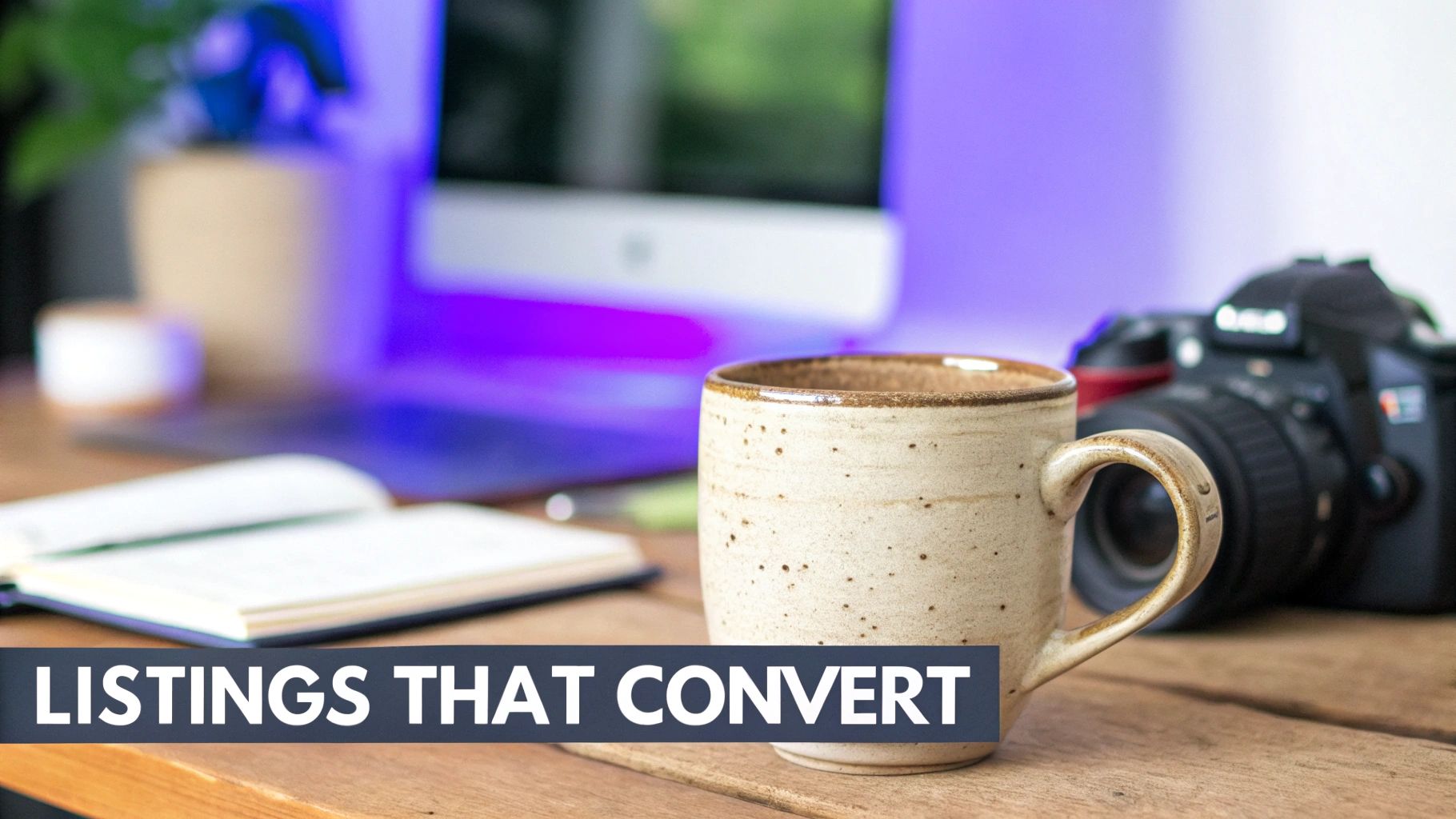
Create Lifestyle Shots: This is where the magic really happens. A photo of your ceramic mug on a stark white background is fine. It’s informative. But a photo of that same mug on a cozy desk, next to a good book and steaming with coffee? That's aspirational. You’re selling an experience, not just a mug.
Add a Video: Etsy listings with video get more attention. A short 5-10 second clip showing your product in use or just slowly rotating can reveal details that a static image can't. In fact, research shows that 87% of buyers have been convinced to buy a product after watching a brand's video.
Your goal with photography isn't just to show what your product is. It's to help the customer envision the life they'll have with your product. That's the emotional connection that drives someone to click "Add to Cart."
If you’re ready to really level up your product visuals, our guide on how to take professional product photos is packed with practical advice you can use right away.
Write Descriptions That Tell a Story
Once your photos have grabbed their attention, your product description is what seals the deal. This is where you connect with the customer, answer their unspoken questions, and highlight what makes your item so special. Ditch the dry list of features and focus on the benefits.
For example, instead of saying, "This candle is made with soy wax," try something like, "Our hand-poured soy wax candle provides a clean, long-lasting burn, filling your space with a calming lavender scent without any of the soot or toxins."
See the difference? The first is just a feature. The second is a benefit that solves a problem (messy, unhealthy candles) and paints a picture.
Here’s a simple framework for crafting descriptions that actually convert:
Start with a Hook: Open with a sentence that speaks directly to your customer's desires. For a chunky knit blanket, you might start with, "Imagine curling up on a chilly evening with this incredibly soft, oversized blanket..."
Focus on the "Why": Clearly explain how your product will make their life better. Will it save them time? Help them relax? Make them the hero of gift-giving?
Provide the Nitty-Gritty: Use bullet points for easy-to-scan information like dimensions, materials, care instructions, and what’s included. This helps shoppers quickly find the specific details they’re looking for.
Build Trust: Add a sentence about your process or what makes your shop unique. Something simple like, "Each piece is handcrafted with care in my small studio..." adds a personal touch that builds confidence and sets you apart from the big-box stores.
When you combine stunning visuals with a story-driven description, you create a listing that does more than just show a product—it creates desire and makes the decision to buy feel both easy and exciting.
Use Etsy Ads and Marketing to Amplify Your Reach
https://www.youtube.com/embed/9gotmxodsqQ
Relying on your SEO work is a great start, but it's often a slow burn. If you really want to kick your growth into high gear and see those Etsy sales climb, you have to get proactive about putting your products in front of more people. This is where a smart marketing plan—mixing on-platform tools like Etsy Ads with your own off-site efforts—really makes a difference.
Think of it this way: SEO helps people who are already looking for you to find you. Marketing, on the other hand, reaches out and finds people who don't even know they need your product yet.
Demystifying Etsy Ads
I get it—the thought of paying for ads can be nerve-wracking, especially when you're watching every single penny. But when you use them strategically, Etsy Ads can be an incredible tool for gathering data and driving that crucial initial traffic. The good news? You don't need a huge budget to get started.
You can begin testing the waters with a daily budget of just $3 to $5. The goal here isn't to blast your entire shop with ads; it's to be surgical.
Promote Your Proven Winners: Start by advertising 2-3 of your best-selling items. These are the listings you already know have a solid conversion rate, so you have a better chance of turning a paid click into an actual sale.
Test Your Newcomers: Got a brand-new product you're excited about? Ads can give it the initial boost it needs to get seen, make its first few sales, and collect those all-important early reviews.
Analyze the Data: Etsy gives you a dashboard with all the key metrics: your spend, views, clicks, and revenue. Make it a habit to check in weekly. If a particular ad isn't bringing in sales after a couple of weeks, don't be afraid to pause it and try advertising a different product. It's all about finding a positive Return on Ad Spend (ROAS).
Your first ad campaigns are as much about learning as they are about earning. You're paying for valuable data on which products shoppers are clicking on, which can inform your entire business strategy down the line.
Leveraging Off-Site Marketing
Building a brand that lasts means creating your own traffic sources that live outside of Etsy. Doing this not only expands your sales potential but also makes your business much more resilient. For Etsy sellers, two of the most effective and budget-friendly channels are Pinterest and email marketing.
It's also important to understand the platform's direction. Etsy is increasingly focused on generating its own revenue from services like promoted listings. As we head into 2025, sellers will need to be even more strategic as Etsy refines its AI-powered search and advertising. Even with a reported 6.5% decline in Gross Merchandise Sales to $2.8 billion in Q1 2025, Etsy's own revenue kept growing, largely fueled by these seller services. This trend shows that the platform is nudging sellers toward its paid tools, making a balanced on-site and off-site marketing plan more critical than ever. You can read more about Etsy's performance and what it means for sellers in this detailed analysis.
Pinterest: The Visual Search Engine
Pinterest isn't like other social media platforms that are all about what's happening right now. It's a visual search engine where people go to plan for the future—and that includes future purchases. This makes it an incredibly powerful tool for driving targeted, ready-to-buy traffic straight to your shop.
Create beautiful, eye-catching pins for your products, but don't stop at just a photo. Use a simple tool like Canva to add text overlays that highlight a key benefit, like "Perfect Minimalist Wedding Gift" on a pin featuring one of your necklaces. Most importantly, make sure every single pin links directly to the corresponding Etsy product page. Also, try making short video pins; they can seriously boost engagement. If you need a little help getting started, our guide on how to create product videos is a fantastic resource.
Building Your Email List
An email list is one of the most valuable assets you can possibly build for your business. These aren't just random followers; these are engaged fans who have given you explicit permission to contact them directly.
While you can't just grab emails from your Etsy orders, you can definitely encourage people to sign up. A great way to do this is to include a small, tastefully designed insert in your packaging that offers a discount on a future purchase in exchange for joining your mailing list.
Use a straightforward service like Mailchimp or ConvertKit to manage your subscribers. You don't have to overdo it—a simple monthly newsletter showcasing new products, sharing a behind-the-scenes look at your process, or offering an exclusive coupon is perfect. This direct line of communication is your best tool for encouraging repeat business from your happiest customers.
Nailing Your Pricing and Promotions to Drive More Sales
Pricing is easily one of the most agonizing parts of running an Etsy shop. If you price too low, you're basically working for free. Price too high, and you risk scaring off shoppers before they even get a chance to fall in love with your work.
The goal here is to stop guessing and start calculating. Your price needs to be a confident, deliberate choice that not only reflects the true value of your product but also keeps your business healthy and growing. A well-thought-out price tag tells customers you’re a professional who values your craft.
Calculate a Price That Actually Pays You
Before you even glance at what your competitors are doing, you need to figure out your baseline. What's the absolute minimum you have to charge to not lose money on a sale? So many talented sellers shortchange themselves by forgetting all the little costs—and most importantly, their own time.
A simple formula is your best friend here. It takes the guesswork out of the equation and ensures you're starting from a place of profitability.
The Go-To Pricing Formula: (Cost of Supplies + Your Hourly Labor Rate) x 2 = Wholesale Price Wholesale Price x 2 = Retail Price
Let's see this in action. Say you make custom-stamped leather keychains.
Cost of Supplies: The leather, metal ring, and other bits and pieces run you $4.00 per keychain.
Your Hourly Labor Rate: You've decided your skilled time is worth $25/hour. It takes you about 15 minutes (0.25 hours) to craft one, making your labor $6.25.
Wholesale Price: ($4.00 + $6.25) x 2 = $20.50
Retail Price: $20.50 x 2 = $41.00
That final $41.00 isn't just a number pulled out of thin air. It covers your materials, pays you a fair wage, and bakes in a profit margin for things like Etsy fees, marketing, and future growth. Now you have a solid foundation you can tweak based on market research, but you’ll never accidentally undercharge again.
The Undeniable Power of "Free Shipping"
In the online shopping universe, the words "free shipping" are pure magic. Did you know that unexpected shipping costs are one of the biggest reasons people abandon their carts? Studies consistently show an average cart abandonment rate of around 70%, and surprise fees at checkout are a huge culprit.
Of course, shipping is never actually free. The secret is to bake the average shipping cost right into your item's price.
By rolling the shipping cost into your product price, you meet a huge customer expectation without eating into your profit. A shopper is almost always more willing to pay $45 for an item with "free" shipping than they are to pay $38 for the item plus a separate $7 for shipping.
To get this right, figure out your average shipping cost for an item across the different places you ship to. Then, simply add that average to your retail price. It’s also worth noting that Etsy gives a search boost to listings that are part of a shop's free shipping guarantee (usually on orders over $35).
Run Promotions That Create a Sense of Urgency
With your core pricing set, you can now use promotions to spark interest and encourage shoppers to buy now. A good sale isn't about randomly slashing prices; it's a strategic move designed to create urgency and drive action.
Look for key moments to grab a buyer's attention throughout the year.
Holiday & Seasonal Sales: This is a no-brainer. Plan targeted promotions around big holidays like Christmas, Mother's Day, and Valentine's Day. Get them running a few weeks early to catch the organized shoppers.
Abandoned Cart Coupons: This is one of my favorite tools. Etsy lets you automatically send a coupon to someone who puts an item in their cart but doesn't check out. It’s a gentle nudge that can recover a surprising number of would-be lost sales.
"Thank You" Coupons: After a customer makes a purchase, have Etsy automatically send them a discount code for their next order. It’s a small touch that makes customers feel appreciated and is fantastic for encouraging repeat business.
Build Customer Loyalty for Repeat Business
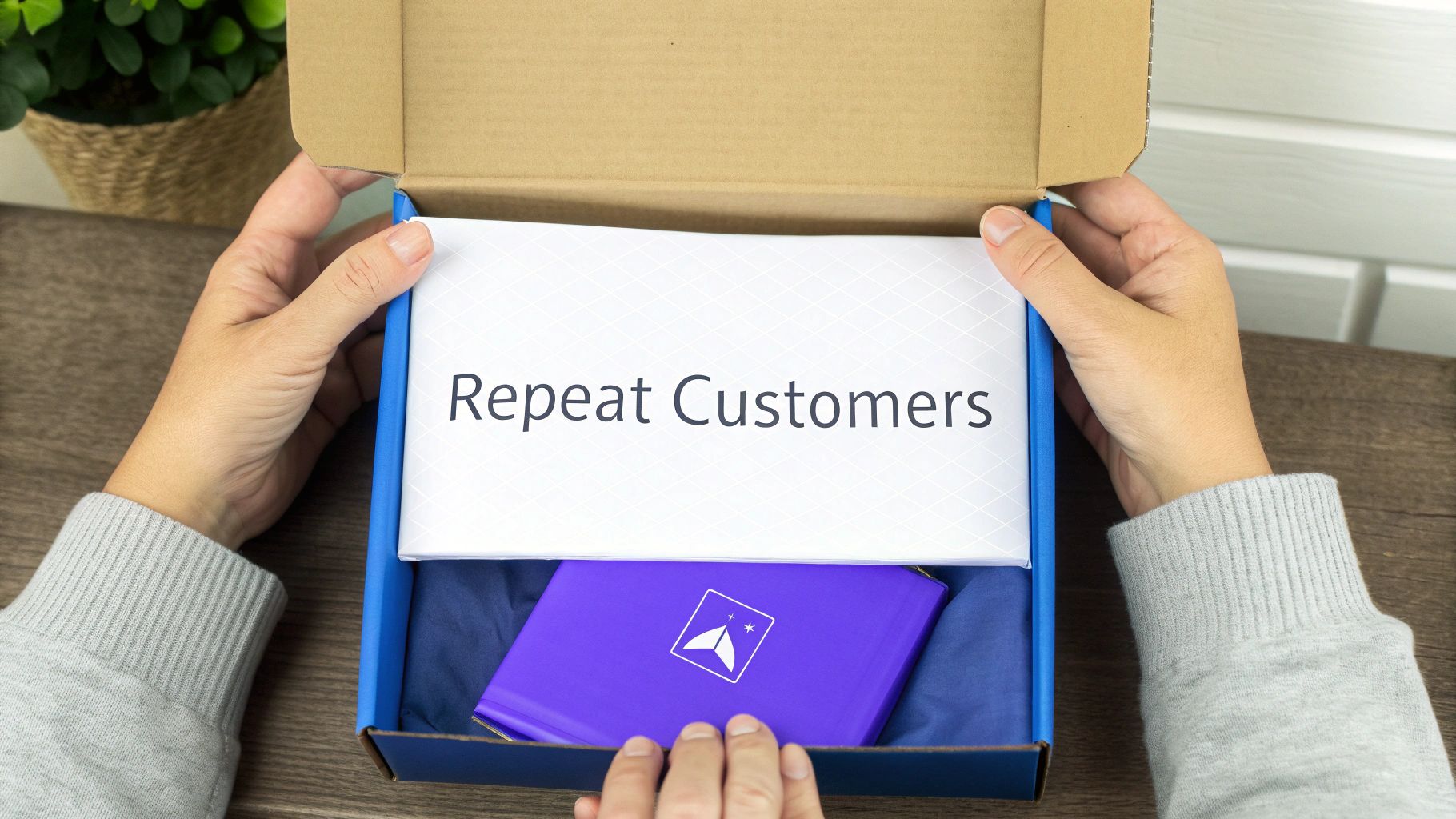
Sure, landing a new customer feels great. But a repeat customer? That's the real win for any Etsy business. These loyal buyers are the foundation of a healthy shop—they spend more, leave those fantastic reviews that serve as social proof, and become your best word-of-mouth marketers.
The trick is to make the entire experience feel personal and special, leaving a lasting impression long after they’ve clicked "buy." This isn't just about shipping a product; it's about starting a relationship that begins the moment the order notification hits your inbox.
Create a Memorable Unboxing Experience
In the world of e-commerce, the moment a customer opens your package is the first physical touchpoint they have with your brand. A little extra effort here can turn a simple transaction into a memorable event, and it doesn't have to cost a fortune.
A Handwritten Thank-You Note: Never underestimate the power of a simple, personalized note. Using their name and genuinely thanking them for their order shows there's a real person behind the shop.
Branded Touches: Small details make a big difference. Think custom stickers sealing the tissue paper or a branded thank-you card. These touches make your packaging look polished and professional.
Care Instructions: If your product needs special care, include a nicely designed instruction card. It's not just practical; it shows you care about your creation even after it's left your hands.
Provide Five-Star Customer Service
Amazing customer service is the glue that holds customer loyalty together. It’s all about being quick, kind, and professional in every conversation. This is a huge piece of the puzzle when figuring out how to improve sales on Etsy.
Etsy’s Star Seller badge heavily favors sellers who reply to that first message within 24 hours. Make sure you have notifications turned on so you can respond quickly, even if it's just a quick note to say you've seen their message and will get back to them soon.
When problems pop up—and they always do—see them as a chance to shine. A customer whose issue is resolved with speed and empathy often becomes more loyal than a customer who never had a problem in the first place.
This level of service is especially important as your shop grows. International buyers now account for 40% of Etsy's gross merchandise sales, with a huge presence in the UK, Canada, and Europe. Clear communication and reliable support for these customers can unlock a massive part of the market. You can dig into more stats about Etsy’s expanding global user base to see the potential.
Got Questions About Boosting Your Etsy Sales?
As you start digging into ways to get more sales on Etsy, a few key questions always seem to pop up. Let's tackle them head-on with some straight-to-the-point answers I've picked up over the years.
How Long Does It Really Take for Etsy SEO to Work?
I get it, you just spent hours updating your listings and you're refreshing your stats every five minutes. The hard truth? Etsy SEO is a marathon, not a sprint. While a small tweak might give you a tiny, temporary boost, you're really playing the long game.
From what I've seen with my own shops and countless others, it usually takes 30 to 90 days of consistent effort to see a real, measurable impact on your traffic. The key is to make your changes and then have the patience to let the algorithm do its thing.
Should a Brand New Shop Even Bother with Etsy Ads?
Absolutely, but you have to think about them differently. For a new shop, Etsy Ads aren't just about getting sales; they're an incredible tool for gathering data, fast. It’s your shortcut to getting initial eyeballs on your products and figuring out what people actually want to buy.
My advice? Start small. A budget of $2-$5 per day on just your top few listings is plenty. Let it run for a couple of weeks, then dive into the numbers. Are you getting clicks? Are those clicks converting? This is how you find your winners.
Think of that ad spend as an investment in market research, not just an expense. You're paying to learn which of your products has true bestseller potential.
Is Free Shipping a Must-Have to Make Sales?
It's not technically mandatory, but in 2024, it's pretty close. Etsy's search algorithm heavily favors listings that offer free shipping, and shoppers have been trained to look for it—many even filter out listings that don't have it.
But here’s the secret: you don't have to eat the cost. The smart move is to figure out your average shipping expense and bake it right into your product price. This way, you give customers the "free shipping" they crave without tanking your profit margins. It's the best of both worlds.
Ready to create stunning, on-model product photos without the cost and complexity of a traditional photoshoot? Look Atlas uses AI to turn your basic product images into hyper-realistic visuals that can double your sales. Generate an entire catalog of studio, lifestyle, and video content in minutes. Discover how it works at Look Atlas.
