So, what’s a "good" ecommerce conversion rate? The textbook answer is somewhere between 2% and 4%, but that's just a starting point. Think of it as a general rule of thumb, not a hard-and-fast rule.
The truth is, your store's performance is tied to so many different factors, like what you sell, how much it costs, and where your customers are coming from.
What an Ecommerce Conversion Rate Really Means
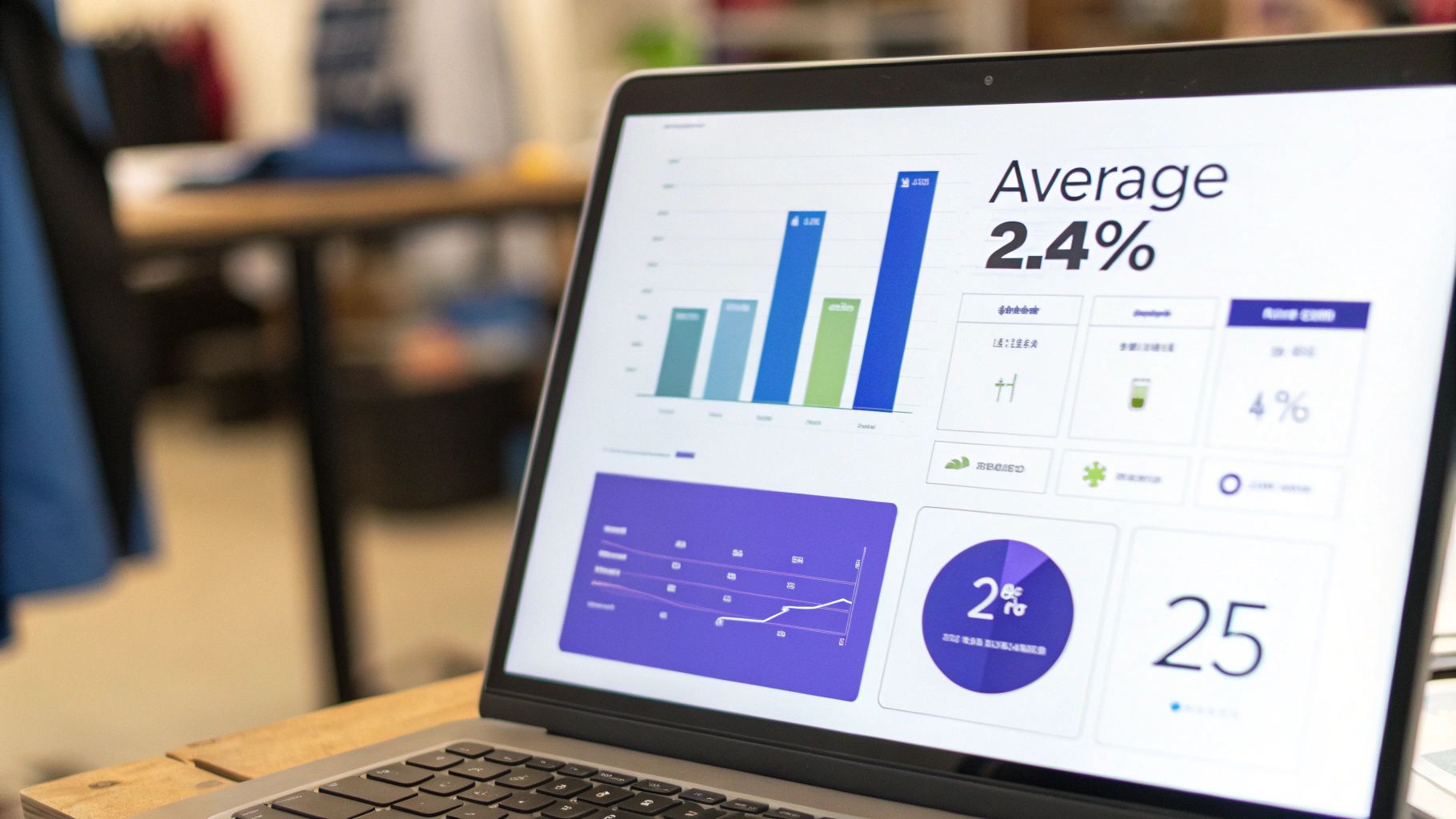
I like to think of a conversion rate as a store's batting average. It tells you what percentage of people who walk through your digital front door actually end up buying something. The math is simple:
(Total Number of Sales / Total Number of Visitors) x 100 = Conversion Rate
Let’s say you had 1,000 visitors yesterday and 30 of them bought a product. Your conversion rate for that day would be 3%. Easy. But knowing that number is one thing; understanding what it means in the grand scheme of things is where the real work begins. And that’s why we have benchmarks.
Using Benchmarks as a Compass
Comparing your numbers to industry averages is one of the best ways to find hidden opportunities and set goals that are ambitious but still realistic. Don't think of benchmarks as a report card. Instead, see them as a compass that shows you where to focus your attention.
It's also interesting to see how much these benchmarks have changed over the years. Back in the early 2000s, with clunky websites, a 1.5%–2.5% rate was pretty standard. As user experience improved from 2010 onwards, that figure climbed to 2.5%–4.0%. The pandemic even saw a temporary spike to 4.2% before things settled back into the 2%–4% range we see today. If you're curious, you can dig into some historical insights about ecommerce benchmarks to see just how much shopper behavior has evolved.
Benchmarks don't tell you if you're "good" or "bad." They tell you where to look next. A low conversion rate isn't a failure—it's a clear signal to investigate specific parts of your customer journey, like your product pages or checkout process.
At the end of the day, understanding these numbers helps you get past the surface-level stuff. It gives you the power to find the friction points, double down on what’s working, and make smart decisions that actually grow your business.
Finding Your Industry's Conversion Rate Benchmark
Trying to compare your store’s performance to a global average is a bit like comparing a speedboat to a cruise ship. Sure, they’re both boats, but they serve entirely different purposes and operate in completely different ways. An online furniture store selling high-ticket items will naturally have a different conversion rate than a fast-fashion brand that thrives on impulse buys. This is exactly why you need to zero in on ecommerce conversion rate benchmarks for your specific industry.
The customer mindset is completely different from one sector to the next, which creates unique performance standards. Think about it: a shopper looking at a $5,000 sofa is going to take their time—weeks, maybe even months. They’ll research, compare options, and think it over. On the other hand, someone buying a $25 lipstick they’ve used for years might click "buy now" in a matter of minutes.
Why Industry Averages Vary So Much
So, what's behind these massive differences? It really comes down to two things: the level of thought required for the purchase and the amount of trust needed.
High-Consideration Products: Big-ticket items like luxury goods, furniture, or expensive electronics demand a long decision-making process. The financial commitment is higher, so customers browse, leave, and come back multiple times before they’re ready to pull the trigger. This longer journey naturally leads to lower conversion rates.
Low-Consideration Products: Categories like personal care, food, and affordable fashion often rely on repeat business and accessible price points. Once a customer trusts your brand, the decision to buy again is quick and easy, which helps push conversion rates up.
The data backs this up completely. A look at sector-specific eCommerce conversion rates shows some pretty stark differences. Personal Care Products, for instance, lead the pack at 6.8%, with Food & Beverage close behind at 6.02% over the past year. At the other end of the spectrum, Luxury & Jewelry sits at just 0.95%, proving just how much the product type shapes customer behavior. You can dive deeper into the numbers with these industry-specific performance benchmarks.
Key Industry Conversion Rate Benchmarks
To give you a clearer picture of where you stand, it helps to look at the numbers side-by-side. The table below shows the typical conversion rate ranges for several key industries. Find the one that best fits your business to see how you measure up against the competition.
Average Ecommerce Conversion Rate by Industry
This table provides a clear comparison of average conversion rates across different ecommerce sectors, highlighting the performance disparities.
Industry | Average Conversion Rate (%) |
|---|---|
Personal Care Products | 6.5% - 6.8% |
Food & Beverages | 4.9% - 6.0% |
Electronics & Home Appliances | 3.0% - 3.6% |
Pet Care | 2.3% - 2.6% |
Retail Fashion | 1.6% - 1.9% |
Home Decor & Furniture | 1.5% - 1.9% |
Luxury & Jewelry | 0.7% - 1.0% |
Seeing these numbers in context is everything. They help you set realistic goals and spot potential issues with much greater accuracy.
For example, a fashion store converting at 2% could be considered average for its niche. But if a personal care brand was only converting at 2%, that would be a major red flag, pointing to a huge opportunity for improvement.
Ultimately, these industry-specific benchmarks give you the right lens to view your performance through. Instead of vaguely wondering if your 1.8% conversion rate is "bad," you can see that it's actually pretty solid for a home decor store—but would need some serious work if you were selling pet supplies. Gaining this kind of nuanced perspective is the first step toward making smarter, more effective changes to your store.
How Channels And Devices Shape Your Conversion Rates
Knowing your industry’s average conversion rate is a great starting point, but it's just one piece of the puzzle. You also have to consider how people find you and what device they’re using when they land on your site.
Think of it this way: not all traffic is created equal. The channel that brings a visitor to your store says a lot about their mindset. The same goes for whether they’re browsing on their phone during a lunch break or sitting down at a desktop computer, ready to buy.
The Story Behind Your Traffic Sources
A customer who clicks a link in your email newsletter is already warm. They know your brand, they like what you do, and they've literally opted in to hear from you. Their intent to purchase is usually pretty high.
Contrast that with someone casually scrolling through Instagram who happens to see one of your ads. They might be intrigued, but they're in a discovery mode, not necessarily a buying mode. This fundamental difference in user intent is why conversion rates vary so wildly from one channel to another.
Email marketing and organic search almost always lead the pack with the highest conversion rates. These channels capture people who are either already loyal to your brand or actively searching for the exact products you sell.
On the other end of the spectrum, you have channels like paid social media and display ads. These often have lower conversion rates because they act more like digital billboards—they’re fantastic for building brand awareness and introducing new people to your products, but they aren’t typically designed for immediate sales. The trick is to have realistic expectations for each one.
The chart below shows just how much these rates can fluctuate, even among industries that are performing well.
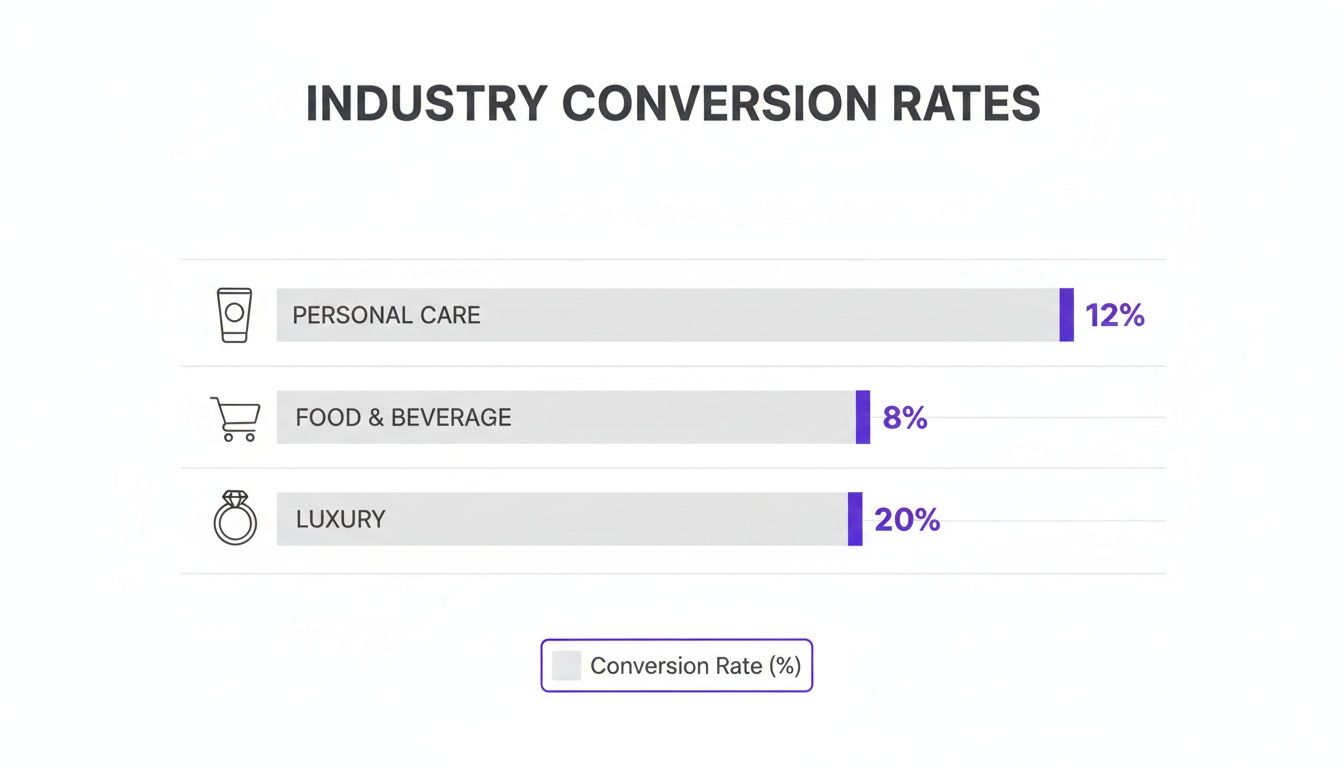
It makes sense when you think about it. High-trust categories like Personal Care, where customers often make repeat purchases, will naturally convert better than high-consideration purchases like luxury goods, which have a much longer sales cycle.
The Great Mobile vs. Desktop Divide
For years, we've seen one trend hold steady: people love to browse on their phones, but they prefer to buy on their computers. While mobile traffic might make up the bulk of your sessions, desktop is still the king of conversions.
The numbers are pretty stark. On average, desktop sessions convert at around 3.9%, but mobile sessions fall way behind at just 1.8%. It seems many shoppers use their phones to research and compare, then switch over to a bigger screen to complete the purchase.
This gap screams "opportunity." If your mobile checkout process is frustrating, slow, or just plain confusing, you're leaving a ton of money on the table. The experience needs to be buttery smooth. Small tweaks like bigger buttons, simplified forms, and offering mobile wallets can make a huge difference.
It's also about making your products come alive on a small screen. This is where rich media shines. For tips on this, check out our guide on how to create product videos that are perfect for grabbing a mobile user's attention.
Getting granular with your data is non-negotiable. As of September 2024, the global ecommerce average conversion rate was 1.58%. But that single number hides a lot of nuance. For example, some Facebook ad campaigns see rates as high as 9.21%. And while Windows desktop users convert at 5%, mobile iOS users convert at just 2%.
When you understand these differences, you can start making smarter decisions—allocating your marketing spend more effectively and optimizing your site experience where it will have the most impact.
How to Accurately Calculate and Track Your Conversion Rate
Knowing the industry benchmarks is a great starting point, but the real magic happens when you get your hands dirty with your own numbers. This is where you turn abstract data into real, tangible growth for your business.
First things first, let's nail down the basic formula. It’s simply the percentage of your website visitors who end up making a purchase.
(Total Number of Sales ÷ Total Number of Unique Visitors) x 100 = Conversion Rate
Let’s say you had 5,000 unique visitors last month and 100 of them bought something. Your conversion rate would be 2%. Simple, right? Think of this number as your baseline—the starting line for understanding your store's health.
Where to Find Your Data
Don't worry, you won't be crunching these numbers with a calculator. Your ecommerce platform and analytics tools do all the heavy lifting. If you’re on a platform like Shopify, you'll find this metric front and center on your dashboard, giving you a quick pulse check on performance.
For a much deeper dive, you absolutely need to be using Google Analytics 4 (GA4). GA4 lets you go way beyond a simple site-wide average. You can track sales, watch how users behave, and slice and dice your audience to see what’s working on different devices or marketing channels.
This is where you start to uncover the why behind your numbers.
Look Beyond the Basic Formula
One of the biggest mistakes I see merchants make is looking at their overall conversion rate and stopping there. A single, blended rate can be misleading because it hides the crucial details.
Imagine your overall conversion rate is a healthy 2.5%. Not bad. But when you break it down by the source of the traffic, a much clearer picture emerges:
Email Marketing: Converting at a fantastic 5.1%
Organic Search: Bringing in sales at 3.2%
Paid Social: Lagging behind at just 0.9%
Now that’s a story. This segmented view instantly tells you which channels are your superstars and which ones are struggling to pull their weight. Instead of one generic number, you have a diagnostic tool that shows you where to double down on what’s working and where to rethink your strategy.
This is why tracking specific ecommerce conversion rate benchmarks for your own channels isn’t just a nice-to-have; it's essential for smart growth.
Actionable Strategies to Boost Your Conversion Rate
Alright, you've done the diagnostic work by understanding the benchmarks. Now for the treatment. Moving from data analysis to real action is where you actually start turning those insights into revenue. The strategies below aren't just theory; they are proven, high-impact changes that get more visitors to click "buy."
We'll kick things off with the most treacherous part of the customer journey, where the vast majority of sales are lost: the checkout. This is where even the smallest bit of friction can kill a sale in seconds.
Simplify the Checkout and Build Trust
A clunky, confusing checkout is the ultimate conversion killer. It’s no secret that around 70% of shoppers abandon their carts, and it's often because they hit a snag in the final steps. Your one and only goal here is to make buying from you completely effortless.
Here are a few ways to cut out the friction and give shoppers the confidence they need to complete their purchase:
Eliminate Surprises: Be totally upfront about shipping costs, taxes, and estimated delivery times. Show this info on the product page or in the cart itself—long before checkout begins—to prevent sticker shock and build crucial trust.
Offer Guest Checkout: Forcing someone to create an account is like putting up a brick wall right before the finish line. A guest checkout option respects their time and can slash your abandonment rate.
Streamline Forms: Only ask for what you absolutely need to process the order. Every extra field is another reason for someone to get frustrated and leave. Use tools that auto-fill addresses to make it even faster.
By zeroing in on these common pain points, you tackle the biggest reasons for cart abandonment head-on. Once you've smoothed out your checkout, you can explore other powerful strategies to increase your ecommerce sales and keep refining your store's performance. The key is to remove barriers and make the path to purchase as smooth and secure as possible.
Harness the Power of Visuals and Social Proof
In ecommerce, your product photos do all the heavy lifting. Customers can't touch, feel, or try on your products, so stunning visuals are the only way to bridge that gap between just browsing and actually buying.
Think of your product images as your hardest-working salesperson. They need to be crisp, compelling, and show off the product from every conceivable angle. On-model photos are especially powerful because they help shoppers instantly visualize fit and scale, answering critical questions before they even have to ask.
Compelling visuals do more than just showcase a product; they create an emotional connection. When a shopper can see themselves using your product, the purchase decision becomes much easier. This is especially true in fashion and apparel, where context is everything.
Beyond great imagery, social proof is your most valuable currency for building trust. Displaying customer reviews, star ratings, and testimonials right on your product pages validates your claims. Shoppers will always trust other shoppers more than they trust your marketing copy.
For a deeper dive, you can explore these 10 Powerful Conversion Rate Optimization Techniques to find even more ways to improve your strategy.
Common Questions About Conversion Rate Benchmarks
Even when you have all the data, applying ecommerce conversion rate benchmarks to your own store can bring up some tricky questions. Let's walk through a few of the most common ones that pop up, so you can use these numbers to make smarter decisions for your brand.
We'll start with a classic question about timing and then dig into how to troubleshoot performance gaps.
How Often Should I Check My Ecommerce Conversion Rate?
It's so tempting to refresh your analytics daily, I get it. But this often leads to overreacting to normal, day-to-day ups and downs. One slow Tuesday doesn't mean your entire strategy is broken.
A much saner (and more effective) approach is to review your conversion rate on a weekly and monthly basis. This gives you enough time to see past the daily noise and spot actual trends. Of course, if you're running a specific A/B test or a big campaign, you'll want to watch it more closely. Just remember to wait for enough data to reach statistical significance before you declare a winner.
Why Is My Conversion Rate So Low?
Seeing your numbers lag behind the industry average can be frustrating. Before you panic, first make sure you're comparing apples to apples. A luxury watch brand will have a completely different benchmark than a fast-fashion t-shirt shop.
If the comparison is fair, here are some of the usual suspects to investigate:
A Clunky Mobile Experience: If your site is a pain to use on a phone, you're losing sales. It's that simple.
Slow Page Speeds: Every extra second it takes for a page to load is another chance for a potential customer to leave.
A Confusing Checkout Flow: Too many steps, hidden fields, or unclear instructions will send shoppers running for the hills.
Surprise Shipping Costs: This is the #1 reason for abandoned carts. Be upfront about costs long before the final payment screen.
Low-Quality Traffic: Your marketing might be great at getting clicks, but are those clicks coming from people who are actually likely to buy?
Think of the benchmark as your starting point for a deeper dive, not a final verdict on your store's potential.
What Does a High Add-To-Cart Rate and Low Conversion Mean?
This is actually great news! It’s a clear signal that your product pages are working beautifully. Your photos, descriptions, and overall presentation are convincing shoppers that they want your product.
A high add-to-cart rate with low final sales tells you exactly where the problem is: your cart and checkout process. The issue isn't what you're selling; it's the final steps of the buying journey.
Start hunting for friction points. Are you forcing people to create an account? Do you offer trusted payment options like Apple Pay or PayPal? Is your shipping information hard to find or understand? Smoothing out this last leg of the race can dramatically boost your sales. For more tips on getting those initial clicks, check out our guide to effective ecommerce photo editing.
What Counts as a Conversion Besides a Sale?
A sale is the ultimate win—what we call a macro-conversion. But there are dozens of smaller actions, or micro-conversions, that are incredibly important to track. These are the little steps that show a visitor is engaged and moving in the right direction.
Some key micro-conversions to watch are:
Adding an item to the cart or wishlist
Signing up for your email list
Creating a customer account
Downloading a resource like a sizing guide or lookbook
Keeping an eye on these gives you a much fuller picture of how well your site is performing and how engaged your visitors really are.
Ready to transform your product photos into conversion-driving assets? With Look Atlas, you can generate ultra-realistic, on-model images instantly, eliminating the need for expensive photoshoots. See how AI can help you create stunning visuals that sell by visiting https://www.lookatlas.com.
