
Jewelry Photography Price: Compare Quotes by Deliverable
There is no defensible single jewelry photography price. A quote for one clean catalog frame, a focus-stacked ring detail, a necklace on a model, and a styled campaign image may all use the phrase "one photo," while buying very different amounts of production.
Make the deliverables comparable before you compare the totals. Define what each image must prove, translate every quote into the same scope, expose what happens outside the base rate, and only then choose a studio, an in-house workflow, or a hybrid production route.
Start with one SKU and four deliverable lanes
A useful request for quote begins with one representative SKU, preferably a piece that contains the hardest material, setting, chain, clasp, engraving, or stone in the collection. Give every supplier the same source material and ask them to price the same four lanes.
Catalog packshots establish identity. Specify the number of views, background, shadow or reflection treatment, crop, color profile, dimensions, file type, and whether each colorway counts as a separate product. "Three images" is incomplete if one supplier expects three angles of one ring while another expects three rings.
Macro and detail images inspect construction. Name the prongs, hallmarks, engraving, stone facets, clasp, links, or texture that must remain legible. Ask whether the quote includes focus stacking, exposure compositing, dust removal, scratch cleanup, and color matching. A close crop is not automatically a finished macro asset.
On-body and scale images show how a piece sits on an ear, neck, wrist, hand, or garment. Specify the crop, model source, styling, hair and makeup, fitting, number of looks, and intended usage. Talent cost and talent usage are separate questions.
Campaign images carry a concept. List the set, props, surfaces, location, wardrobe, creative direction, orientations, crops, and channels. A campaign day can include a photographer, producer, stylist, assistants, rentals, talent, and advanced retouching. It should not be compared with a plain packshot as if both were interchangeable outputs.

Look Atlas decision framework: define the image job and hidden boundaries before comparing totals.
The scope card is deliberately short. Its job is to prevent a supplier from solving a different assignment and appearing cheaper only because the missing work has not yet entered the estimate.
Translate the quote without manufacturing a market average
Published prices are useful as examples of how scope changes a provider's own offer. They are weak evidence for a universal rate.
As of 9 November 2026, Squareshot’s website says the studio is closed. Its September figures below are historical examples of how a quote can be structured, not currently bookable offers.
On September 14, 2026, Other Planet Studio published a Classic packshot offer at $13 to $17 per photo and a Premium packshot offer at $60 to $150 per photo. On the same date, Squareshot published product-shoot day rates from $1,125 to $4,450 and model-shoot day rates from $2,950 to $7,450. These figures use different units and inclusions. They are not a market range, an average, or a recommendation.
Translate each estimate into the same five buckets: setup and production, capture deliverables, retouching and compositing, rights and talent, and logistics or contingencies. Preserve the supplier's original unit, then add a second view for your own planning:
all-in project cost / approved, channel-ready final images
Keep "approved" in the denominator. Test frames, near-duplicates, rejected retouches, and outputs that fail a marketplace or campaign specification do not reduce the effective cost of the library.
This calculation is a comparison aid, not the article's answer. A lower result can still be the wrong choice if the image fails to show the correct stone, setting, scale, or usage rights.
The cheapest line can stop before the hard work
Ask where standard work ends. Jewelry can turn a small wording difference into a large production boundary.
A base retouch may cover crop, background cleanup, and broad color correction. It may not cover rebuilding a chain path, removing deep scratches, compositing reflections, replacing stones, preserving engraving through a stack, or preparing layered source files. Agree on what may be altered. Retouching that makes a piece more attractive by changing its construction is not a better deliverable. The separate lights for jewelry photography guide helps define the physical source and modifier before that retouching boundary is written.

Sourced provider examples checked September 14, 2026. Units, inclusions, and suppliers differ; these are not market averages or recommendations. Squareshot announced its closure by 9 November 2026; these are historical offers.
The same distinction applies to models. A quote may include capture but not casting, fitting, wardrobe, hair and makeup, hand preparation, agency charges, or usage beyond a stated period. Squareshot's historical jewelry calculator separated model source, model type, outfits, scenes, usage duration, and extra models. The useful lesson is the separation, not any one calculator total.
Revisions need a trigger. State how many rounds are included, whether a round means one consolidated list, and what becomes a paid change. Separate supplier error from a client brief change. If the delivered metal color is wrong against the approved reference, that is not the same event as asking for a new background after production.
Reshoots need the same clarity. Record who pays when the sample arrives damaged, a required angle was absent from the approved shot list, a model is unavailable, a stone is visually inaccurate, or the client changes the SKU after the test frame. "Revisions included" does not answer those cases.
Rights and jewelry logistics belong inside the estimate
Commercial photography pricing can include three distinct components: a creative or production fee, a license fee, and expenses. The American Society of Media Photographers' commissioning guidance also places preproduction and postproduction inside the assignment, with equipment, assistants, stylists, models, travel, insurance, retouching, and delivery among the possible expenses.
Do not treat delivery of a JPEG as proof that every planned use is cleared. The U.S. Copyright Office's photographer guidance says the photographer is generally the author and initial copyright owner unless a valid work-made-for-hire arrangement or transfer applies. Ask the supplier to state the permitted media, territory, term, paid use, edits, third-party delivery, and whether model usage follows a different term. This is a procurement question, not legal advice.
High-value jewelry adds custody questions. Put declared value, carrier, insurance responsibility, intake condition photography, storage, on-site access, return method, and loss or damage procedure in writing. A local drop-off, an insured shipment, and a photographer working inside the brand's vault do not carry the same expense or risk.
Put these questions in every request for quote
Ask the vendor | What the answer changes |
|---|---|
What is one billable image? | Separates a view, product, setup, crop, and final file. |
Which four deliverable lanes are included? | Prevents catalog, macro, on-body, and campaign work from being blended. |
What does standard retouching include? | Exposes stacking, compositing, cleanup, color, and layered-file boundaries. |
Which people and production roles are included? | Reveals casting, model, stylist, makeup, assistant, and producer costs. |
What usage is licensed? | Defines channel, territory, duration, paid media, edits, and talent usage. |
What triggers a paid revision or reshoot? | Assigns the cost of supplier error, sample failure, and brief changes. |
Who owns shipping, insurance, and custody? | Prices high-value sample handling instead of leaving it implicit. |
What must pass before final delivery? | Turns taste into checks for identity, color, construction, scale, files, and crops. |
Send the same questions to every supplier and require explicit exclusions.
Send the same card and questions to every supplier. Ask them to mark exclusions rather than simply confirm the brief. A blank field is a future negotiation, not a zero-cost line.
Choose the route by the evidence the image must carry
A specialist physical studio is the safer default when the image must document construction, stone color, hallmark detail, or an exact macro view. It is also the direct route for a campaign built around a named photographer, real talent, a location, or physical lighting that is itself part of the creative idea. The broader professional jewelry photography guide carries those decisions into capture and approval.
An in-house setup can fit repeatable catalog work when the brand controls the samples, can save the lighting geometry, and has a trained product owner who approves color and construction. Its costs move from an external invoice into equipment, space, staff time, training, retouching, and queue ownership. "Already paid for" labor is still production capacity.
A hybrid route can begin with an approved physical master and use generated imagery for selected context or variation. It is unsuitable when the source does not show the detail the final image must prove, when apparent scale is legally or commercially sensitive, or when nobody is assigned to reject product drift.
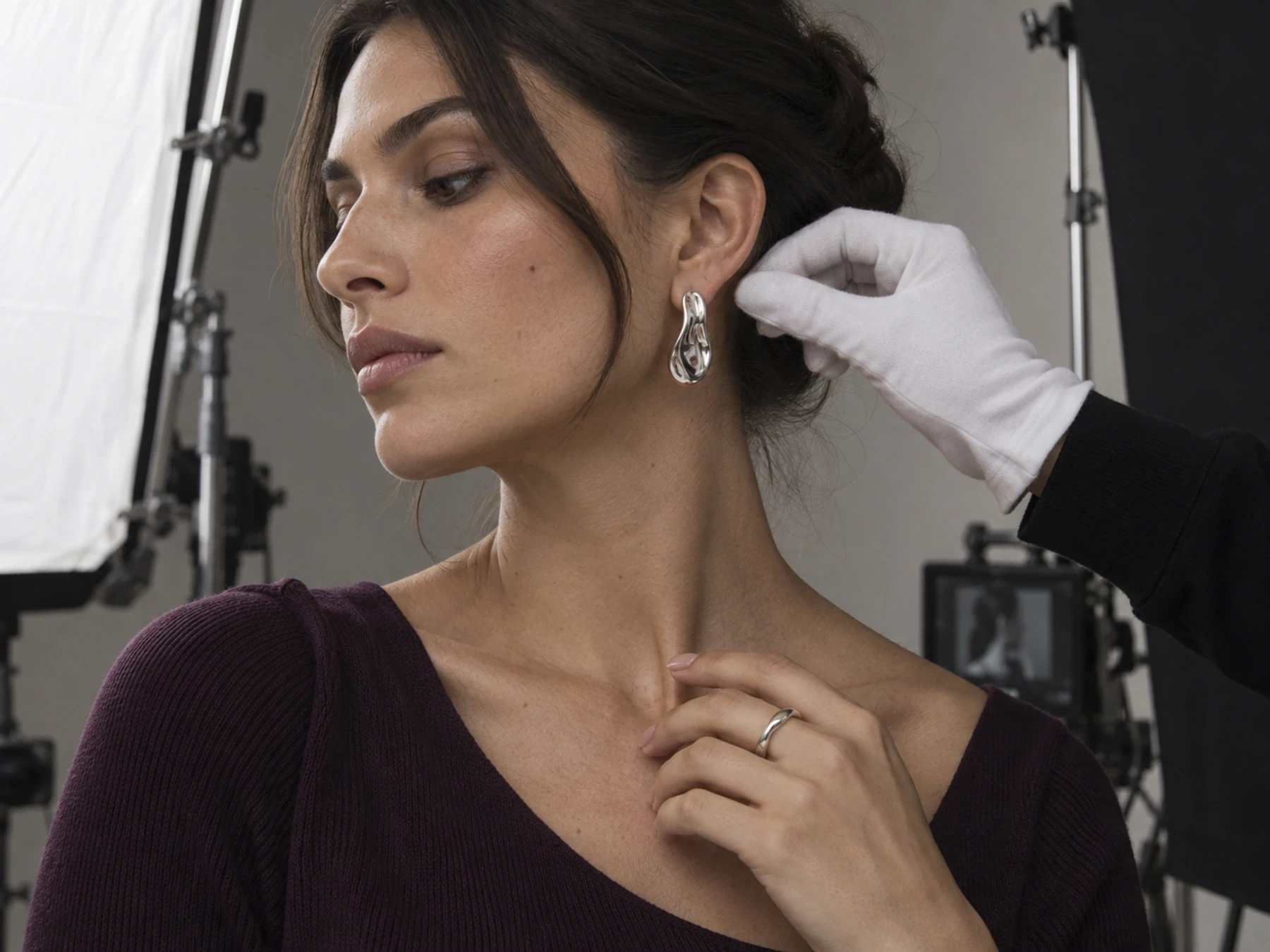
Conceptual illustration: a fictional on-model jewelry production scene, not a provider delivery, controlled result, or product-fidelity claim.
The route can differ within one collection. A brand might physically capture the packshot and macro evidence, use a controlled model shoot for a hero necklace, and test generated context for lower-risk social or campaign variations. The quote should preserve those boundaries rather than collapse everything into a claim that one method replaces the others. For a fuller in-house, studio, and hybrid decision, use the ecommerce photoshoot framework.
Use Look Atlas after the factual source is approved
Look Atlas is relevant after the product-truth work is defined. Its current jewelry page presents a workflow that starts from uploaded jewelry photos and creates on-model or clean studio contexts for rings, necklaces, and earrings. Use the approved catalog master as the source, direct the missing context, and compare each result back to the real piece before release.
The current monthly pricing page lists Starter at $49, Pro at $99, and Business at $399, with different credit, output, touch-up, and resolution terms. Those are subscription prices, not a jewelry price per image. Do not divide the Starter price by "about 40 photos" and present the result as a guaranteed unit cost. Rejected outputs, source preparation, human review, physical masters, and the chosen output mix still belong in the production calculation.
For the next quote, choose one representative SKU and complete its four-lane scope card. Price that exact assignment, mark every exclusion, and approve one test product through final files and rights before scaling the collection. A useful jewelry photography price is not a number found in isolation. It is a number attached to an image job you can inspect and accept.
