
How to Choose the Right Partner for High-Converting Product Image

1. Introduction: Why Ecommerce Brands Need Professional Product Imagery
In ecommerce, product images often determine whether a customer clicks on a listing or scrolls past it. Because shoppers cannot physically see or touch products online, visuals become the primary way brands communicate quality, design, and value.
High-quality product imagery helps brands build trust, highlight important details, and influence purchasing decisions. Clear photos show texture, color accuracy, and product features, helping customers feel confident about what they are buying.
For this reason, many online brands work with an ecommerce photography agency to produce consistent, professional images for product pages, advertisements, social media campaigns, and digital catalogs.
This guide explains what ecommerce photography agencies do, what their services cost, and how modern ecommerce brands scale visual production efficiently.
2. What Is an Ecommerce Photography Agency?
An ecommerce photography agency specializes in creating product images designed specifically for online stores and digital marketplaces.
Unlike general photography studios, ecommerce agencies focus on visuals that perform well on product pages, marketplace listings, and advertising platforms.
Typical services offered include:
Product photography
Model photography
Lifestyle product shoots
Photo retouching and editing
Catalog photography
Visual content for ads and social media
These agencies understand the technical requirements and visual standards needed for platforms like ecommerce websites, marketplaces, and digital advertising channels.
3. Why Product Photography Is Critical for Ecommerce Success
Product imagery plays a major role in several key ecommerce performance metrics.
Professional product photos can improve:
Click-through rates in search results and ads
Product page conversions
Brand perception and professionalism
Customer trust and confidence
Since customers cannot inspect products in person, images must clearly communicate important details such as size, texture, functionality, and overall quality.
Strong visuals reduce uncertainty and help shoppers feel confident enough to complete a purchase.

4. Services Offered by Ecommerce Photography Agencies
Ecommerce photography agencies typically provide several types of visual production services.
Product Photography
These are clean, studio-style images usually shot on white or neutral backgrounds. They are commonly used on marketplaces and product pages where clarity and consistency are essential.
Lifestyle Photography
Lifestyle images show products being used in real-world environments. These photos help customers imagine how the product fits into everyday life.
Model Photography
Model photography features products worn or used by models, which is especially important for fashion, accessories, and beauty products.
Product Retouching
Post-production editing improves visual quality by:
Enhancing colors
Removing imperfections
Adjusting lighting and contrast
Improving image clarity
Catalog & Campaign Photography
Large-scale photography projects are often created for seasonal launches, marketing campaigns, or product catalogs.
5. How Ecommerce Photography Agencies Work
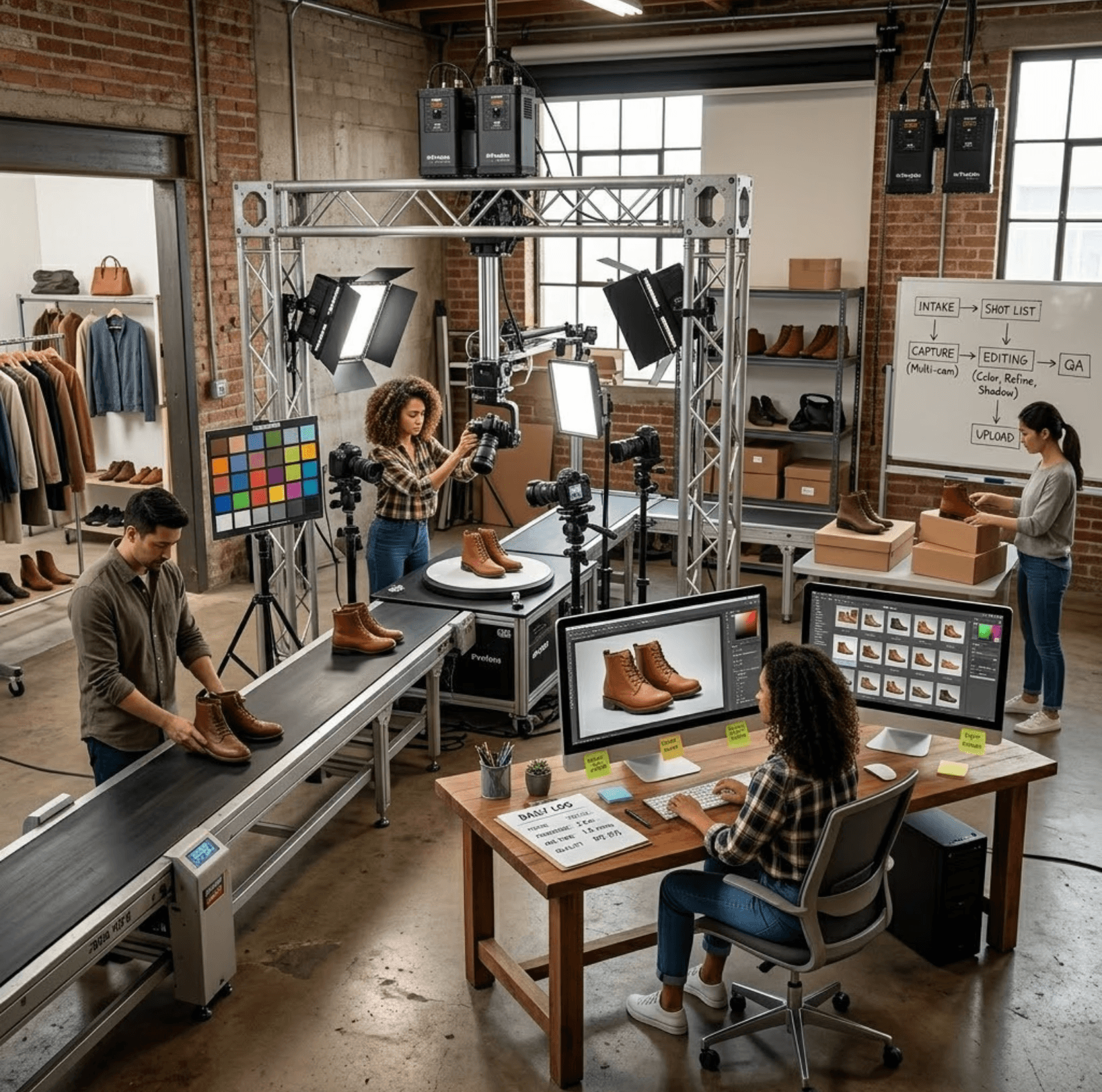
Most ecommerce photography projects follow a structured workflow designed to ensure consistent visual results.
Typical production stages include:
Creative planning and concept development
Shipping products to the photography studio
Photography sessions and shooting
Post-production editing and retouching
Delivery of final images
Depending on the size and complexity of the project, this process can take several days or even weeks before the final images are ready.
6. Ecommerce Photography Agency Pricing
The cost of ecommerce photography varies significantly depending on the complexity of the shoot, the number of products, and the level of editing required.
Common pricing models include:
Per Image Pricing
Many agencies charge $10 to $60 per image, depending on styling, editing, and retouching requirements.
Day Rates
Full studio shoots often use daily production rates ranging from $1,000 to $5,000 per day.
Model Photography
Shoots involving models typically cost $2,000 to $10,000 or more because they require additional coordination and production.
Additional costs may include:
Studio rental
Stylists and creative direction
Props and set design
Photo retouching
Model fees
For ecommerce brands launching large numbers of products, visual production costs can quickly increase.
7. Challenges Brands Face with Traditional Photography Agencies
Although professional agencies produce high-quality visuals, many brands encounter limitations when relying entirely on traditional photography.
Common challenges include:
High production costs
Long turnaround times
Difficulty scaling large product catalogs
Reshooting products for new colors or variants
Scheduling limitations for studio availability
As ecommerce catalogs grow, these challenges can make visual production slower and more expensive.
8. Scaling Visual Content for Large Ecommerce Catalogs
Modern ecommerce brands frequently launch hundreds of new products or variants every year.
Traditional photography production was not designed to support this level of scale.
To keep up with fast product launches, brands increasingly need:
Faster content creation
Consistent visual style across products
Flexible production workflows
Lower cost per image
These needs have led many companies to adopt hybrid visual production strategies.
9. The Shift Toward Scalable Visual Production
Instead of relying solely on studio photography, many ecommerce teams now combine traditional shoots with digital visual generation tools.
This approach allows brands to:
Produce more image variations
Launch products faster
Maintain consistent branding
Reduce production costs
It also allows marketing teams to create new images for ads, product pages, and social media campaigns without organizing new photoshoots every time.
10. Creating On-Model Visuals Without Booking a Studio
One of the most expensive aspects of ecommerce photography is producing model-based product imagery.
Traditional model shoots require:
Hiring professional models
Booking studio space
Coordinating stylists and photographers
Managing complex production logistics
These requirements significantly increase production time and costs.
Today, newer workflows allow brands to generate photorealistic model visuals directly from standard product images.
11. Tool Spotlight: Generating On-Model Product Visuals
Modern visual generation tools help ecommerce teams create on-model imagery without organizing a full photoshoot.
One example is Look Atlas, which allows brands to transform flat product photos into photorealistic images showing products worn by models.
Instead of organizing expensive productions, brands can upload a product image and generate visuals suitable for:
Product pages
Advertising campaigns
Social media content
Product catalogs
These tools preserve key product details such as logos, textures, and patterns, while allowing control over:
Model type
Lighting conditions
Background styles
For growing ecommerce brands, this workflow can dramatically reduce production time while maintaining professional visual quality. Try the Look Atlas to transform your product images into photorealistic model photos.

12. How to Choose the Right Ecommerce Photography Agency
Selecting the right agency is an important decision for ecommerce brands.
When evaluating agencies, consider the following factors:
Portfolio quality and style
Experience within your product category
Transparent pricing structures
Turnaround times for projects
Editing and retouching capabilities
Ability to scale production
The right partner can help maintain consistent visual branding across your entire product catalog.
13. Combining Agencies with Scalable Visual Tools
Many modern ecommerce teams now combine traditional photography agencies with digital production tools.
A typical hybrid workflow might look like this:
Agencies produce high-end hero campaign images
Internal teams generate additional product visuals
Digital tools create variations for ads and social media
This approach balances creative quality with operational scalability, allowing brands to produce more content without dramatically increasing costs.
14. Future Trends in Ecommerce Photography
The ecommerce photography industry is evolving quickly as technology improves visual production workflows.
Key trends include:
AI-generated product imagery
Automated background creation
Scalable model photography
Faster content production pipelines
Brands that adopt modern visual workflows will be able to launch products faster while maintaining consistent branding across multiple platforms.
15. Final Thoughts
An ecommerce photography agency plays an important role in producing professional product imagery for online stores. High-quality visuals improve customer trust, strengthen brand identity, and increase conversion rates.
However, as ecommerce catalogs grow and product launches become more frequent, many brands are combining traditional photography with scalable digital visual tools.
By understanding how ecommerce photography agencies work, and how modern production workflows are evolving, brands can develop visual strategies that support efficient content creation and long-term ecommerce growth.
