
Skincare Photoshoot: Plan the Truth Before the Props
A skincare photoshoot has three products to photograph at once: the package, the formula, and the claim the image implies. A polished frame can still fail if the dropper is wrong, the cream texture is misleading, or a visual cue suggests a benefit the approved copy cannot support.
The practical answer is to plan the shoot as a controlled image system. Lock the product record, assign every frame one job, and define what the set may change before anyone reaches for marble, water, leaves, or a model.
Start with three kinds of product truth
Most skincare briefs describe a mood before they describe the evidence. Reverse that order. Build one reference pack with the final sellable unit, current label artwork, accurate fill color, approved ingredient and benefit language, and a record of the package surfaces that must remain legible.
Then separate three truths:
Pack truth: bottle shape, cap, pump, dropper, label, fill level, net quantity, and color.
Formula truth: viscosity, opacity, finish, spread, bubbles, and the amount a real application uses.
Claim truth: the exact approved message for the destination, including what the image must not imply.
This matters because skincare props are not neutral. A medical-looking tray can imply clinical authority. A citrus slice can imply an ingredient. A dramatically wet face can imply a performance result. The frame needs the same claim review as the caption or ad copy.
Brief field | Release question |
|---|---|
Pack truth | Does every visible component match the sellable SKU and current label? |
Formula truth | Does the swatch show the real color, opacity, texture, and application amount? |
Claim truth | Could a reasonable viewer infer a benefit, ingredient, or result that is not approved? |
Image job | Which buyer question or channel need must this frame answer? |
Change budget | Which background, crop, prop, hand, model, or lighting choices may vary? |
The release board makes package, formula, claim, job, and allowed-change decisions visible before capture.
The FDA cosmetics labeling guidance is a useful reminder that labeling includes more than a pretty front panel. Claims must be truthful and not misleading, and therapeutic positioning can change how a product is regulated. This is not legal advice. It is a production reason to put the approved claim owner into preproduction.
Turn the mood board into a release board
A mood board says what the campaign should feel like. A release board says what the team must be able to approve. Keep both, but do not confuse them.
For each planned image, write the destination, crop, product state, formula state, permitted props, prohibited implications, and named approver. A white-background product-detail image needs a different release condition from a social crop with wet skin and reflective glass. If both are listed simply as “hero,” the team will debate taste when it should be checking facts.
Build the first release board around one difficult SKU. A clear serum bottle with small label type and a pipette gives you more information than the easiest opaque jar. It reveals whether the set, lens, reflections, retouch, and review process can preserve the details most likely to drift.
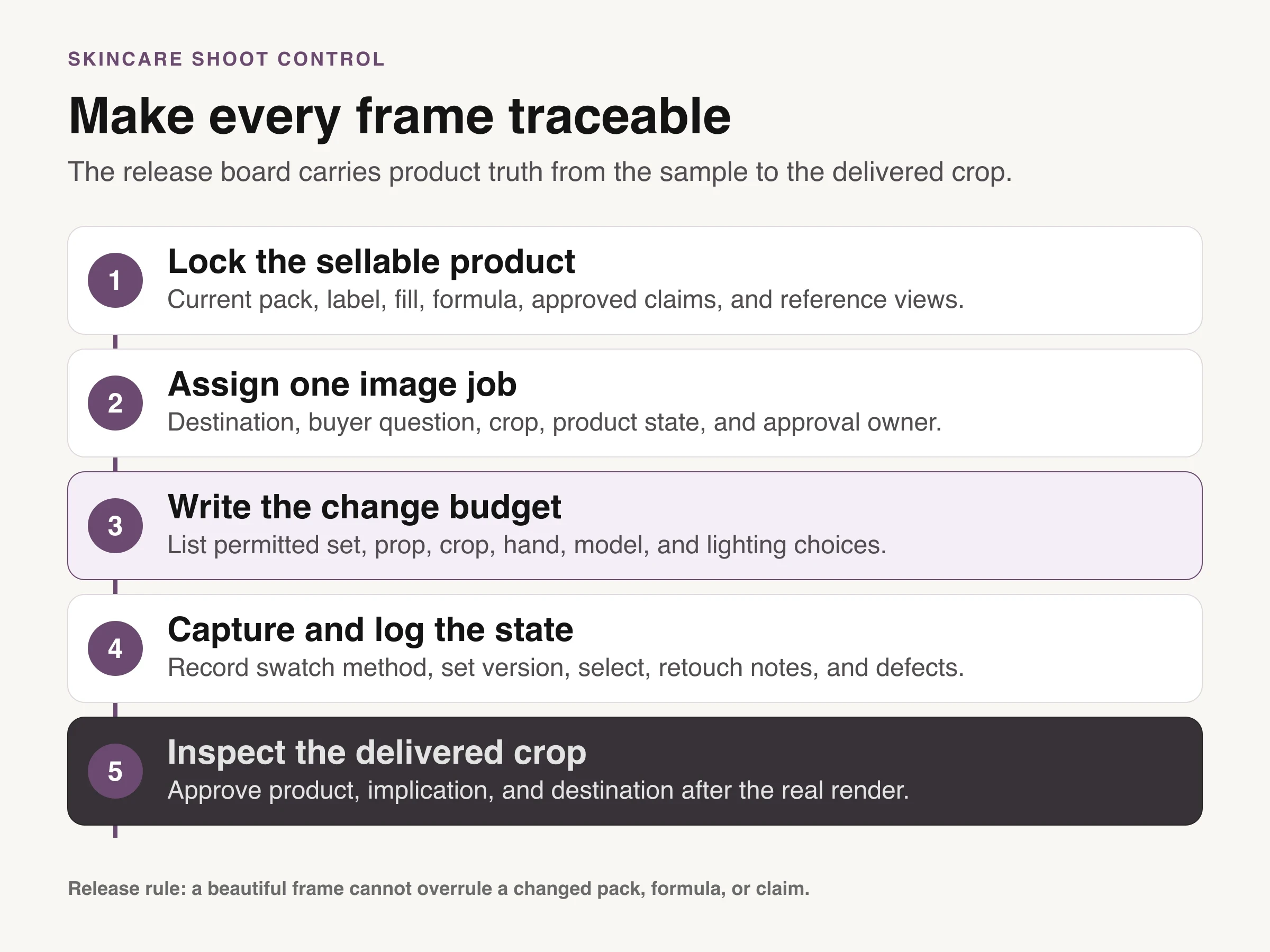
Look Atlas workflow: assign one owner and one observable release condition at each stage.
The five-step sequence above makes the handoff traceable. If a defect appears later, the team can locate whether it entered with the source product, the set instruction, capture, retouch, or channel derivative.
Design a shot system, not a pile of ideas
The useful unit is not “a beautiful skincare image.” It is a frame that earns a place in a buyer journey or campaign. Start with a compact image system:
A clean identification frame that shows the exact product and its scale.
A package-detail frame for applicator, closure, label, or material.
A formula frame that makes texture and amount legible.
A routine or usage frame with an honest action and plausible context.
A campaign frame with the strongest art direction and the widest change budget.
That sequence protects the factual core before creative variation begins. It also clarifies which shots can be extended later. A pack shot can become a reliable product reference. A campaign still may be useful for mood, but it is a poor source of truth if reflections hide the label or props cover the dispenser.
Use the broader guide to taking professional product photos for capture fundamentals. The skincare-specific layer is the formula and implication control described here.
Treat texture as a separate production lane
Serum, gel, cream, oil, balm, and foam behave differently under light. Do not ask one lighting setup to prove all of them. A hard sidelight can reveal a gel edge but make a cream look dry. A large frontal source can make packaging elegant while flattening a translucent smear.
Create texture swatches immediately before capture and record the application method: pipette drops, spatula amount, finger spread, waiting time, and surface. Replace a swatch when it skins over, separates, collects dust, or no longer resembles normal use. If a cosmetic sample is substituted for the marketed formula, the frame must be labeled internally as a styling reference and reviewed before release. Do not silently present a surrogate as the product.
For on-skin frames, define what is documentary and what is styled. Retouch may remove a temporary capture distraction, but it should not manufacture a result, erase a material skin feature to imply efficacy, or turn a controlled lighting highlight into evidence of a product benefit.
Keep pack, scene, and claim rules visible at review
Creative review tends to enlarge mood and shrink compliance. Put the three release surfaces into the same review view so the team sees the trade-off.
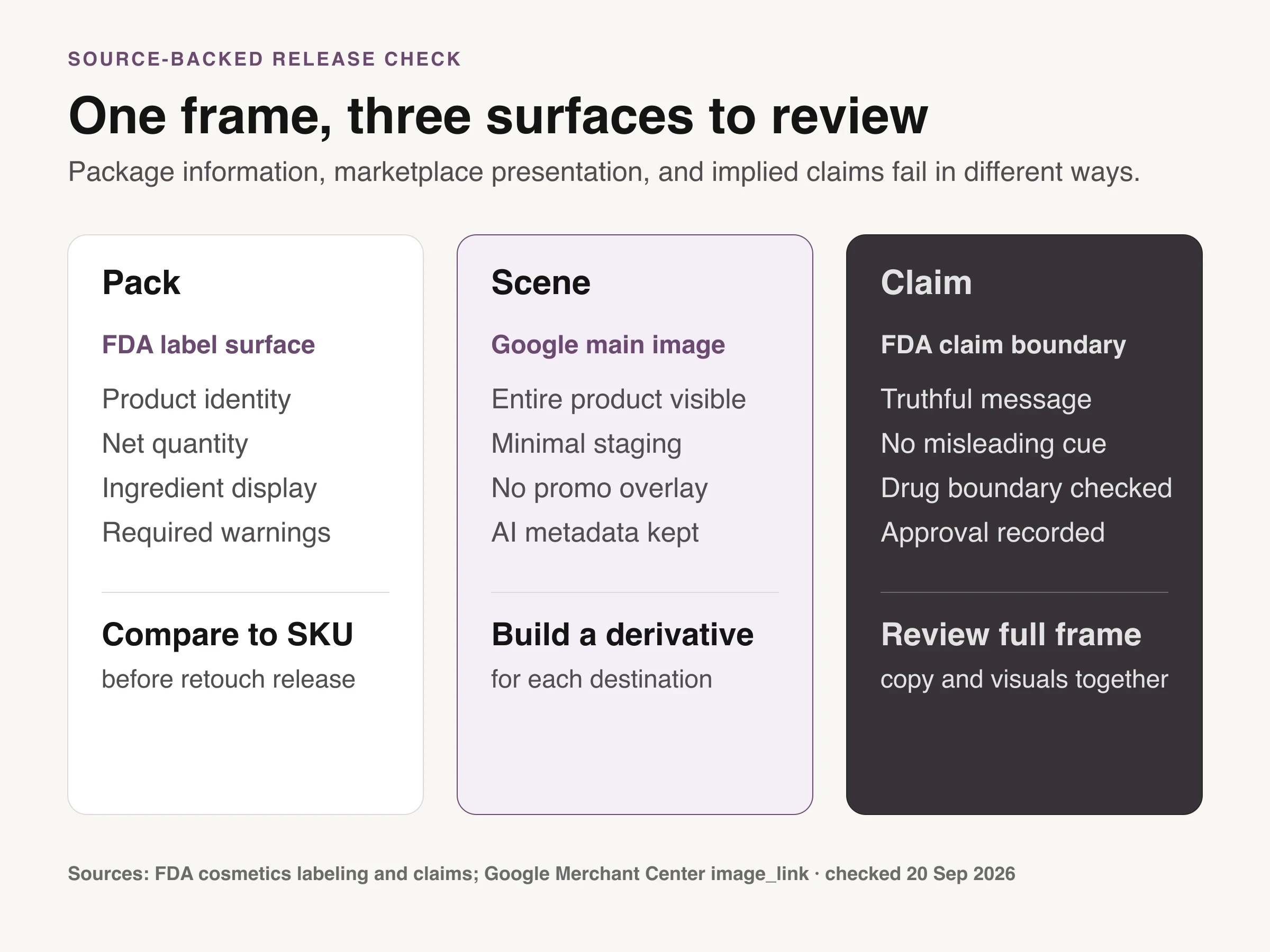
Sourced chart: FDA labeling and claims guidance plus Google Merchant Center image rules, checked September 20, 2026. Requirements vary by market and destination; recheck before release.
The sourced chart does not say that every skincare image must be a white-background marketplace frame. It shows why one campaign master cannot be exported everywhere without inspection. Google Merchant Center asks the main product image to display the entire product with minimal or no staging and prohibits promotional overlays. The FDA separately treats label and claim accuracy as regulated product information. The destination and the message both shape the release decision.
For every select, review at actual delivery crops. A label that is technically present can become unreadable in a square thumbnail. A dropper that looks attached in the wide master can appear to float after a vertical crop. A hand placed safely for social may cover the net quantity on a product-detail derivative.
Use three passes:
Product pass: compare the container, closure, label, fill, and formula with the reference pack.
Implication pass: ask what ingredient, result, authority, or use case the complete frame suggests.
Destination pass: inspect the exact square, portrait, banner, and product-page renders, not only the retoucher's master.
Decide what belongs on set and what can be extended
Capture physically what must be factual, difficult to reconstruct, or legally sensitive. That usually includes the approved product unit, label detail, true formula texture, applicator behavior, and any human-product interaction used as evidence of real use.
Digital or generated extensions can be useful for controlled background and campaign exploration after those anchors exist. Look Atlas is relevant in that extension lane: an ecommerce team can begin with approved product imagery and direct studio, lifestyle, campaign-style, or product-on-model visuals. Every proposed output still needs review against the exact SKU and approved claim boundary.
The safe division is simple. The source photography owns product truth. The extension brief owns the allowed scene changes. A reviewer owns release. Check current Look Atlas plans when scoping the workflow rather than freezing price or plan details into a production standard.
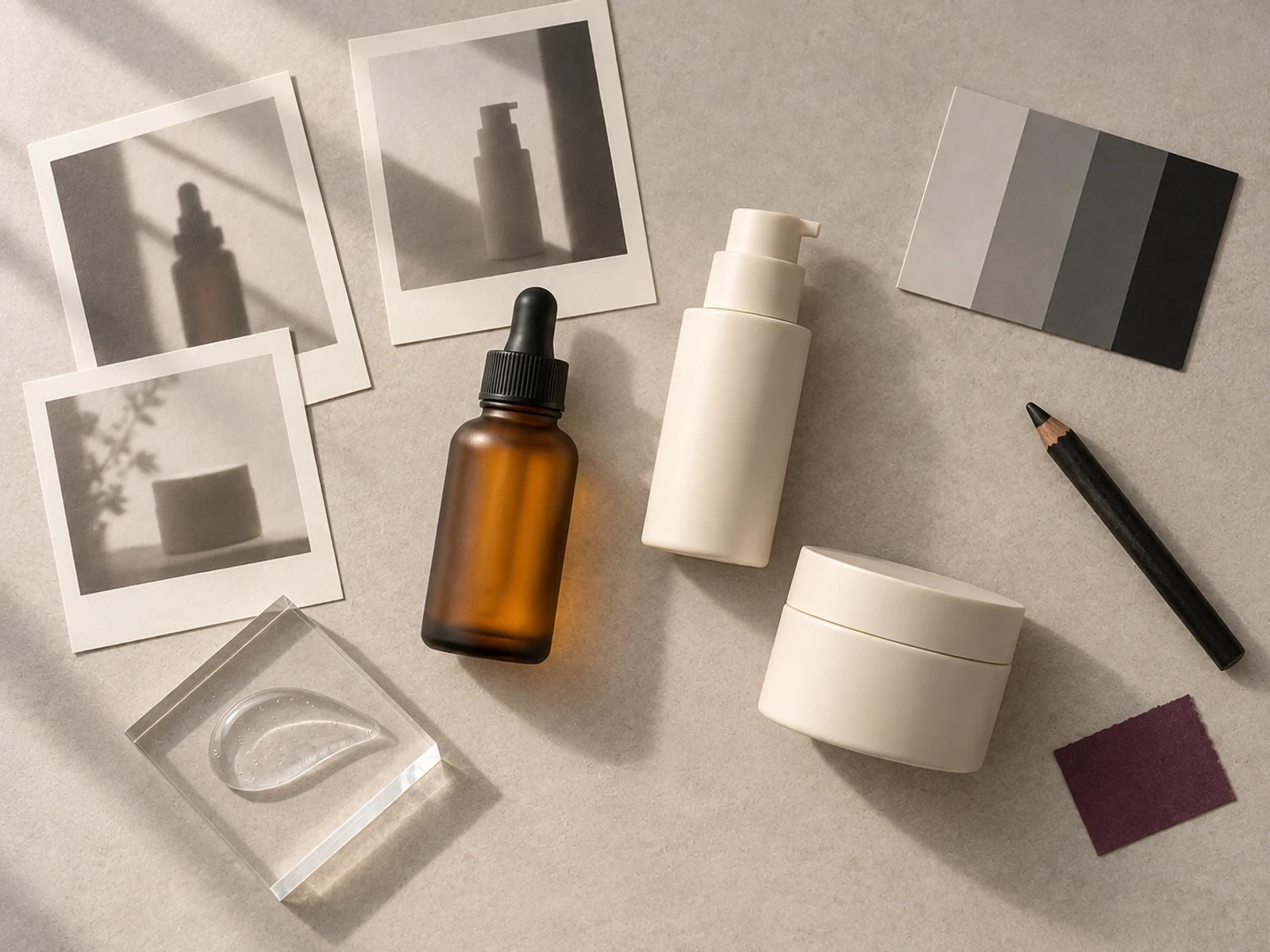
Conceptual illustration: a fictional set-review table, not a real SKU, photoshoot, customer asset, controlled comparison, or proof of product performance.
The conceptual review scene is deliberately unbranded. In a real production, each contact sheet should point back to the exact SKU, brief version, capture date, and approver. That record matters more than a folder named “final.”
Finish with a six-frame pilot
Do not validate a new skincare visual system across the whole range. Use one difficult product and six frames: clean identity, label detail, formula close-up, application context, one campaign still, and one channel crop. Include the smallest label type, most reflective surface, and most claim-sensitive setup you expect to use.
Release the system only when the six frames stay accurate as a set. The pack should look like one product, the formula should behave consistently, the implied claims should match approved language, and every channel derivative should survive its real crop. If one frame fails, fix the stage where the defect entered instead of polishing the symptom downstream.
A skincare photoshoot is ready when the creative idea and the product record can coexist in the same frame. Plan that agreement first. The props can come second.
