
Product Photography Cost per Image: The Real Quote Math
The three provider examples below advertise different product photography price structures, from per-photo tiers to booking fees and session rates. These selected offers do not establish a market average, and a headline rate is not a dependable budget by itself. Styling, booking fees, retouching, shipping, rush delivery, models, licensing, and rejected frames can change the effective price before one image reaches a product page.
The useful number is landed cost per approved image: every required production cost divided by the files that pass review and are ready for their intended channels. That denominator turns unlike quotes into something an ecommerce team can compare.
Treat each advertised offer as a scoped example, not a promise. Product type, volume, location, creative complexity, crew, and usage all change the job. A reflective watch, a folded T-shirt, and a location lifestyle frame are three different production problems even when a quote labels each one “one image.”
Turn every quote into the same two-column budget
Do not begin by comparing the bold number. First rewrite each quote so the same production obligations sit on the same rows. If a studio includes a service, record it as included. If the quote is silent, mark it confirm, not zero.
Shopify's current product photography pricing guide identifies experience, shot type, equipment, location, scope, editing, and turnaround as price drivers. A usable ecommerce comparison also needs product handling, casting or styling, rights, revisions, exports, and the approval denominator.
Quote line | Normalize it as |
|---|---|
Capture | Per image, per product, hourly, or day rate; include minimum booking |
Product handling | Inbound and return shipping, assembly, cleaning, steaming, storage |
Set and people | Studio, location, props, stylist, assistant, model, hair and makeup |
Post-production | Included edit level, clipping, compositing, color work, revision rounds |
Rights and delivery | Channels, territories, term, exclusivity, file sizes, crops, source files |
Approval denominator | Number of files expected to pass product, brand, and channel review |
A quote is comparable only when capture, handling, set, post-production, rights, delivery, and the approval denominator use the same definitions.
Send that table back with the request for quote. A supplier can price an explicit scope more accurately, and your team can see which apparent saving is simply an omitted obligation.
Divide by approved images, not delivered candidates
The camera may produce hundreds of frames and the studio may deliver forty selects. Neither count describes the inventory your brand can use. The denominator should be the images that pass four checks: correct product, correct creative treatment, correct channel specification, and cleared rights.
Use this equation:
landed cost per approved image = all required job costs ÷ approved channel-ready images
Consider a clearly hypothetical job with $1,500 in capture, styling, retouching, shipping, and handling. If forty candidates are delivered, the superficial unit cost is $37.50. If thirty pass release, the useful cost is $50. The ten rejects still consumed budget even though they never became commerce assets.

Look Atlas editorial method: the values are hypothetical. Replace every cost and approval count with your own quote and pilot data.
This calculation is not an argument for the highest keeper rate at any price. It is a way to expose where the budget leaks. If most rejects fail because a required back view was missing, fix the product photography shot list or brief. If they fail because glass reflections vary from SKU to SKU, the lighting and retouching scope may be underpriced. If a channel crop is missing, make the export set part of delivery rather than an emergency after the shoot.
Three published rate cards show why the headline needs context
Public rates are useful when you read the service boundary beside the price. They are not a universal average and they should not be used to rank providers whose work has not been reviewed.
As of 9 November 2026, Squareshot’s website says the studio is closed. Its September figures below are historical examples of how a quote can be structured, not currently bookable offers.
In the provider pages captured on 7 September 2026, ProductPhoto publishes on-white rates of $40 per photo for one to ten photos, $35 for eleven to fifty, and $30 for fifty-one or more. Soona lists $39 per selected photo and a $149 per-booking Studio Pass for the nonmember option, plus premium edits at $9 or more. Squareshot lists product shoots from $50 per image or $750 for two hours, alongside separate add-ons including transparent backgrounds and recoloring.
Those numbers answer different questions. Ten selected photos at Soona's listed nonmember Studio Pass terms would begin at $539 before premium edits or other services, which is $53.90 per selected photo. ProductPhoto's one-to-ten on-white tier is already expressed per delivered photo. The historical Squareshot card offered either a per-image starting point or a short-session price. None of those facts tells you how many files your own team will approve.
Use published pricing as a scope probe. Ask why the volume break exists, which edits qualify as standard, whether the fee applies to images ordered or images delivered, and what makes the starting price rise.

ProductPhoto on-white rate card captured 7 September 2026, plotted on one dollar-per-photo scale. Volume tiers describe this provider and service, not a market average or quality ranking.
Fixed fees become cheap only when the batch is genuinely repeatable
A fixed booking, setup, or art-direction fee behaves like a shared cost. Spread a $300 setup across six approved images and it adds $50 to each. Spread it across sixty and it adds $5. That arithmetic makes batching attractive, but only when the products can share a setup without weakening the result.
Group SKUs by production behavior, not just collection name. Matte packages that share a crop and shadow can often travel together. Reflective metal, translucent glass, textured black fabric, and products that require assembly may need separate light, handling, or retouching lanes. Forcing them into one fast batch can lower the quoted capture rate while raising rejection and correction work.
Volume discounts are valuable when repetition is real. Before accepting one, ask for the assumed number of products per setup, angles per product, styling changes, approval checkpoints, and final files. The unit price should fall because repeated work has been removed, not because required work has gone unnamed.
Usage rights and revision rules belong in the cost calculation
Receiving a file does not automatically answer who owns the copyright or where the photograph may be used. The U.S. Copyright Office's guidance for photographers says the photographer is generally the author and initial copyright owner unless the work qualifies as work made for hire. Contracts and local law matter, so the commercial rights need to be written rather than assumed.
Ask the quote to state permitted channels, territories, duration, paid-media use, marketplace use, packaging, retailer syndication, exclusivity, and whether the brand receives layered or source files. This is not legal advice. It is production hygiene that prevents a cheap image from becoming expensive when a new use was never licensed.
Revision language needs the same precision. “Retouching included” can mean global cleanup, one standard pass, or a tightly limited list. Define what counts as a correction, what counts as a new creative direction, who consolidates feedback, how many rounds are included, and what happens when the product sample or original brief was wrong.
Use Look Atlas for controlled variation, not as a fake studio quote
A hybrid workflow can separate documentary product capture from selected visual variations. Photograph or approve the source that owns product truth, then use Look Atlas to direct studio, lifestyle, on-model, or campaign-oriented imagery where the source pack and human review can support the transformation.
The cost model stays the same. Include the source capture, tool plan, internal direction time, rejected outputs, human review, retouching, and approved files. Do not call every generated output a usable image, and do not promise savings before measuring your own approval rate.
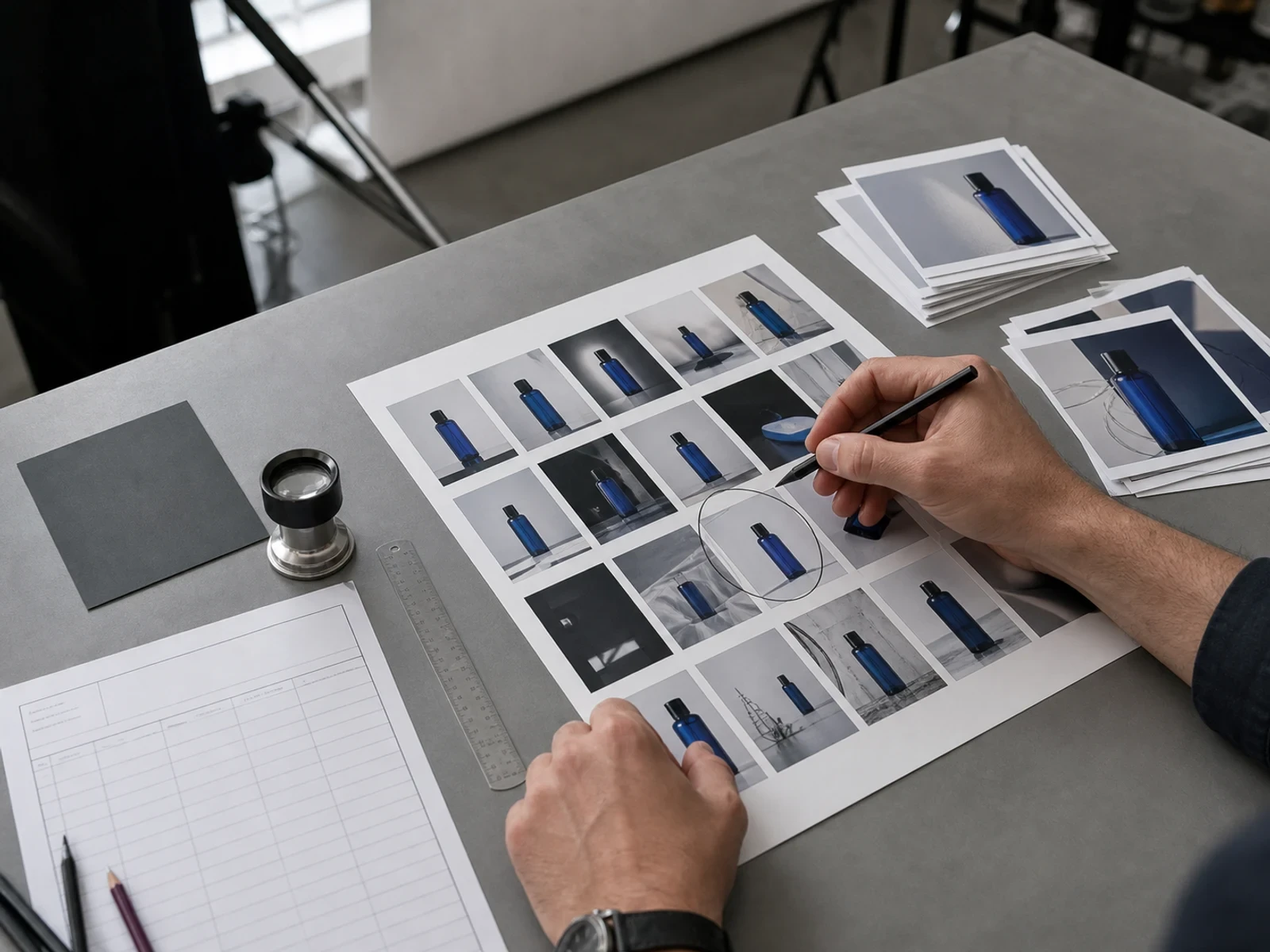
Conceptual illustration: a producer marks an approved candidate during a fictional review. It is not a paid job, measured approval rate, provider output, or Look Atlas result.
The current Look Atlas pricing page is the right place to verify plan terms when you build the estimate. Keep changing prices and allowances out of the production brief. For capture fundamentals that improve either a physical or hybrid source set, use the guide to taking professional product photos.
Generated variation is a poor substitute for missing product evidence. If construction, texture, scale, fastening, or color is not visible in the source, return to capture. The approved-image denominator should reward truthful, channel-ready assets, not visual novelty.
Match the pricing model to the uncertain part of the job
Per-image pricing works well when the output is standardized: a known background, repeatable crop, stable product class, and written edit standard. It gives the buyer a clean deliverable count and gives the studio an incentive to make production efficient.
Per-product pricing can work when every SKU receives the same small gallery. Confirm the angle count and whether color variants, group images, detail frames, and packaging views count as separate products.
Hourly or day pricing fits exploratory styling, on-model work, location production, and campaigns where the team is buying coordinated access to people, equipment, and a set. It shifts throughput risk toward the buyer, so define the shot priority and approval moments before the clock starts.
Project pricing is often clearest when one fee covers a specified campaign, but only if the estimate still itemizes assumptions. A single total with no deliverable definition is not simplicity. It is postponed negotiation.
Reconcile the quote in twenty minutes
Choose one representative SKU, preferably the hardest one in the batch. Write the required images and destinations, then normalize every quote against the two-column table. Calculate three numbers: total required cost, expected approved files, and landed cost per approved image.
Next, mark every unknown that could change the total: handling, setup changes, talent, retouching level, revisions, rights, rush, delivery formats, and sample return. Ask each supplier to confirm the same list in writing. Keep the portfolio and process review separate from the arithmetic, because the lowest normalized quote can still be the wrong visual partner.
The decision is ready when another teammate can see what one “image” includes, which costs remain variable, what approval means, and which party owns each risk. That is the unit price worth using in a budget.
