How to book product photography and confirm what happens next
To book product photography, send a defined job to a suitable photographer, reconcile the proposal with the images you need, and get written confirmation of what reserves the shoot and starts delivery. An enquiry, a quotation and a confirmed production slot are different events. Your launch plan needs to know which one has actually happened.
This guide covers commissioning photography for ecommerce products, rather than photographing books. It starts after you have a plausible supplier in mind and ends with a booking another teammate can manage without searching through your messages.
Ask what the booking button actually commits
Before submitting a form, identify the service you are buying. A studio rental can provide space and equipment without supplying the photographer, styling or finished images. A full-service product shoot can include some of those responsibilities, but the proposal needs to say which ones. Do not infer a production team from photographs of a well-equipped room.
Supplier processes differ. ProductPhotography.com says starting a project creates an order number without an obligation or immediate payment; the project enters its production queue after planning, quotation and payment. Prospect Street Studio describes an initial conversation followed by recommendations and next steps to secure the project. Neither description makes a first enquiry equivalent to a completed shoot booking.
Ask the supplier to confirm these points before your team treats the date as committed:
Booking question | Confirmation to keep |
|---|---|
What have we reserved? | Named service, shoot date or production window, and whether it is a hold or confirmed. |
What makes it confirmed? | Required agreement, payment or other event, plus who confirms receipt. |
What must arrive first? | Accepted samples, approved brief, props and any other dependencies with deadlines. |
When will we receive usable files? | Delivery milestone, the event that starts the clock, and any approval or edit stages before it. |
What happens if the job changes? | How to approve changed scope, reschedule, cancel or request extra work under the supplier's terms. |
Keep the supplier’s actual answers with the booking. These questions are planning guidance, not contract interpretation.
Read the relevant terms before accepting them. These questions organize a booking conversation; they do not replace the supplier's agreement or determine what a particular contract means.
Make the proposal describe the same job you described
Attach a version of your product photography brief and shot list to the enquiry. The brief settles the creative and acceptance decisions; the shot list identifies the required images. The booking should refer to those versions so a later revision cannot silently change the job.
Then check the quote's unit. “Ten products” does not tell you whether you are buying ten images, several views of each item, or a period of studio time. Ask which outputs count as separate chargeable images and which are included exports. A square crop of an existing frame and a newly photographed back view should not be left under the same unexplained “extra image” label.
Optional services deserve an explicit answer too. On its public pricing page, ProductPhotography.com separately lists transparency, ghost-mannequin and hand-modeling additions. The chart shows that one provider's published add-on amounts, checked on October 28, 2026. They are not total shoot prices or market averages.
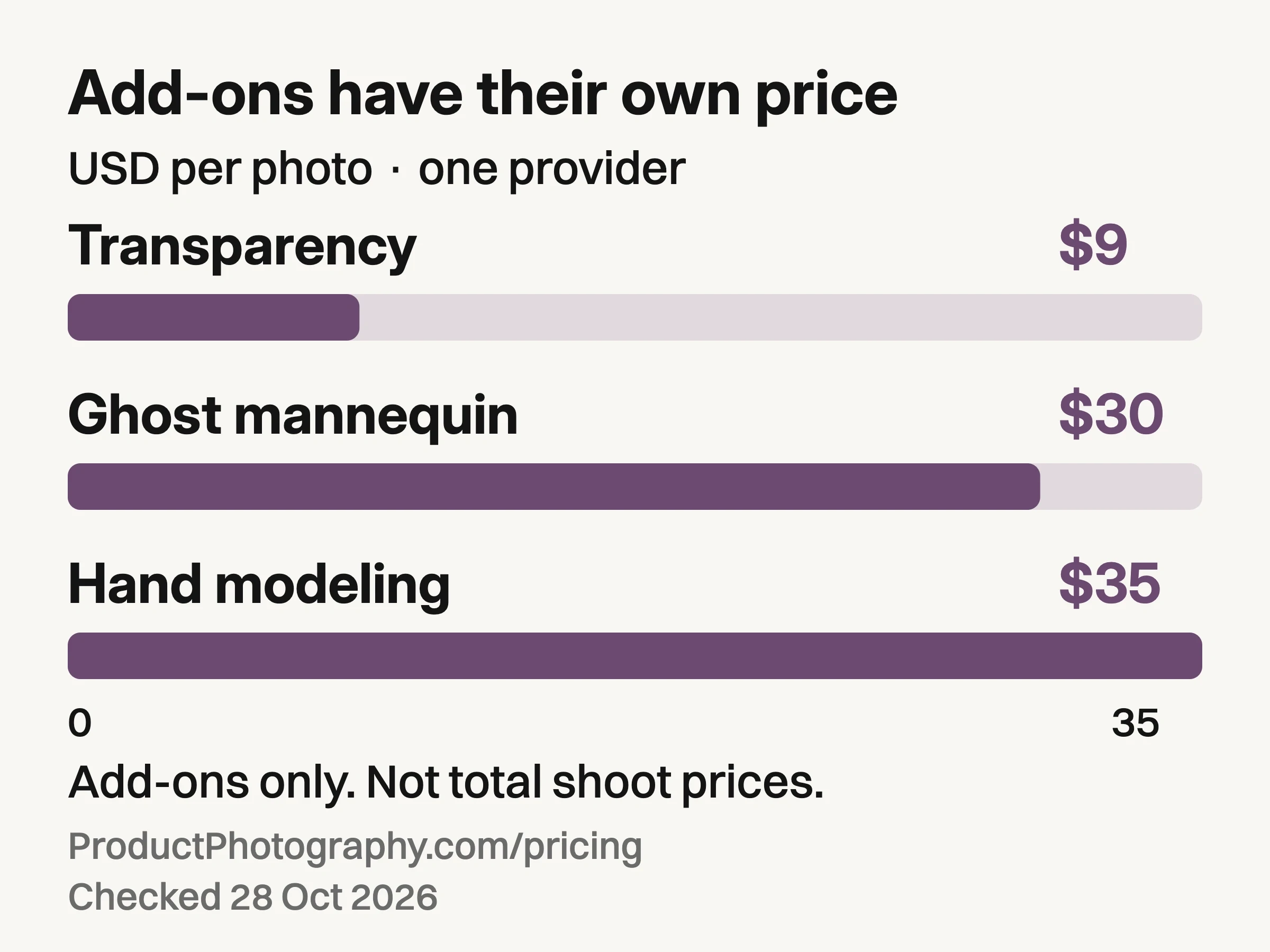
ProductPhotography.com published add-ons, checked October 28, 2026: transparency $9, ghost mannequin $30 and hand modeling $35 per photo. One provider only; not total shoot prices, a combined package or a market average. Confirm your own quote.
You do not need those three services on every job. Their value here is evidential: a published per-photo service can still have separately priced work. Mark each requirement as included, separately quoted or unnecessary before comparing totals. If a quote is silent about a needed task, ask; silence is not a zero-cost line.
Keep the discussion concrete. “We need the bag shown open with a hand lifting the flap” lets the producer identify talent, handling and retouching work. “Please include everything” does not.
Wait for shipping instructions, then send a verifiable sample kit
A shipping address is not permission to send an unannounced box. Squareshot's process says not to ship before the proposal is accepted. It also describes checking delivered items against the proposal before invoicing. Follow the chosen supplier's actual sequence rather than assuming every studio works this way.
Obtain the correct destination, contact, job reference and receiving window. Confirm any special arrangements for fragile, oversized, perishable or assembled products before dispatch. List the exact variants and included parts inside the parcel, and keep photographs of what you packed. Those records help distinguish a missing accessory from an accessory the team never intended to include.
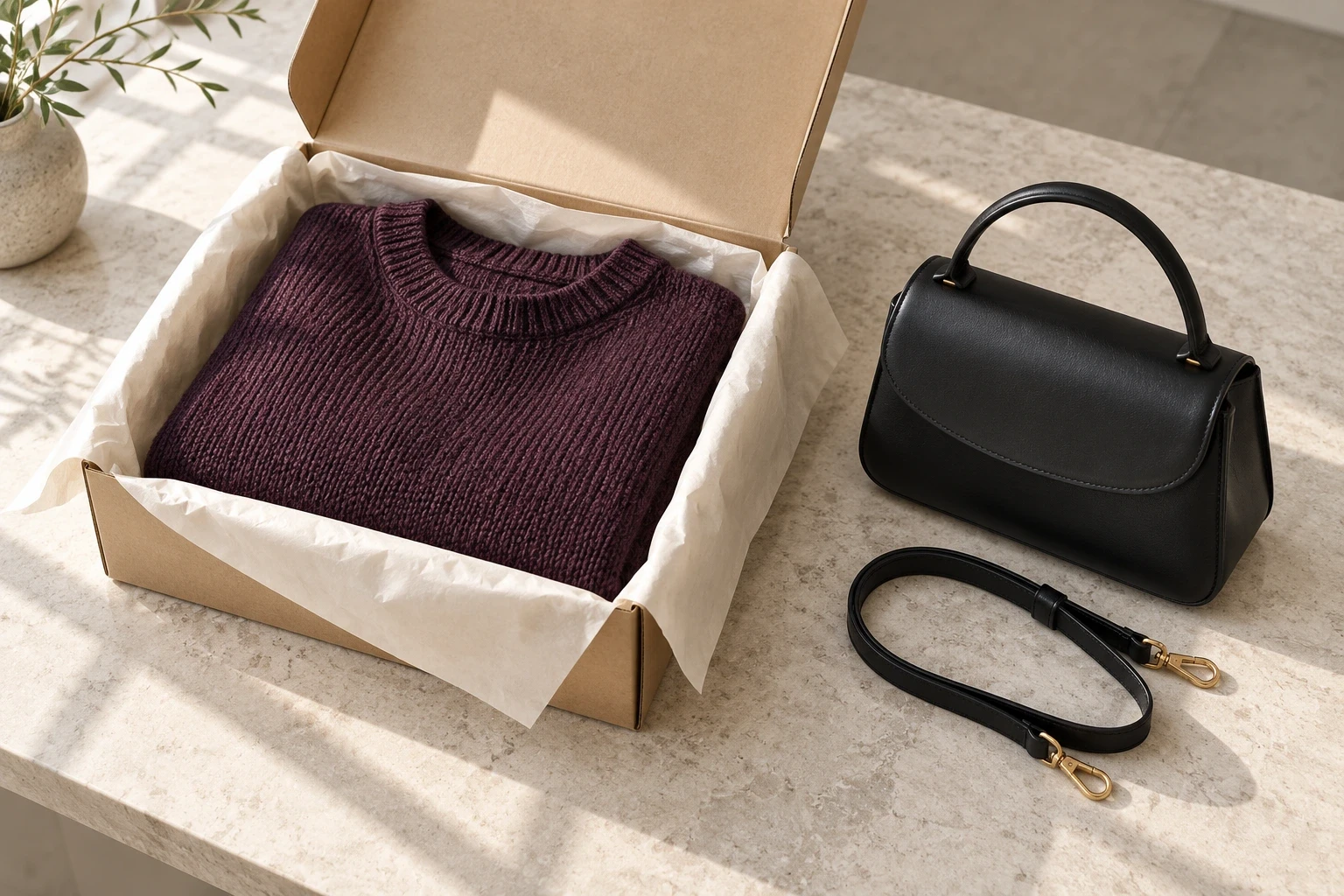
Conceptual illustration: a separate fictional sample-kit arrangement. Record the actual products and included parts in your own shipment.
Ask the receiving team to confirm both arrival and readiness. A tracking status can establish that a carrier delivered a parcel; it does not establish that the correct colorway is inside, the sample is undamaged, or the brief's required strap has arrived. If something is missing, record who will supply it and whether the shoot can proceed without that part.
Arrange the return, storage or disposal of samples before they disappear into a studio cupboard. Request the supplier's process and any associated charges; do not assume the return is included. When the project uses a unique prototype, make the handoff and return responsibilities particularly explicit.
Put the delivery clock beside its starting event
“Ready in a few days” is incomplete without “after what?” The relevant event might be payment, accepted samples, the shoot, selection of images or approval of edits. Ask for the delivery stage that matters to your launch: proofs to select, retouched masters or final channel-ready files.
For example, soona's checkout guide puts image selection, optional premium edits and order placement after the shoot. Its stated edit-delivery period appears at that checkout stage. The useful lesson is the dependency, not a promise that your whole project takes the same amount of time. Confirm the current commitment for your actual order.
Work backward from the date your ecommerce team needs accepted files. Leave explicit time for your own review and requested corrections, product-page upload and a final display check. Ask whether the supplier counts business or calendar days and what happens when your approver replies late. A calendar reminder cannot compensate for an unassigned approver.
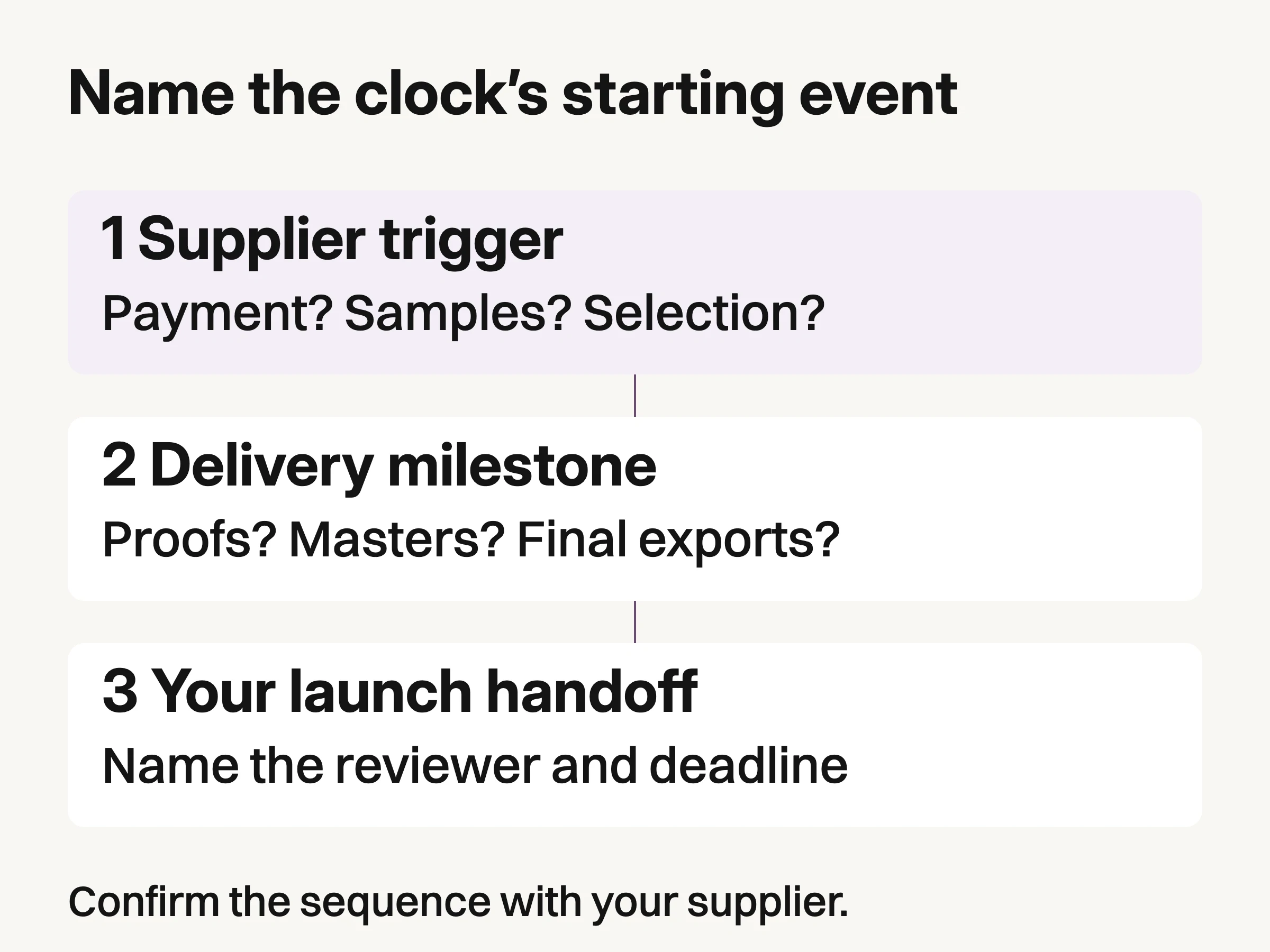
Attach the promised date to a named starting event and delivery stage. Confirm the actual sequence with your supplier.
Send one confirmation that closes the loose ends
Use a short message to connect the agreed documents and dates. The following is a template to complete with the supplier, not a record of a real booking:
Please confirm the booking for [job reference] against brief [version] and shot list [version]. We understand [event] confirms [shoot date or production window]. Samples must be accepted by [date], with receipt confirmed by [person]. Delivery means [proofs, retouched masters or final exports] by [date], measured from [starting event]. [Name] will approve selections and feedback. Please identify any excluded work, outstanding dependencies, and the agreed process for changes and sample return.
If the reply introduces a new dependency, put it into the schedule before circulating “shoot booked.” For example, a model approval still outstanding can affect the production plan even if the product box is already at the studio.
A physical shoot and generated campaign work can also have separate scopes. Look Atlas creates product-on-model, studio and campaign-style imagery from product photos. If that is part of your plan, commission the source photographs you need and identify the later generated deliverables separately. Check current Look Atlas plans for the applicable product offering; this guide assumes no particular price or allowance. Keep documentary product views where accurate physical detail is required.
For capture fundamentals before commissioning that source work, use the professional product photography guide. For this booking, the immediate finish line is a supplier's confirmation that a teammate can act on: the job, its reservation status, the next dependency and the promised delivery event.
