
Product photography brief: a template that settles decisions
A product photography brief should let another person make the right production decisions without reconstructing your intentions from messages. It needs to identify the products, image uses, creative boundaries, deliverables, approval owner, and unresolved questions. A mood board and a list of angles leave too much of that work unfinished.
Consider a simple disagreement: the photographer thinks the bag campaign needs a hand in frame; merchandising needs the closure visible. Both can follow the same reference and still deliver different answers. The brief has to settle which requirement wins, or assign separate images to the two jobs.
Put the job on one page before listing the frames
Start with the business task, not a camera instruction. “Refresh the tan bag product page and make one campaign image” tells a producer more than “shoot premium lifestyle.” Add the included variants, exclusions, destinations, decision maker, delivery date, and links to the current product record and style references.
Then keep the documents in their proper roles. The brief records decisions for the job. The product photography shot list turns them into individual outputs. The agreement holds the commercial terms. A reference board communicates visual direction. Link them using versions instead of duplicating everything inside the brief.
For any requirement likely to cause a disagreement, write a decision receipt: the requirement, the evidence that explains it, the person who decides, the observable pass condition, and the change that would reopen it. This is a Look Atlas planning method, not a claim that a particular document format prevents every reshoot.
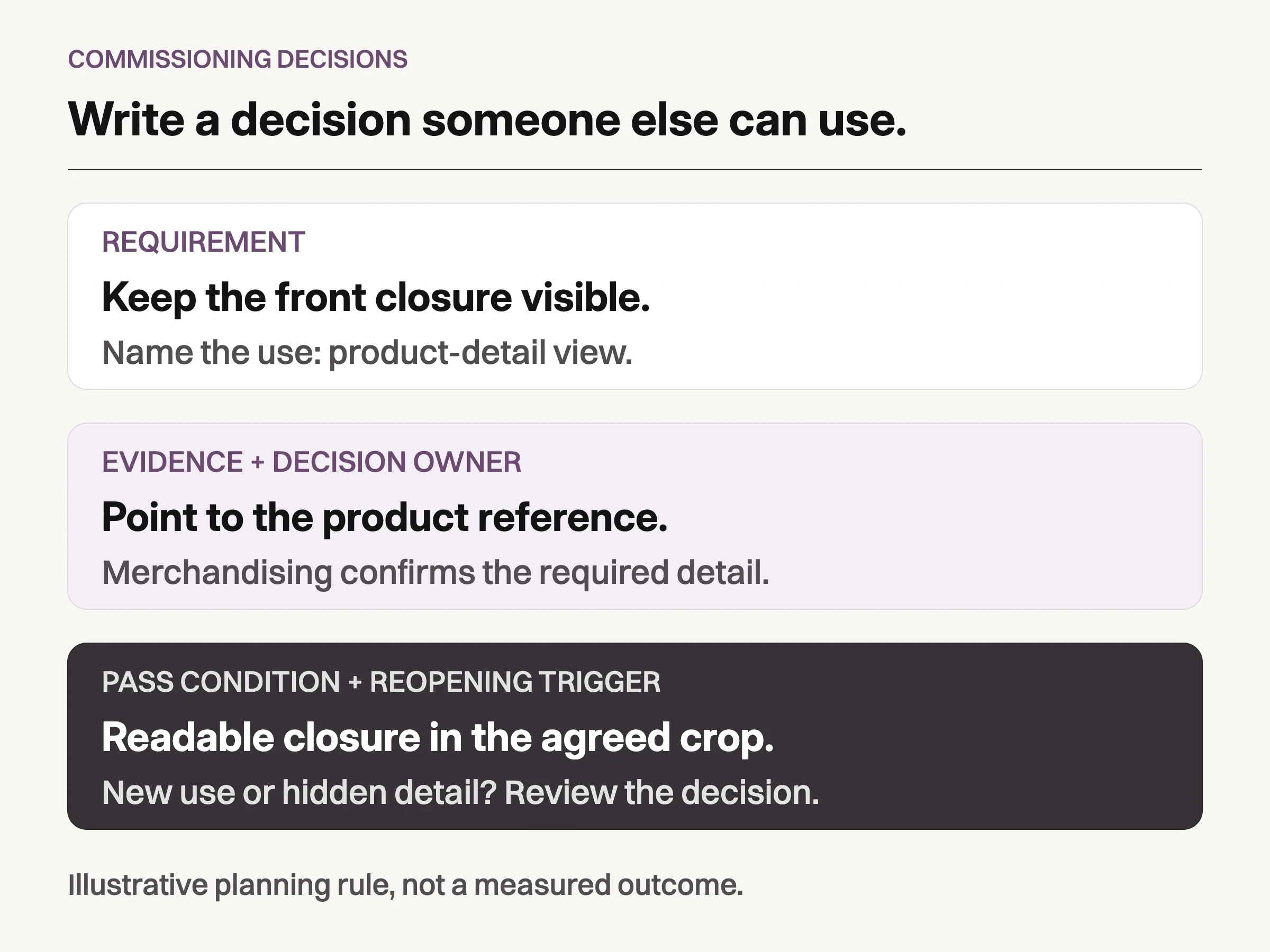
Look Atlas planning method: make the requirement, evidence, owner, pass condition, and reopening trigger explicit.
Replace a mood-board adjective with an acceptance test
“Soft light” can become “keep the front clasp readable without a hard reflection across it.” “Consistent” can become “use the same approved crop reference for the collection thumbnails.” Keep the reference image, but state the feature you want to borrow and the features you do not want to copy.
Distinguish a requirement from a preference. The clasp being visible may be mandatory for the product-detail image. A hand position may be optional in the campaign frame. If both are mandatory in one image, the producer needs a reference or test frame showing that they can coexist.
Delivery needs the same precision. Name the destination, aspect ratio, format, approved color workflow, naming pattern, and recipient. Shopify's product-media guidance explains that image display depends on the theme. That makes a crop checked in your actual product template more useful than a universal “best size” copied from another store. Adobe's export documentation likewise treats naming, format, and sizing as distinct choices. “High-resolution files” does not settle them.
A bag reference shows why one brief needs two image jobs
The retained Look Atlas onboarding pair below makes the conflict visible. In the source, the front buckle and coiled strap are available for inspection. In the generated context, a person's hand covers part of the upper-right bag area. The context tells a styling story, but it cannot answer every construction question.
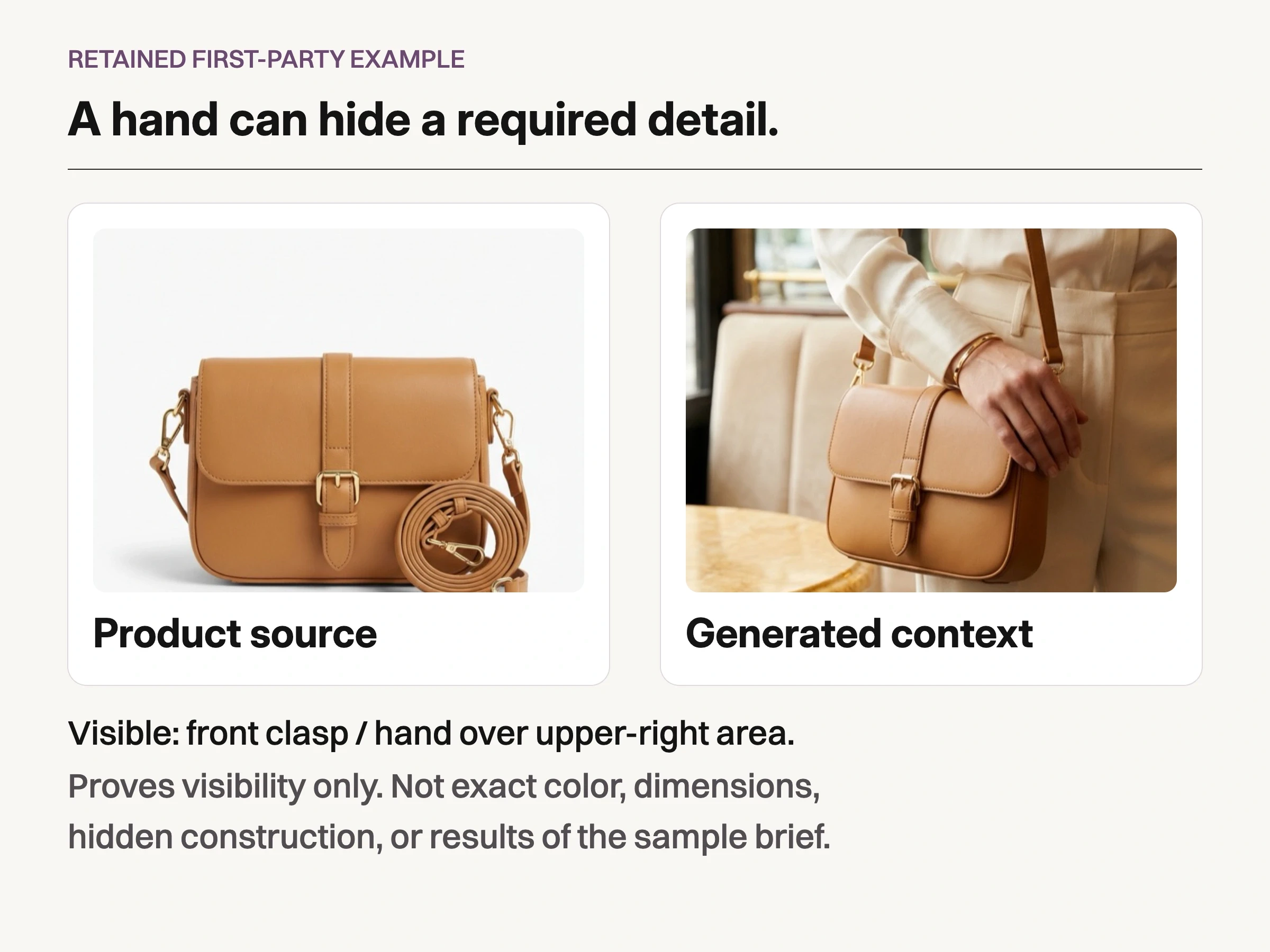
First-party example: the source shows the front clasp and coiled strap; a hand overlaps the upper-right bag in generated context. This demonstrates visibility only, not exact product fidelity or results of the sample brief.
This is an existing first-party source and generated context, not a shoot commissioned with our sample brief. The pair demonstrates visible coverage and occlusion only. It does not establish exact color, dimensions, material identity, hidden construction, carrying capacity, or reliable output across products.
For a job like this, write two requirements: a documentary view where the product details can be inspected, and a context image where the allowed occlusion is explicit. Do not approve the context image as evidence for a region the hand hides. If a buyer needs that region, assign another frame rather than asking the reviewer to infer it.
Copy this filled brief, then replace every example value
The example below describes a hypothetical commission for one tan shoulder bag. Its names and choices are teaching values, not facts about the retained product or a completed client job. Copy the field names; replace the values with your own confirmed decisions. Leave an unknown labeled as an open question with an owner and a due point.
Brief field | Filled example to adapt |
|---|---|
Job and decision owner | Tan bag product-page refresh; ecommerce lead confirms scope and final selects. |
Included products | One approved tan sample; other colors and accessories excluded. Record its actual SKU before production. |
Uses and outputs | Clear product-detail set plus one campaign image. Link the versioned shot list for individual frames. |
Visual direction | Neutral daylight reference for shadows only; keep the front closure unobstructed in product views. |
Product and edit boundary | Preserve shape, stitching, closure and included pieces. Dust cleanup allowed; no invented construction. |
Delivery and dependencies | Confirm crop in the actual page template. Record formats, naming, recipient, sample arrival, and delivery date. |
Review and changes | One consolidated feedback owner. Approve a named proof version; assess new uses before promising new crops. |
Open question | Is strap adjustability a required buyer detail? Merchandising must answer before the shot list is frozen. |
Hypothetical filled brief: replace every value and name an owner for anything unresolved.
Keep instructions near their evidence. A visual reference should say “shadow direction only,” “approved product orientation,” or “avoid this crop,” not just “inspiration.” A technical requirement should name its current client or destination source and the person who checked it.
Freeze the decisions that would invalidate the estimate
A useful brief separates what is settled from what is still exploratory. Before confirming the schedule, resolve the product range, required uses, output groups, approval path, sample dependencies, and revision boundary agreed with the supplier. If one is undecided, identify which work can proceed safely and which part remains on hold.
The estimate should make its assumptions visible. A second colorway, an extra delivery format, and a new campaign concept may have very different production consequences. Ask the producer to assess the change against the agreed job; do not promise that every new request fits the original allowance.
Keep sample condition in this conversation. A damaged closure might be irrelevant to a distant context image and unacceptable for a detail frame. Name the person who can approve a substitute or request another sample. When physical capture is needed, the professional product photography guide covers the camera and lighting work that follows these decisions.
Conceptual illustration: a sample handoff before production. This generated bag is unrelated to the retained tan-bag proof example.
Use this checklist at the handoff
Send the brief with the current product record, references, shot list, and delivery requirements. Ask the receiving producer to answer these questions before work starts:
Can I identify every included product and variant, plus the exclusions?
Does each image use have a purpose and a place in the shot list?
Do references identify the feature to borrow and what to avoid?
Are protected product details and allowed edits explicit?
Can I find the actual destination requirements and crop reference?
Are sample arrival, feedback, delivery, and their owners recorded?
Is there one person who consolidates feedback and names the approved proof?
Is every remaining unknown assigned, with a point when work must pause?
An unanswered question is an action to assign, not a box to tick optimistically. One person can hold several roles; the decisions still need to be recorded.
Carry the same brief into generated work
When the commission includes generated context, Look Atlas can create product-on-model, studio, lifestyle, and campaign-style imagery from product inputs. Carry over the approved sources, protected details, permitted scene changes, and review owner. A plausible image still needs to satisfy the brief's observable requirements. Check Look Atlas pricing for current terms when choosing how to execute that portion of the job.
Change one requirement without reopening the whole shoot
Suppose the team adds a vertical campaign placement after approving a horizontal frame. Record the new use, proposed crop, affected outputs, and decision owner. The producer checks whether the existing image has the necessary space and visibility. If it does, approve the derivative; if it does not, assess a new composition before agreeing to delivery.
Keep the previous brief and record the amendment against a new version. The useful handoff is a short statement: what changed, who accepted it, which outputs it affects, and which earlier decisions still stand. Start your next brief with the requirement your team is most likely to interpret differently, and settle that one first.
