
How to photograph earrings without inventing a matching pair
One earring looks longer, darker or less detailed than the other. Before resizing it or copying the better-looking half, check whether the difference belongs to the jewelry or to the way it was photographed. To photograph earrings accurately, keep both actual pieces identifiable while you adjust their position, inspect the result and capture the details the front view hides.
Start with a supported camera, a simple background, stable mounts appropriate to the fastening and soft, controlled light. Photograph the real pair together before making separate detail images. The useful result is a record of two pieces, including any genuine differences, rather than a perfectly symmetrical picture created in editing.
Give each piece an identity before moving it
Call the pieces A and B in your capture notes. These are tracking labels, not claims about which ear they belong on. Keep them in separate marked tray positions when off the set, and record which is on the left of the first frame. Do not attach adhesive labels to delicate jewelry merely to identify it.
Inspect the actual pair before capture. Are the ornaments identical, mirrored, intentionally different or handmade with visible variation? Which parts move freely? Note the real arrangement instead of assuming every pair should face inward or share an identical outline.
For studs, use a stable support that accommodates the posts. For hanging designs, leave the components free to settle without twisting or pulling them into shape. The earring display guide covers mounting and clearance; here the priority is keeping the comparison traceable after either piece moves.
In Nikon's jewelry photography tutorial, Jody Dole describes composing multiple pieces while looking through the camera. Use that view to check the pair, not just the arrangement seen from beside the table.
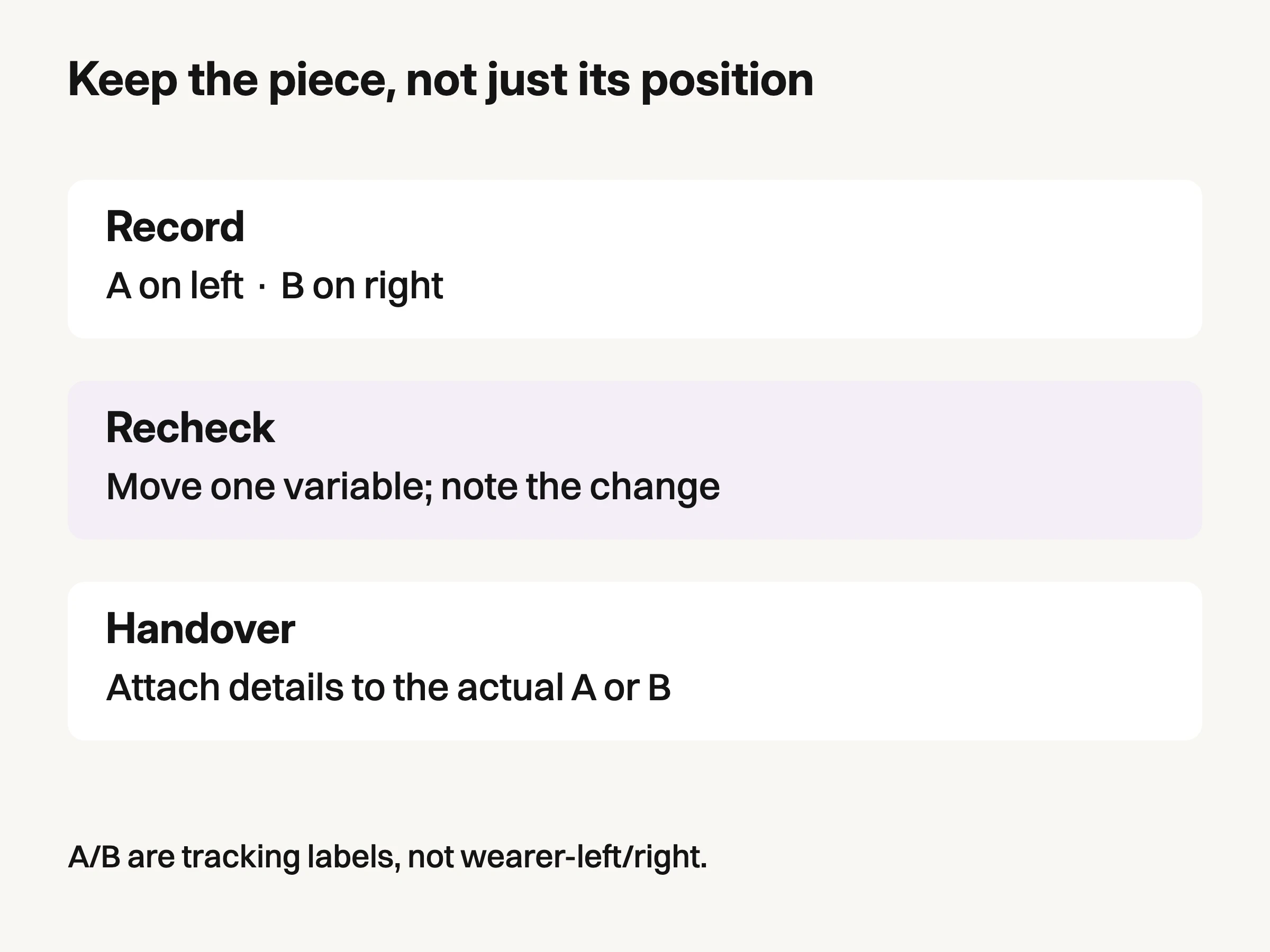
Proposed capture record: A/B identify the pieces in your notes, not a designated wearer-left or wearer-right earring.
Recheck a mismatch before correcting it
Make the first frame with both pieces settled and the important front surfaces at comparable depth and orientation. Avoid placing one noticeably closer to the camera merely to make a pleasing diagonal. Keep camera position, exposure, white balance and processing stable while comparing frames. If using a phone, use the available focus and exposure controls consistently rather than allowing each tap to create a different-looking reference.
If A looks longer, first inspect A and B physically. Then compare their suspension points and orientation through the camera. A tilted ornament may project differently from one facing forward, and flexible drops may settle into different arrangements. Reposition the actual piece without bending its construction, wait for movement to stop and take another frame.
Change one variable at a time. Correct orientation before moving the light, and check camera-to-piece depth before resizing anything. If the apparent difference disappears after that change, retain both frames and record what changed. That is useful evidence for this setup, not proof that every mismatch has the same cause.
For a brightness difference, an additional check is to exchange the two pieces' positions while preserving their intended orientation as closely as their construction allows. Record the swap. If the darker appearance follows a location, investigate the lighting and reflected surroundings there. If it follows the piece, inspect its surface and angle again. Neither outcome alone identifies the metal, finish or a defect; several factors can change together when reflective jewelry moves.
GIA's gem and jewelry photography guidance recommends avoiding mixed color temperatures and explains how diffusion changes shadows and reflections on polished metal. A consistent lighting environment makes comparison more useful, but it does not certify calibrated color. Do not independently whiten or recolor each earring until an authentic difference disappears.
What differs in the image | Recheck before editing |
|---|---|
One piece looks longer or wider | Compare the actual pieces, then normalize depth and orientation without reshaping them. |
A hanging component looks missing | Let the piece settle and inspect overlaps; photograph the actual component from another view. |
One piece looks darker | Keep exposure stable, check surface angle and reflected surroundings, then record a position swap if useful. |
One front is sharp and the other soft | Recheck their depth and focus before sharpening either file separately. |
A difference remains after careful recapture | Compare with the real pair and preserve genuine variation rather than cloning the other piece. |
Proposed rechecks for the actual pair. A changed appearance is a clue, not automatic proof of a single cause.
These are proposed diagnostic checks for your own setup. No physical pair was photographed or tested for this article. Keep the untouched captures so a retoucher can see what was observed rather than receiving only a request to “make them match.”
Read a real pair photograph without guessing the cause
The Metropolitan Museum of Art's Earrings, accession 09.37.18a, b, provides a useful reading exercise. The retained photograph shows two ornate pieces with upper decorative forms and lower hanging assemblies. Those lower assemblies present visibly different projections: more of one angled structure is exposed on the left, while a different arrangement of edges and hanging clusters is visible on the right.
That is an observation of the photograph. It does not establish that the pieces have unequal physical dimensions, that either is defective, or that a particular camera or mounting error caused the difference. The museum record identifies the medium as metal; the photograph alone does not justify a more specific material claim.

The Metropolitan Museum of Art, Earrings, 09.37.18a, b, Rogers Fund, 1909. Public domain / CC0. Annotations identify visible regions only; physical dimensions, original setup and cause of the different projections are unknown.
The annotations retain the whole pair and point to the regions worth comparing. Neither earring has been independently enlarged, mirrored or reconstructed. The image is available under the Met's Open Access policy.
If this were your own pair, the next step would be to inspect and reorient the actual hanging components, not to copy one assembly onto the other. Here, access to the objects and the original setup is unavailable, so the cause remains unknown. This source image is not a before-and-after result of our proposed method.
That restraint matters during retouching. A photograph can show that two regions look different without explaining why. Resolve what can be checked with the real jewelry; leave unsupported conclusions out of the edit brief.
Keep the back and scale views attached to the same pieces
Once the pair view is usable, capture the actual fastening and reverse construction of A and B where they differ. Keep the identities in filenames or notes. A polished front photograph cannot establish a post's length, a hinge's construction or which removable back accompanies the piece.
For a stud, show the post and supplied back without covering their relationship. For a hoop, show the real opening and fastening arrangement without forcing it. For an articulated drop, a separate view may be needed to reveal the connection hidden behind the ornament. These are recording tasks, not instructions to operate an unfamiliar or fragile mechanism beyond its normal use.
Record actual dimensions separately and state what was measured, such as overall hanging length or the widest ornament. A ruler reference should share the relevant measurement plane; a decorative stand of unknown size is not a measurement. An on-ear photograph can add wearing context, but it does not establish comfort, weight or an exact dimension by itself.
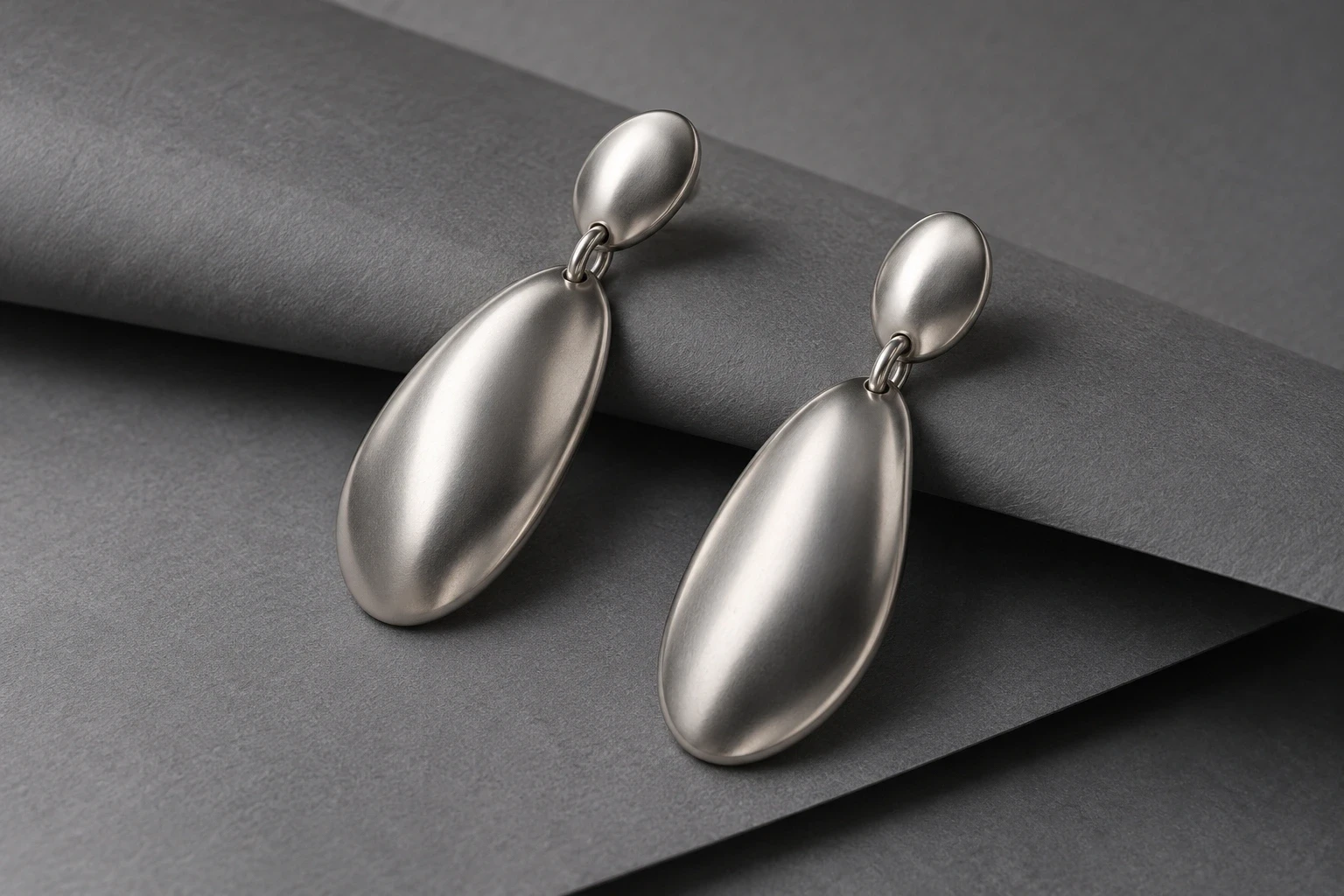
Conceptual illustration: a separately generated fictional pair. It is not a second view of the hero or a physical capture, fastening demonstration or controlled comparison.
Check both pieces at the delivered image size and in the available detail view. Confirm that the selected front, fastening and dimension notes still refer to the same pair and variant. If a detail is soft or hidden, recapture it rather than adding invented texture or reconstructing a closure from a similar product.
The professional jewelry photography guide covers the broader production brief. For this session, the useful handover is more specific: the original pair frame, identified A/B details, any diagnostic recaptures and the measured product facts. Separate genuine variation from corrections supported by another photograph.
After those references exist, Look Atlas for jewelry imagery can be considered for generated creative scenes. Review those candidates against both real earrings. A generated pair is not independent evidence of fastening detail, physical scale or matching construction.
Before packing the jewelry away, select one difference that originally concerned you and write down what the recapture established. If the answer is still uncertain, keep the uncertainty visible in the handover. A faithful pair is a stronger product record than two copies of the most convenient earring.
