Lifestyle Product Photography Services: The Complete Guide to High-Converting Visual Content
1. Introduction: Why Lifestyle Photography Sells Products
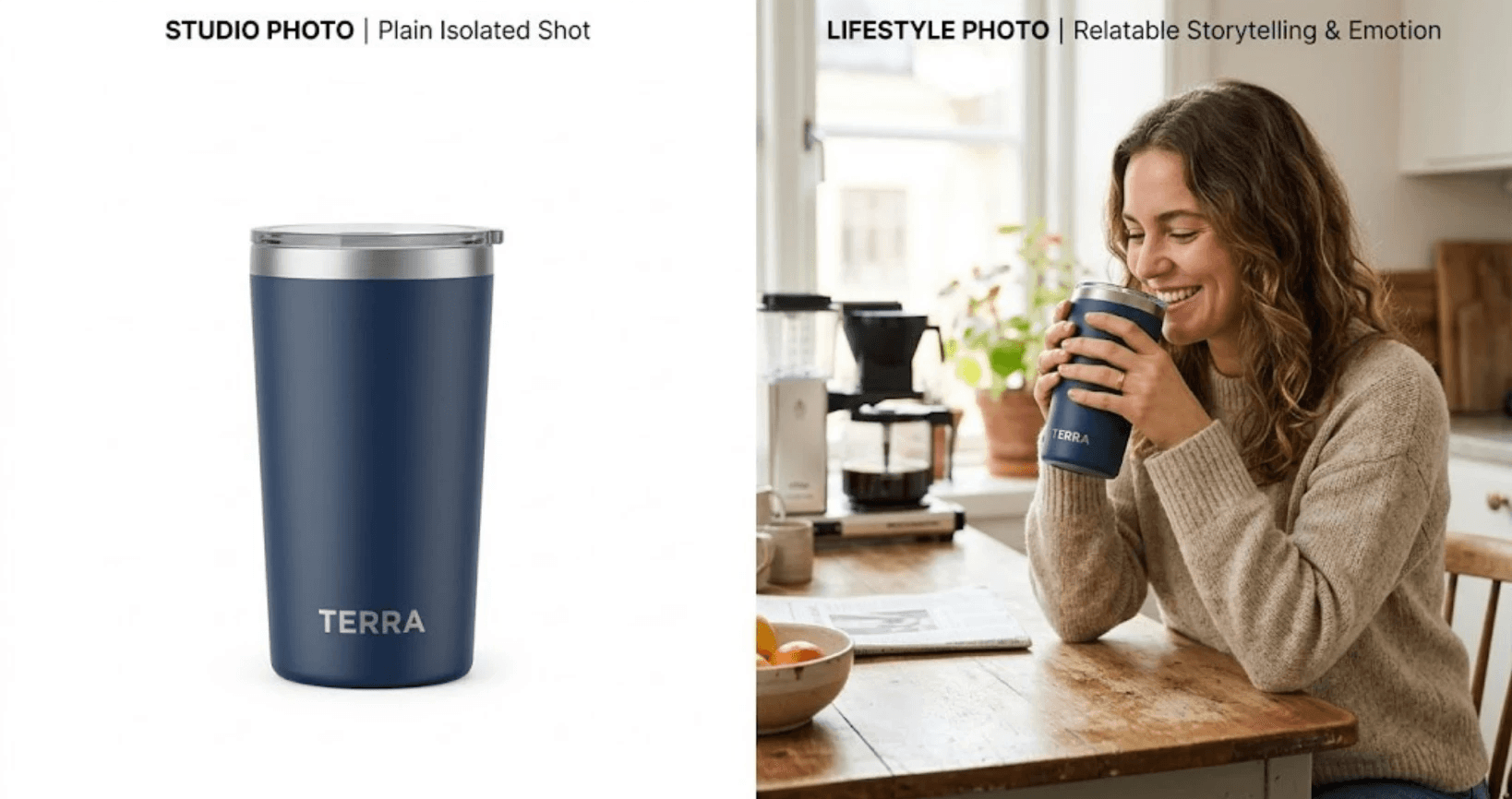
In today’s ecommerce landscape, customers don’t just buy products they buy experiences. With countless options available online, shoppers are no longer convinced by plain product images alone. While clean white-background photos are essential for clarity, they often fail to answer the most important question in a buyer’s mind:
“What will this product look like in my life?”
This is where lifestyle product photography services make a powerful impact. By placing products in real-world scenarios, lifestyle imagery helps customers visualize how the product fits into their daily routines. It transforms a simple product into a story, making it more relatable and desirable.
Lifestyle photography doesn’t just improve how your product looks, it improves how it sells. It builds emotional connection, enhances perceived value, and ultimately drives faster purchasing decisions.
2. What Are Lifestyle Product Photography Services?
Lifestyle product photography services focus on capturing products in real-life environments or situations rather than isolating them against a plain background. These services are designed to create a narrative around the product, showing how it is used, who uses it, and why it matters.
Unlike traditional product photography, lifestyle shoots involve a combination of creativity, planning, and execution. They go beyond technical accuracy to deliver emotional impact.
These services typically include:
Concept development and creative direction
Location selection or set design
Model coordination and casting
Styling, props, and scene setup
Professional photography and lighting
Post-production editing and retouching
The goal is to create visuals that feel natural, engaging, and aligned with the brand’s identity.
3. Why Lifestyle Photography Increases Conversion Rates
Lifestyle images are not just visually appealing, they are performance-driven assets that directly influence buying behavior.
Helps Customers Visualize Usage
When customers see a product in use, they can easily imagine how it fits into their own lives. This reduces uncertainty and makes decision-making easier.
Builds Emotional Connection
Lifestyle imagery creates a mood or feeling. Whether it’s comfort, luxury, adventure, or simplicity, these emotions make products more desirable.
Increases Perceived Value
Products shown in high-quality, real-world settings appear more premium. This can justify higher pricing and improve brand positioning.
Improves Engagement
Lifestyle visuals tend to perform better on social media platforms, advertisements, and landing pages. They capture attention and encourage interaction.
Together, these benefits lead to higher click-through rates, longer page engagement, and improved conversion rates.
4. Types of Lifestyle Product Images
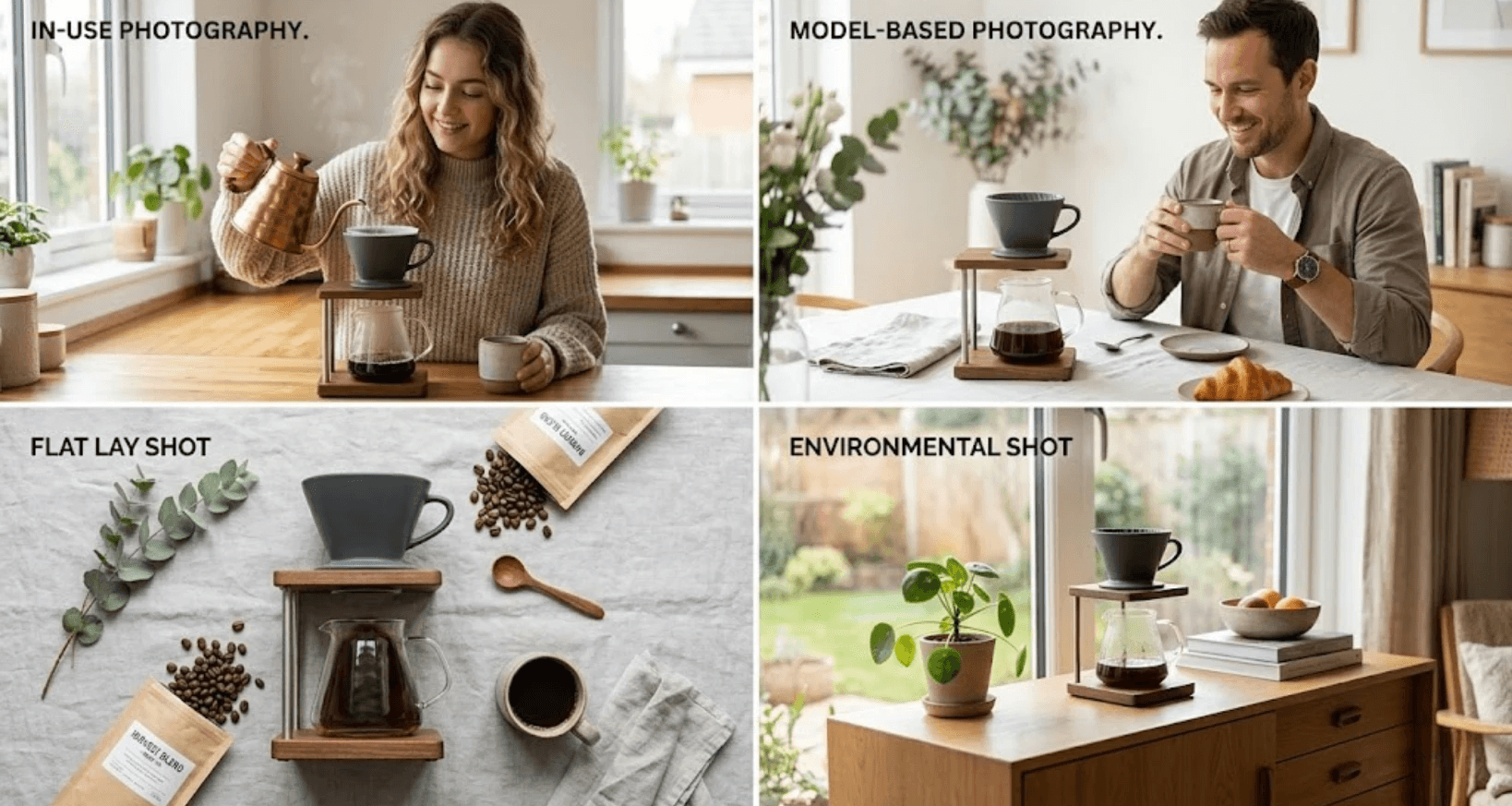
There are several types of lifestyle images, each serving a unique role in marketing and sales.
In-Use Photography
These images show the product being actively used. For example, a coffee mug being held, a skincare product being applied, or a fitness product in action.
Model-Based Photography
This involves people interacting with the product. It adds relatability and helps customers understand scale, fit, and real-world application.
Flat Lay Lifestyle Shots
Flat lays feature products arranged on surfaces like tables or floors, often with complementary props. These are popular for social media and branding.
Environmental Shots
These images place the product in realistic environments such as homes, offices, or outdoor settings. They help create context and tell a story.
Using a mix of these image types ensures a well-rounded visual strategy.
5. Lifestyle vs Standard Product Photography
Both lifestyle and standard product photography play important roles, but they serve different purposes.
Feature | Standard Photography | Lifestyle Photography |
Background | White or neutral | Real-world scenes |
Focus | Product details | Product experience |
Use Case | Ecommerce listings | Ads, branding, social media |
Emotional Impact | Low | High |
Standard images provide clarity and compliance, while lifestyle images drive engagement and emotional appeal. The most successful ecommerce brands use both strategically.
6. What’s Included in Lifestyle Photography Services
A full-service lifestyle photography provider typically handles every aspect of the production process.
This includes:
Creative direction and concept planning
Mood boards to define visual style
Location scouting or studio setup
Model hiring and coordination
Props, styling, and scene design
Professional shooting and lighting
Post-production editing and color grading
Because of the number of moving parts involved, lifestyle photography is more complex than standard product shoots, but it also delivers greater impact.
7. Pricing for Lifestyle Product Photography
The cost of lifestyle photography varies depending on the scale and complexity of the shoot.
Typical Pricing
Basic lifestyle shoot: $100 to $500 per image
Advanced shoots with models: $500 to $2000+ per session
Full campaign production: $2000 to $10,000+
Factors That Affect Pricing
Number of images required
Models and talent fees
Location and studio costs
Props and styling complexity
Editing and retouching needs
While the investment can be significant, the return often comes in the form of improved conversions and stronger brand positioning.
8. Challenges with Traditional Lifestyle Shoots
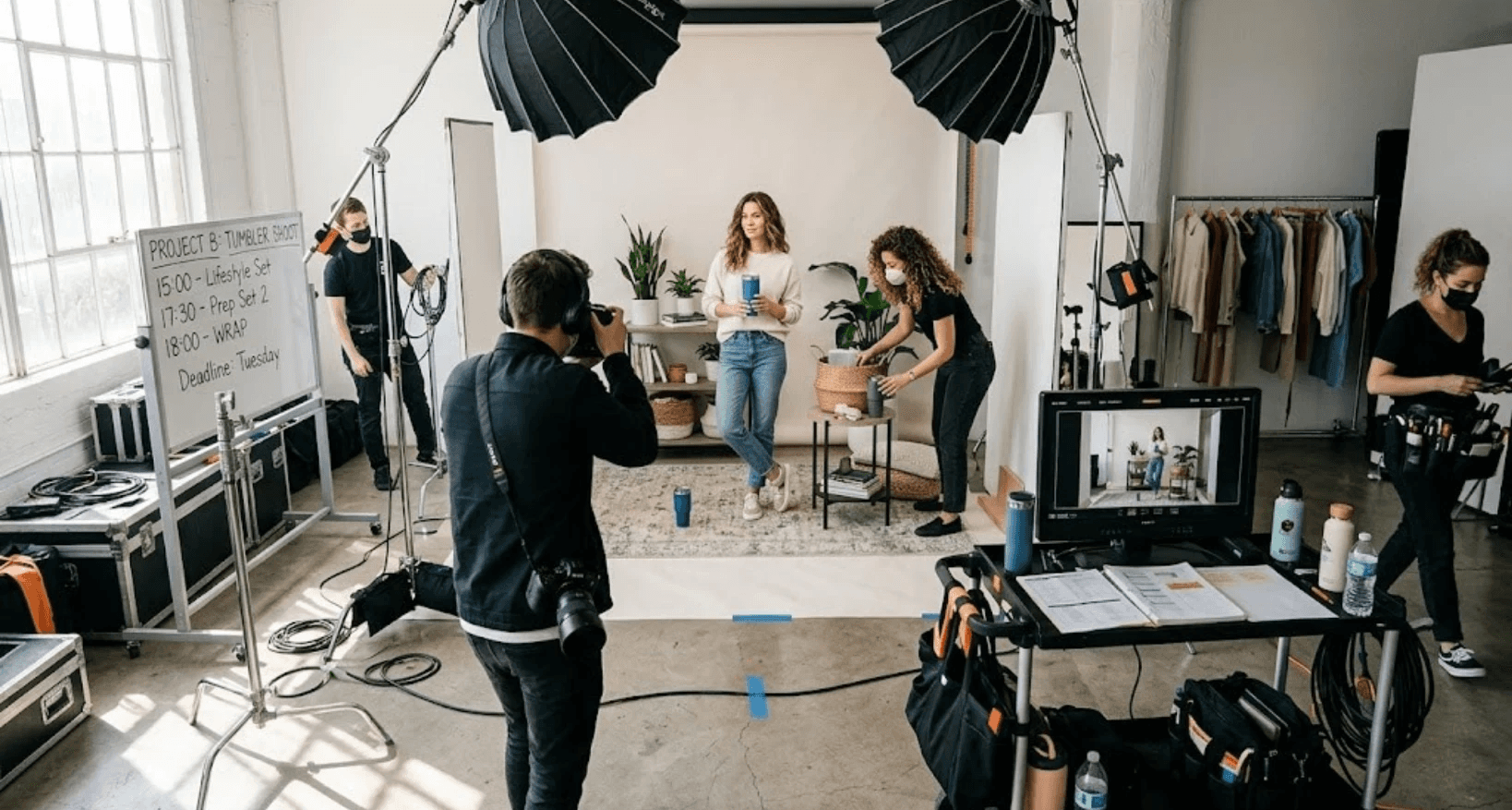
Despite their effectiveness, traditional lifestyle shoots come with several challenges.
High Production Costs
Hiring models, renting locations, and organizing teams can be expensive.
Long Timelines
Planning, shooting, and editing can take weeks or even months.
Complex Coordination
Managing photographers, stylists, models, and logistics requires significant effort.
Limited Scalability
Creating new visuals for every product or variation is difficult and costly.
Difficulty in Creating Variations
Testing different concepts or styles requires entirely new shoots.
These challenges make it difficult for fast-growing ecommerce brands to scale their visual content.
9. Scaling Lifestyle Visual Content
Modern ecommerce brands need to produce more content, faster, and at lower costs. This has led to the adoption of scalable visual production strategies.
Use our ecommerce photoshoot decision guide to choose between an in-house set, a specialist studio, and a hybrid AI workflow before committing the brief.
Key approaches include:
Batch production of multiple products in one shoot
Template-based visual design for consistency
Hybrid workflows combining photography and digital editing
AI-assisted tools for faster image creation
These methods allow brands to maintain quality while improving efficiency.
10. The Rise of On-Model and Scenario-Based Visuals
Lifestyle photography is evolving to include more dynamic and platform-specific visuals.
Today’s trends include:
On-model product images
Scenario-based storytelling
Social-first visuals optimized for platforms like Instagram and TikTok
Ad-focused creatives designed for performance marketing
These visuals are highly effective because they align with how modern consumers interact with content online.
11. Tool Spotlight: Creating Lifestyle Visuals Without Full Photoshoots
To overcome the limitations of traditional shoots, many brands are shifting toward faster, more flexible visual production methods.
Instead of relying entirely on studios, sellers can now enhance simple product photos into lifestyle-ready visuals using advanced AI workflows. Platforms like Look Atlas make it possible to generate realistic, on-model or contextual imagery without the need for full-scale production.
With this approach, brands can:
Generate multiple lifestyle variations in minutes
Reduce dependency on costly shoots
Experiment with different visual styles for ads and campaigns
Scale content efficiently across platforms
This shift allows brands to move from slow, shoot-based production to a more agile, on-demand workflow, where high-quality visuals can be created, tested, and updated as quickly as products are launched.
For fast-growing ecommerce brands, having this level of flexibility can make a noticeable difference in how quickly they adapt and compete.

12. How to Choose the Right Lifestyle Photography Service
Selecting the right service provider is crucial for achieving strong results.
Consider the following factors:
Portfolio quality and creative style
Experience within your industry
Ability to develop strong concepts and storytelling
Turnaround time and reliability
Clear and transparent pricing
A good provider understands not only how to create beautiful images but also how to create visuals that convert.
13. Common Lifestyle Photography Mistakes
Avoiding common mistakes can significantly improve your results.
Overcomplicated Scenes
Too many elements can distract from the product.
Poor Lighting
Inconsistent or harsh lighting reduces image quality.
Distracting Backgrounds
Backgrounds should support the product, not compete with it.
Weak Storytelling
Images should clearly communicate a use case or emotion.
Inconsistent Branding
Different styles across images can confuse customers and weaken brand identity.
Effective lifestyle photography should enhance the product while keeping it as the focal point.
14. Future Trends in Lifestyle Product Photography
The lifestyle photography industry is rapidly evolving with new technologies and consumer expectations.
AI-Generated Lifestyle Visuals
AI tools are making it easier to create realistic scenes without physical shoots.
Faster Content Production
Brands are moving toward rapid creation cycles to keep up with demand.
Personalized Product Imagery
Dynamic visuals tailored to specific audiences are becoming more common.
Scalable Visual Testing
Brands are testing multiple image variations to find what performs best.
Staying ahead of these trends can provide a significant competitive advantage.
15. Final Thoughts
Lifestyle product photography services are essential for brands that want to create engaging, high-converting visuals. By showing products in real-world contexts, these images help customers connect emotionally and make confident purchasing decisions.
However, as ecommerce continues to scale, relying solely on traditional photography methods can limit growth. This is why many brands are adopting a hybrid approach, combining creative photography with modern, scalable tools.
The future of product imagery lies in balancing creativity with efficiency. Brands that can produce high-quality, engaging visuals quickly and consistently will stand out in increasingly competitive markets.
