A model release is the legal document that gives you permission to use someone’s face, or "likeness," in photos and videos for business. Think of it as a crucial safety net. It protects everyone involved—photographers, brands, and the models themselves—by spelling out exactly how the images can be used, which helps sidestep messy legal disputes down the road.
Right here, you’ll find our downloadable templates to get you started.
Your Free Model Release Form Template
Before we get into the nitty-gritty of legal clauses and special situations, let's put the most important tool right in your hands. A solid model release is like a legal handshake between you and your subject. It’s what turns a beautiful photograph into a valuable commercial asset.
Without that signature, your work is stuck in a legal gray area, pretty much limited to personal or editorial use. That severely tanks its value.

This document is your proof of consent. It’s your shield from liability if a model later changes their mind about how their image is used, as long as you're sticking to the terms they agreed to. It’s basically insurance for your creative work. It gives you and your clients the confidence to use the images everywhere—in ads, on products, and across all your marketing campaigns.
If you have questions about how our AI platform handles image rights and model usage, feel free to get in touch with our team through our contact page.
Anatomy of a Model Release Form
Every good model release form template is built on a few core components that make it a legally sound agreement. Getting to know these parts is the first step in protecting your work.
Here’s a quick look at the critical elements that make a model release form legally sound and effective for commercial use.
Component | What It Does | Why It Matters |
|---|---|---|
Parties Involved | Clearly names the model, the photographer, and/or the company paying for the shoot. | This leaves no room for doubt about who is making the agreement, who is granting permission, and who is receiving it. |
Grant of Rights | Details the exact permissions the model gives for the use of their likeness. | This is the engine of the release. It defines how you can use the images—for ads, products, etc.—and gives you the legal authority to publish and profit from them. |
Consideration | Confirms that something of value was exchanged for the rights (e.g., money, prints). | This is what makes the contract legally binding. The phrase "for value received" shows a fair trade happened, even if it wasn't a cash payment. |
Signatures & Date | Includes dated signatures from the model (plus a parent/guardian for minors) and a witness. | The signatures are the final seal of approval, proving everyone read, understood, and consented to the terms on that specific day. |
Getting these four elements right is non-negotiable for any commercial photography project. They are the foundation of a clear, enforceable, and professional agreement.
Breaking Down Your Model Release, Clause by Clause
Let's be honest, a model release form can look like a wall of intimidating legal text. But don't let the jargon scare you. Think of it less as a stuffy legal document and more as a clear, detailed agreement that protects everyone involved. Once you can translate that legalese into plain English, you'll be able to use your template with total confidence.
Here’s a practical walkthrough of the essential clauses you’ll find in any standard model release form template. We'll break down what they actually mean in the real world and why each one is an indispensable part of your professional toolkit.
Identifying the Parties Involved
First things first, you have to know who's who. This section is the simplest part of the agreement, but it's the foundation for everything else. It just needs to clearly state the full legal names and contact info for everyone signing the contract.
The Model: The person whose likeness is being photographed.
The Photographer/Company: The person or business that gets the rights to use the images.
The Witness (Optional but Recommended): A neutral third party who watches the signing, which just adds another layer of legal muscle.
Getting this right is crucial. It leaves no room for confusion about who is giving permission and who is receiving it, setting the stage for the rest of the agreement.
Understanding the Grant of Rights
This is the engine of the entire release. The "Grant of Rights" clause is where the model officially gives you their permission to use their likeness for commercial purposes. It spells out exactly what you're allowed to do with the photographs.
A rock-solid grant of rights should give you the freedom to:
Use the images in any and all media: This is about future-proofing. It covers print, web, social media, video, and any technology that hasn't even been invented yet.
Use the images for any lawful purpose: This typically points to commercial uses like advertising, promotion, marketing, and sales.
Alter or modify the images: This is more important than ever. It covers everything from simple retouching to complex composite work or even AI-powered edits.
This section is what turns a personal portrait into a valuable commercial asset. It gives you and your clients the flexibility needed to actually use the images effectively.
Key Takeaway: A broad "Grant of Rights" clause is your best friend. If the terms are vague or restrictive, you could severely limit the future value of your images. Clarity and comprehensive language are absolutely essential for any long-term commercial work.
The Concept of Consideration
For any contract to hold up in court, something of value has to be exchanged. In legal terms, this is called consideration. It doesn't always have to be a stack of cash; it's simply the proof that both sides got something out of the deal.
Consideration can take many forms:
A specific payment.
A set of professional prints from the shoot.
Portfolio images and valuable experience for a new model.
Even the simple phrase "for value received" works, as it legally acknowledges that a fair exchange happened.
By including a consideration clause, you prevent a model from coming back later and claiming they got nothing for their signature, which could torpedo the whole agreement. It cements the release as a professional, binding contract.
Duration and Territory: The Scope of Use
Beyond what you can do with the images, the release has to define where and for how long. These terms are non-negotiable for projects with a global audience or marketing plans that span years.
Perpetuity: This is just a fancy legal word for "forever." Granting rights in perpetuity means the image can be used indefinitely without ever needing to ask for permission again. It's the gold standard for most commercial and stock photography.
Worldwide: This one is pretty self-explanatory. It allows the images to be used in any country on the planet. For global brands, this is a must-have to run international campaigns without hitting legal walls.
Liability and Indemnification Explained
This is often the most confusing part of a release, but the idea behind it is straightforward. Indemnification is basically a promise to cover the other party's back if something goes wrong. To really get a handle on the legal weight here, it helps to understand the concept of a liability waiver and how it protects both sides.
In short, the model agrees not to sue you or your client for using the photos as laid out in the release. It’s your legal shield. This clause protects you from future claims of defamation, invasion of privacy, or other headaches, as long as you're playing by the rules you both agreed to.
Of course, this protection is a two-way street. Your own terms and conditions should also outline your responsibilities. For a clear example of how these legal terms are structured, you can see our own terms and conditions.
The Irrevocable Consent Clause
So what happens if a model has a change of heart a year after the shoot? That’s exactly what the irrevocable clause is for. It means that once the release is signed, the model can't take back their consent.
This provides incredible stability and peace of mind for both you and any client who licenses the images. Imagine a brand sinking millions into a campaign built around one photo, only to have the model pull their permission. The irrevocable clause prevents that nightmare scenario from ever happening, making the rights you've secured permanent and reliable.
Handling Global Shoots and GDPR Compliance
The moment your shoots go international, your legal paperwork needs a passport, too. A model release that’s ironclad for a shoot in Los Angeles might be full of holes in Lisbon. The rules around consent and privacy can shift dramatically once you cross a border.
This is especially true if you're working with models or clients in the European Union. You've probably heard of the General Data Protection Regulation (GDPR). It's not just for tech giants; it fundamentally changes how photographers have to handle images of people.
Why Photographers Need to Care About GDPR
It’s easy to tune out when you hear legal acronyms, but this one is critical. Under GDPR, a photograph of someone who can be identified is considered personal data. That simple fact elevates a model release from a standard contract to a data protection document.
Suddenly, it’s not enough for a model to just say, "Sure, you can use my picture." They must give explicit, informed consent that clearly outlines how their personal data—their image—will be gathered, stored, used, and shared.
Think of it this way: GDPR gives people the right to control their own data. For a photographer, that means being completely transparent. You need to treat a model's likeness with the same level of care you'd give any other sensitive information, giving them clear control.
This new layer of responsibility reinforces the need for a well-structured release, which covers all your bases, especially when navigating regulations like GDPR.
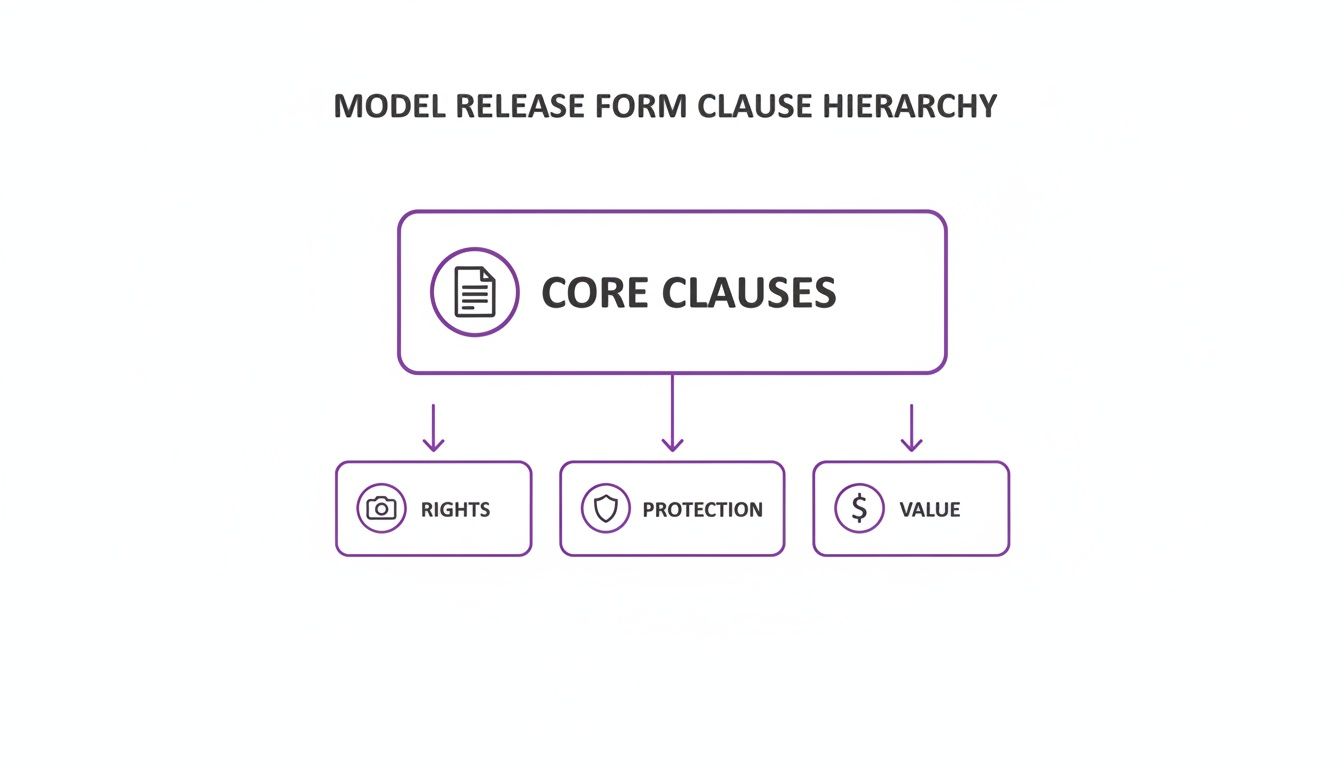
As you can see, a solid release is built on clauses that define rights, protection, and value. For international work, each of these needs to be viewed through the lens of GDPR's strict requirements.
Key Clauses for a GDPR-Compliant Release
To get your model release form template ready for the world stage, you can't just tack on a line about GDPR. You need to weave specific, clear, and unambiguous language throughout the document.
Here’s what your updated release absolutely must include:
Who's the Data Controller? You need to clearly state who is responsible for the data. That's usually the photographer or their business. Include your name and contact details.
What's the Legal Basis? The form should explicitly state that the model’s consent is the legal foundation for processing their personal data (i.e., the photos).
Why Are You Using the Photos? Be specific. Don't just say "for promotional purposes." List everything: social media, website portfolios, client ad campaigns, print brochures, etc.
How Long Will You Keep the Data? Define your data retention period. If you intend to keep the images forever ("in perpetuity"), you have to say so.
What Are the Model's Rights? Your release must inform the model of their rights under GDPR. This includes their right to see the data you hold, ask for corrections, and, in some cases, request that their images be deleted.
Model releases have always varied by country, but GDPR was a game-changer. European photographers now include this language as standard practice, and savvy creators everywhere are following suit.
Being upfront about how you handle data isn’t just about ticking a legal box; it’s about building trust. For a real-world example of how to communicate this, feel free to review our company's privacy policy. When you update your release, you’re not just protecting yourself legally—you’re showing models you respect them and their rights, which protects your work no matter where in the world it ends up.
Adapting Your Release for AI, Minors, and Sensitive Use
Standard photo shoots are one thing, but today's world of photography and advertising is a whole lot more complicated. Your basic model release form template needs a few key upgrades to handle the unique challenges that come with AI editing, working with minors, and using images in ways that could be considered sensitive.
These aren't just rare exceptions anymore; they're everyday situations that demand very specific legal language. If you don't get this right, you're leaving yourself wide open to legal headaches and reputation damage, which can completely torpedo all the hard work you put into a shoot.
The Rise of AI and Digital Manipulation
The line between a real photograph and a digital creation has basically vanished. With AI tools, you can now change a model’s expression, swap out their clothes, or even drop them into a completely different scene. This is a universe away from simple retouching, and it calls for a dedicated "digital manipulation" clause in your release.
This clause gives you explicit permission to make some pretty significant changes to the model’s likeness. Without it, a model could come back and argue that an AI-generated change misrepresents them, which is a fast track to a legal fight. Think of it as a necessary add-on to the standard "Grant of Rights," but specifically for these transformative edits. If you're looking for a starting point, some AI legal template generators are getting pretty sophisticated at helping you draft this kind of language.
Your clause should be crystal clear that the rights you're getting include things like:
Composite Imagery: The right to blend the model's likeness with other images, graphics, or backgrounds.
Digital Alteration: Permission to tweak features, expressions, and even physical appearance using digital tools, including AI.
Fictional Representation: The ability to use the altered image to create a fictional character or place the model in a made-up context.
Being upfront about this protects your creative freedom and makes sure the model knows exactly what they're signing up for from day one.
Securing Releases for Minors
When you're photographing anyone under the age of 18, the rulebook gets a lot stricter. A minor can't legally sign a contract, which means their signature on a model release isn't worth the paper it's printed on. This is a non-negotiable legal fact.
For a release with a minor to be valid, it must be signed by a parent or legal guardian. That signature is your proof that a responsible adult has given consent on the child's behalf. There are absolutely no workarounds for this.
Critical Point: A release signed only by a minor is legally void. Always, always get a parent or guardian's signature. I'd even recommend having a witness present to verify the signature and the person's relationship to the child. It's a simple step that provides bulletproof protection when working with young models.
Protecting Models with a Sensitive Use Clause
A sensitive use clause is one of the best tools you have for building trust and keeping a professional relationship with your models. What this clause does is protect the model from having their image used in a way that could be embarrassing, defamatory, or just plain harmful to their reputation.
This isn't just about being a nice person; it's a savvy business move. It shows models you respect them and won't throw them into a compromising situation. It reassures them that their face won't suddenly appear next to a controversial topic they never agreed to.
A good sensitive use clause usually prohibits using images in connection with:
Illegal activities
Political endorsements they haven't approved
Content that is sexual in nature
Depictions of violence or substance abuse
Medical conditions or other sensitive personal issues
By including this, you're setting clear boundaries. It makes models much more comfortable signing a broad, perpetual release because they know there are safeguards in place to protect their personal brand and dignity. It’s a small addition that makes a world of difference.
Perfecting Your Signing and Storage Workflow

A fantastic model release is worthless if it gets lost. A scrawled signature on a crumpled piece of paper stuffed in a filing cabinet won’t do you any good when a client or stock agency needs proof of consent. How you get these forms signed and where you store them is just as important as the legal language inside.
Think of it like this: the release form is your legal insurance policy. A solid signing and storage process is the system that ensures that policy is active, valid, and easy to find the second you need it. This is where you graduate from just having a template to having a bulletproof professional workflow.
Wet Signatures vs. E-Signatures
The days of relying solely on pen and paper are pretty much over. While a traditional "wet signature" on a physical form is still legally sound, digital methods have become the standard for good reason—they're faster, more secure, and way more convenient.
Wet Signatures: This is the classic approach. It feels official, but it means printing, signing in person, scanning, and then manually filing. The whole process is slow and creates a physical paper trail that can be lost, damaged, or become a huge pain to dig up later.
E-Signatures: This is the modern, legally binding alternative. Platforms like DocuSign or Adobe Sign don't just capture a signature; they create a secure, verifiable audit trail. This makes everything faster, cuts out paper waste, and lets you save the final document directly into your digital archive. Organization becomes effortless.
For most creators working today, e-signatures are the clear winner. The boost in efficiency and the peace of mind knowing you won't lose a critical document makes the switch a no-brainer for serious asset management.
The Role of a Witness
A witness signature isn't always a strict legal requirement, but it adds a powerful layer of validation to your model release form template. A witness should be a neutral third party who is there when the model signs. Their signature confirms two simple but crucial things: the model signed the form willingly, and they are who they claim to be.
This little extra step can be a lifesaver if a dispute ever pops up. It makes it much more difficult for a model to later claim they were pressured into signing or that the signature isn't even theirs. For high-stakes commercial shoots or when you're working with new talent, getting a witness is a smart, proactive move.
Best Practices for Organizing and Storing Your Releases
Your signed releases are valuable business assets. You need to treat them that way. A messy folder on your desktop or a random drawer full of papers is just asking for trouble. The goal is to build a system where you can pull up any release, for any project, in seconds.
Here’s how to build a rock-solid storage workflow:
Create a Consistent Naming Convention: Simple, logical file names make searching a breeze. Try a format like:
YYYY-MM-DD_[Model-Name]_[Project-Name]_Release.pdf.Use Cloud Storage: Keep your signed releases in a secure cloud service like Google Drive, Dropbox, or a dedicated Digital Asset Management (DAM) system. This protects them from a hard drive crash and makes them accessible from anywhere.
Link Releases to Photos: For the ultimate level of organization, you can embed metadata in your image files that references the specific release form. Some DAM systems even let you link the files directly, so pulling up a photo automatically shows you its legal paperwork.
This kind of organization is non-negotiable when you're submitting to stock photography platforms. In fact, major agencies have driven the standardization of release forms, often accepting templates from multiple sources to make life easier for contributors. Many top platforms provide their own forms or accept common agency releases, which cuts down on administrative headaches. You can learn more about how major stock sites handle releases and see why a tidy system is so vital.
A Pro's Guide to Common Model Release Questions
Diving into the world of model releases often brings up a ton of "what if" scenarios. Even with a great model release form template, you're bound to run into situations that feel a bit murky. Let's cut through the confusion and get you some clear, direct answers to the questions I hear most often from photographers and brands.
Think of this as your field guide for handling those tricky moments with total confidence. Getting this stuff right isn't just about protecting yourself legally; it’s about building a reputation as a true professional who respects everyone involved in the creative process.
Do I Need a Release for Photos I Took in Public?
This is easily the most common question, and the answer always comes down to one thing: how you plan to use the photo.
If your photo is for editorial use—think a news story, a product review, or even a piece of fine art you plan to hang in a gallery—you often don't need a release for people you photograph in a public place. In most places, this kind of use is protected under freedom of expression.
But the second that photo crosses the line into commercial use, the game changes entirely.
Commercial use is anything that helps sell a product or promote a business. We're talking about things like:
An ad in a magazine or on social media
The packaging for a new product
A promotional post on a brand’s Instagram feed
The hero image on a company's website
Using someone's face to sell something without their written permission is a huge legal no-no, often called misappropriation of likeness. So here’s my rule of thumb: if you can even imagine the photo being used commercially down the road, get a signed release. No exceptions.
What’s the Worst That Can Happen If I Use an Image Without a Release?
Honestly? It’s a nightmare. Using an image commercially without a model release is like building your brand’s beautiful new campaign on a sinkhole. It might look fine for a bit, but it’s destined to collapse, and the fallout can be devastating for your business and reputation.
Without that signed piece of paper, you and your client are wide open to a lawsuit. The person in the photo can sue for damages, which can lead to eye-watering fines, massive legal bills, and a court order forcing you to pull the image from every single place it's been used.
The Bottom Line: No reputable stock agency, publisher, or brand will touch an image of an identifiable person without a rock-solid model release. The risk is just too high. It's a non-negotiable part of the job that separates the amateurs from the pros.
Can a Model Change Their Mind and Take Back Consent?
This question really gets to the core of why a well-drafted release is so critical. Generally speaking, the answer is no, a model can't just revoke their consent after signing. That's because any professional release will include one magic word: the consent is "irrevocable."
That single term makes the agreement permanent. It gives you and your clients the legal certainty needed to invest thousands of dollars into campaigns built around those images. Imagine a brand puts up a billboard, only for the model to change their mind a week later—the irrevocable clause is precisely what prevents that catastrophe.
Of course, for this to hold up in court, the contract has to be fair. The model must have been a legally competent adult (or had a parent/guardian sign), they weren't tricked or forced into signing, and they received some form of "consideration" (which can be money, prints, or even just the opportunity to be in the shoot). As long as you've checked those boxes, you're protected.
How Long Does a Model Release Actually Last?
A release lasts for as long as the document says it does. There's no universal time limit; it's all in the terms you agree upon. You could write a release that’s only valid for a year for a specific ad campaign, but that’s not the industry standard for commercial or stock work.
Most professional templates grant usage rights "in perpetuity," which is just legal-speak for "forever."
A perpetual release gives you the most value and flexibility. It essentially future-proofs the image, allowing you or a client to use it years from now in a totally new campaign without having to hunt the model down for another signature. While a limited-term release might make sense for a niche project, a perpetual one is the gold standard for creating a valuable, long-lasting creative asset.
Ready to create stunning, on-model imagery without the hassle of traditional photoshoots and paperwork? Look Atlas uses AI to generate ultra-realistic product photos and videos in minutes, giving you a diverse library of models and endless creative control. Start creating high-impact visuals that sell by visiting https://www.lookatlas.com.
