
Clothing product photography pricing: what changes when you add another view?
A back view, a second colorway and an on-model image can all sound like “one more clothing photo.” They can trigger different charges. Clothing product photography pricing becomes easier to understand when you separate another angle of the same garment from another garment or a different production format.
For example, PVS lists ghost mannequin photography from $65 per garment, with additional angles at $30 each. ProductPhotography.com instead lists a $30 ghost mannequin surcharge on top of the underlying photo price. Those are different units, even though both pages describe ghost mannequin work.
The examples below use providers' public US pricing pages checked October 30, 2026, in Pakistan time. They are scope examples, not a market average, a quality ranking or a quote for your collection. Confirm current terms with the supplier before commissioning work.
Start with the garment already in the order
Imagine you have approved a front photograph of a terracotta blouse and now need the back. The product has not changed, but someone must reposition or restyle it, capture the view and finish another image. Ask whether that work qualifies as an additional angle under the original service.
Now imagine the blouse is a different color. The construction may be identical, but the physical sample and its visible color are different. Do not assume the supplier treats it as an extra angle of the first garment. It may be another base garment charge, another image charge or part of an agreed volume package.
Finally, imagine the request is to show the original blouse on a person. That changes the presentation and potentially the people, styling and usage requirements. It is not simply a back view with a different filename.
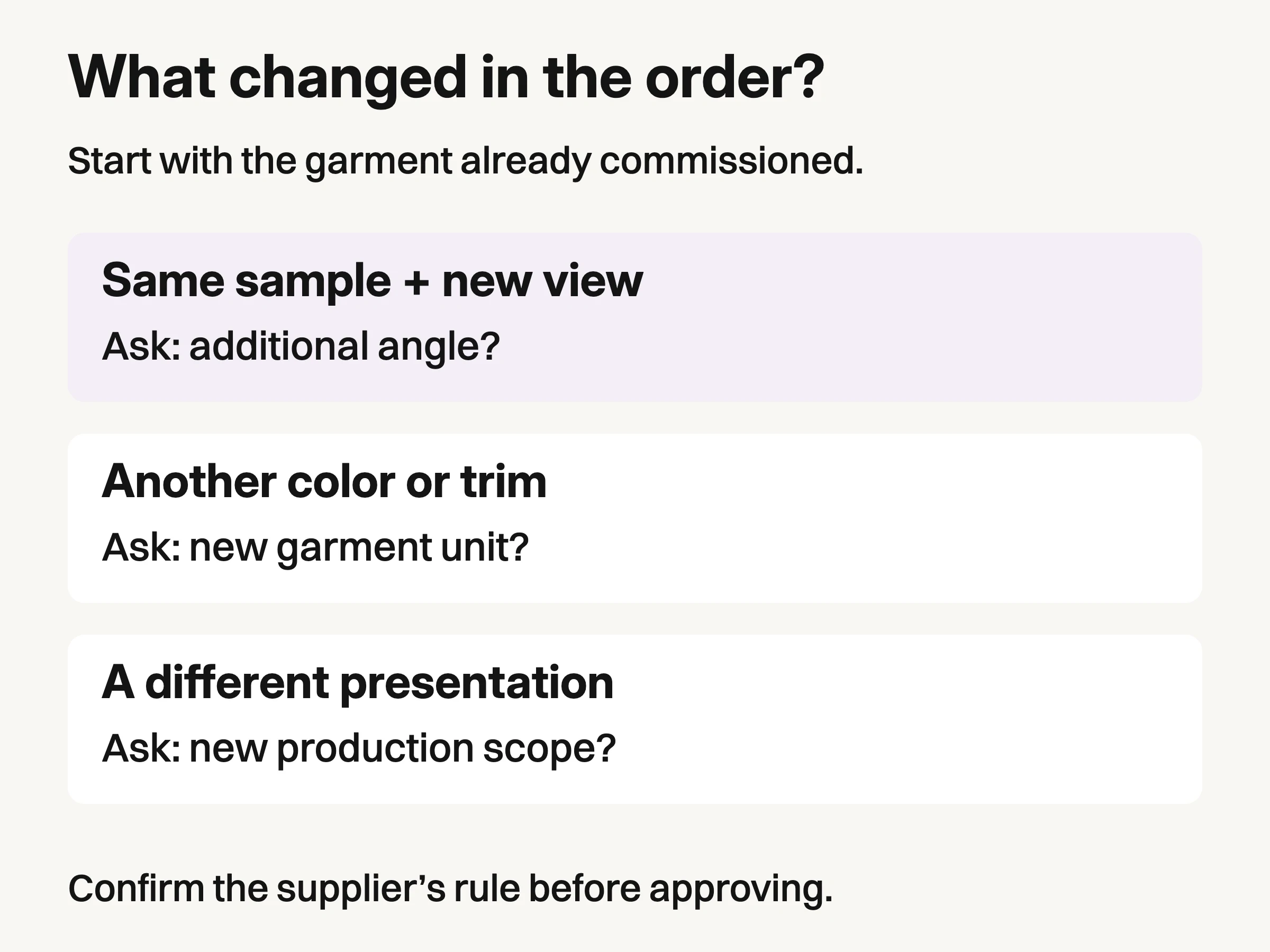
Proposed scope-change questions, not a studio billing policy. Confirm the supplier’s actual terms for your order.
This is a proposed way to classify changes before asking for a price. It does not impose a billing policy on any studio. Send the supplier the original item, the requested change and the intended final image together. That makes the next question specific: does this use the existing production unit, start another one or require a new scope?
For the hypothetical blouse, write “same terracotta sample, one back view, same background and crop” rather than “one extra photo.” For the second colorway, identify the new sample and say whether its front and back are both required. These short descriptions prevent a small addition from becoming an argument about what the original order meant.
An additional-angle rate has a narrow meaning
PVS's published menu lists ghost mannequin work starting at $65 per garment, plus $30 for each additional angle. Its lay-flat service starts at $50 per garment, also with additional angles at $30 each.
Using only the ghost mannequin base and angle figures, the arithmetic is $65 for the base, $95 for the base plus one additional angle, and $125 for the base plus two. The chart intentionally does not label those rows as one, two and three total images: confirm what the base includes.
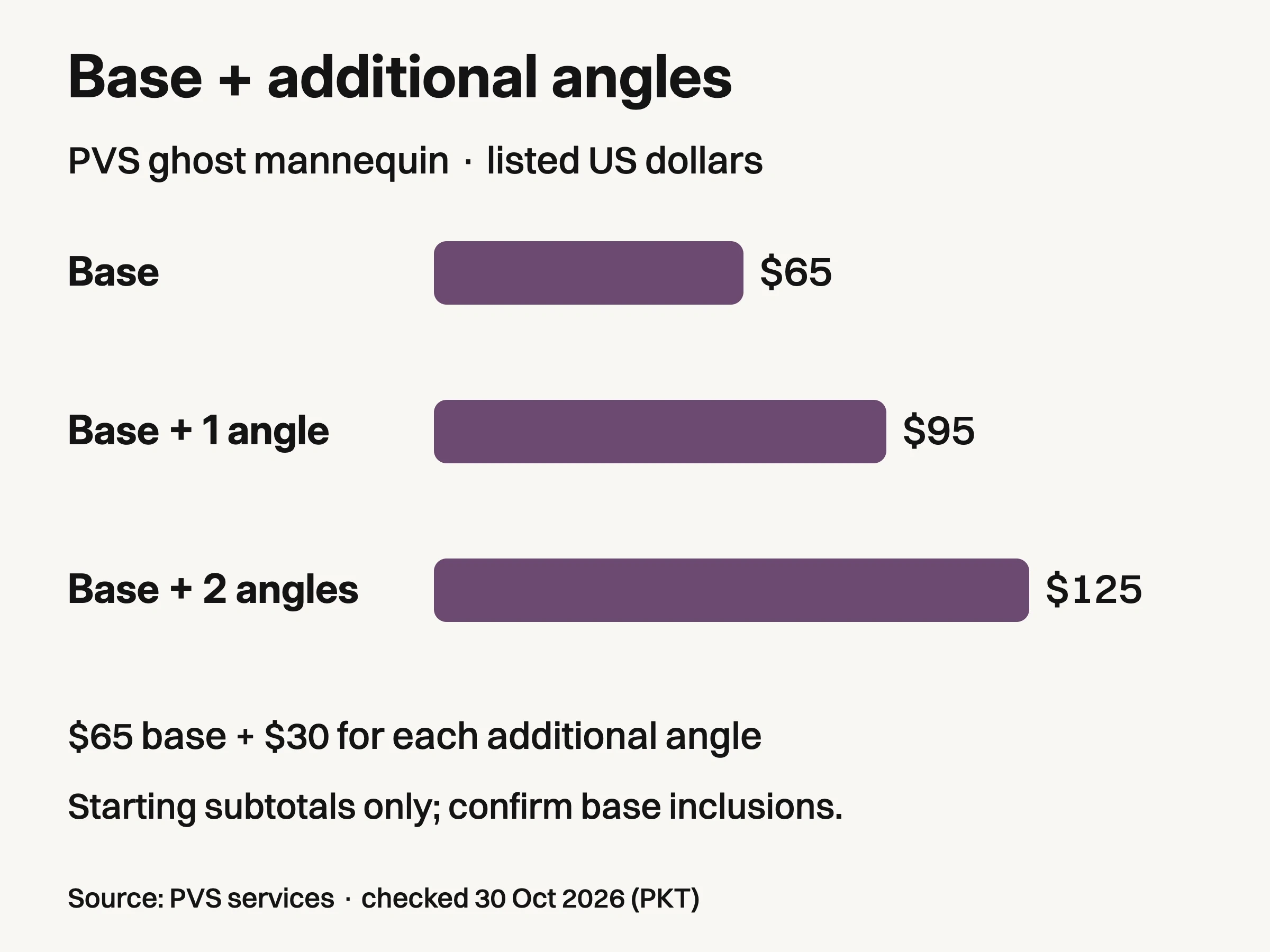
PVS public rates, checked October 30, 2026 PKT: $65 starting base per garment plus $30 per additional angle. Calculated subtotals only, not a quote or total image count. Confirm base inclusions, eligibility and all other applicable charges.
These are calculated starting-price subtotals, not complete quotes. They exclude any tax, shipping, special handling or other charge that might apply, and assume the requested work qualifies for the published base and additional-angle terms. They do not establish the provider's final price for your garment.
The important decision is what the added view contributes. A plain back may establish silhouette; an unusual rear closure may require a closer frame. A single wide back view might not show the closure well enough. Ask for the necessary view, then find out how it is billed. Choosing a cheaper but uninformative angle can leave the original production task unfinished.
“Ghost mannequin” can be the service or an add-on
At ProductPhotography.com, the listed $30 is added to each photo featuring a ghost mannequin. The page explicitly says it is additional to the underlying photo price. It lists steaming, mannequin styling and digital mannequin removal as included in that add-on.
That $30 cannot be compared directly with a studio's full per-garment starting price. First identify the underlying photography service and the number of photos receiving the treatment. Also ask how an interior neckline, lining or transparent panel will be handled if it needs separate capture or more complex compositing.
The final hollow-form image must still describe the actual neckline, shoulder shape, sleeves and hem. Before reducing the post-production scope, identify which construction details depend on it. The garment still needs to be shown truthfully.
ProShot Media's menu provides another billing structure: clothing flat lay is listed at $20 per photo plus a $100 setup fee; ghost mannequin is $25 per photo plus a $120 setup fee. It says setup fees apply once per product type per shoot. That makes the definition of a product type important when a batch mixes blouses, outerwear and accessories. Ask how your actual batch is classified instead of assuming every item shares one setup.
A colorway is a product decision before it is an editing decision
A new colorway deserves its own identification in the brief even when the supplier offers recoloring. Check what must change and what must stay fixed: fabric color, print, lining, buttons, trim and label placement. A garment sold in two colors may also use different hardware or contrast stitching.
Do not request a cheaper color edit as though it were automatically equivalent to photographing the other sample. Ask whether the proposed method can represent that actual variant, what reference is required and how the result will be reviewed. If the reference does not establish a detail, an attractive recolor cannot establish it either.
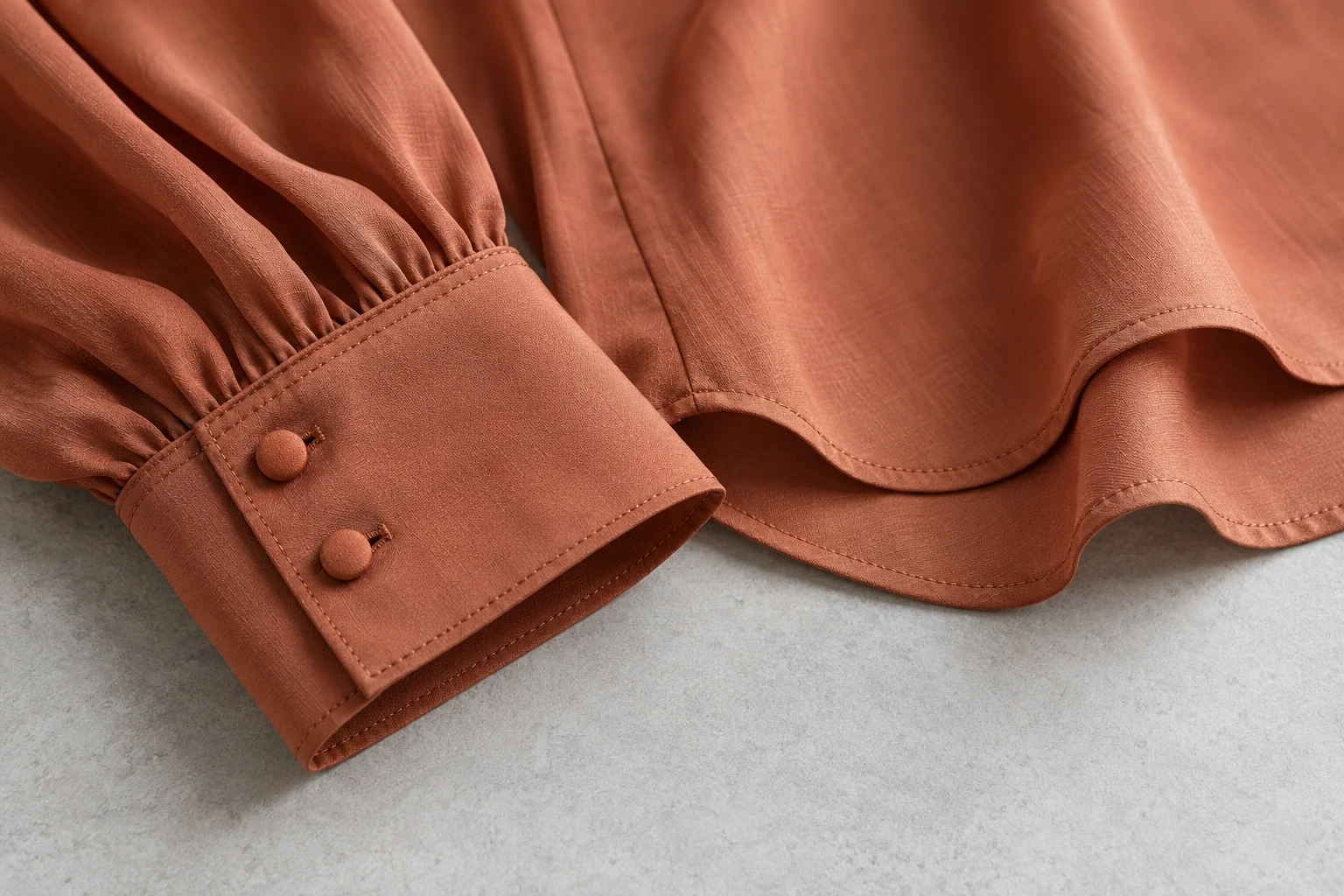
Conceptual illustration: a separately generated fictional garment detail, not a controlled view of the hero blouse or proof of a supplier service.
The ecommerce clothing photography guide helps define the garment views and presentation before this pricing decision. Keep that visual brief attached to the estimate. A supplier should be able to tell which images identify each sellable variant and which are optional campaign material.
This is also where a detail image earns its place. A cuff close-up can explain a closure that a front view hides; a second nearly identical crop may add little. Price the image that answers the unresolved product question, rather than buying a fixed number of files for every style regardless of construction.
Moving on-model changes the scope around the garment
An on-model rate may cover a final image while leaving other production work separate. The current Product Photography NYC pricing page lists ecommerce model photography from $65 per final image, with studio and basic post-production included. Styling and hair and makeup are quoted separately; its additional-production section also identifies model fees as a separate item when needed.
The question is therefore not only how many images you receive. Confirm who supplies the person, which styling work is required, how many looks are planned and which uses the agreement covers. Do not convert an image rate into a complete on-model budget without those answers.
The same blouse may need a factual catalog view and a more expressive campaign frame. Keep their purposes separate in the request. The campaign frame can use a different pose or setting; it should not quietly become the only reference for a construction detail that the catalog image was meant to show.
Ask for the price of the change before approving it
Use the existing order as the baseline. The following questions keep an addition tied to its actual production consequence, without assuming every supplier bills the same way.
Requested change | Ask the supplier to confirm |
|---|---|
Another angle of the same sample | Does the additional-angle rate apply, and what finishing is included? |
Another colorway or changed trim | Is this a new garment unit, a new image or a separately scoped color edit? |
Flat lay changed to ghost mannequin | Which capture, styling and compositing charges replace or supplement the original service? |
Catalog view changed to on-model | Which image, talent, styling and usage terms apply to the new scope? |
Proposed questions for a revised order. The supplier must confirm the applicable billing rule and total.
Ask for the revised deliverable description beside the revised total. Keep the previous version so a teammate can see what changed. If an inclusion is unclear, mark it unresolved rather than treating it as free.
A practical approval can be short: “Add one back view of sample BL-01 in terracotta; retain the agreed background and edit standard; supplier to confirm additional-angle eligibility and revised total.” This is an illustrative request, not a booking or a supplier quotation.
Keep generated variants in their own production scope
Once accurate product sources exist, Look Atlas can support additional on-model and campaign imagery. Use the AI fashion photography page to evaluate that separate creative route. Compare generated outputs with the approved garment reference before accepting them.
Do not subtract a studio fee from an AI plan price and call the difference a saving. Source capture, direction, review and any corrections still belong to the actual work. No cost reduction is demonstrated by the rate examples in this article.
The useful next step is to name the change precisely: same garment and another view, another sellable variant, or another production format. Once the supplier agrees on that unit, the revised price has a meaning your team can approve.
