
Amazon product photography pricing: separate photos, designs and A+ content
A quote for “seven Amazon images” can mean seven finished photographs, a mixture of photos and designed panels, or a package that also includes A+ content. Amazon product photography pricing only becomes comparable once those deliverables are named. Start with the destination and the work required, then read the price beside it.
For current reference points, ProductPhotography.com advertises Amazon packages from $995, while Artfoxlab lists white-background photography at $19.90 per image in its lower-volume band, infographic design at $89.90 per design and A+ content at $349.90 per set of up to seven modules. These are different services, not competing prices for the same output.
All dollar figures here are USD from provider pages checked November 3, 2026. They are advertised terms, not a market average, an endorsement or a quote for your product. Confirm the applicable scope and current total before ordering.
An asset count can hide the work inside a package
ProductPhotography.com's Amazon packages mix hero shots, lifestyle photos and infographics. Its published composition is shown below. The provider describes an infographic as photography combined with graphic design; the package count does not tell you how many underlying camera captures it will require.
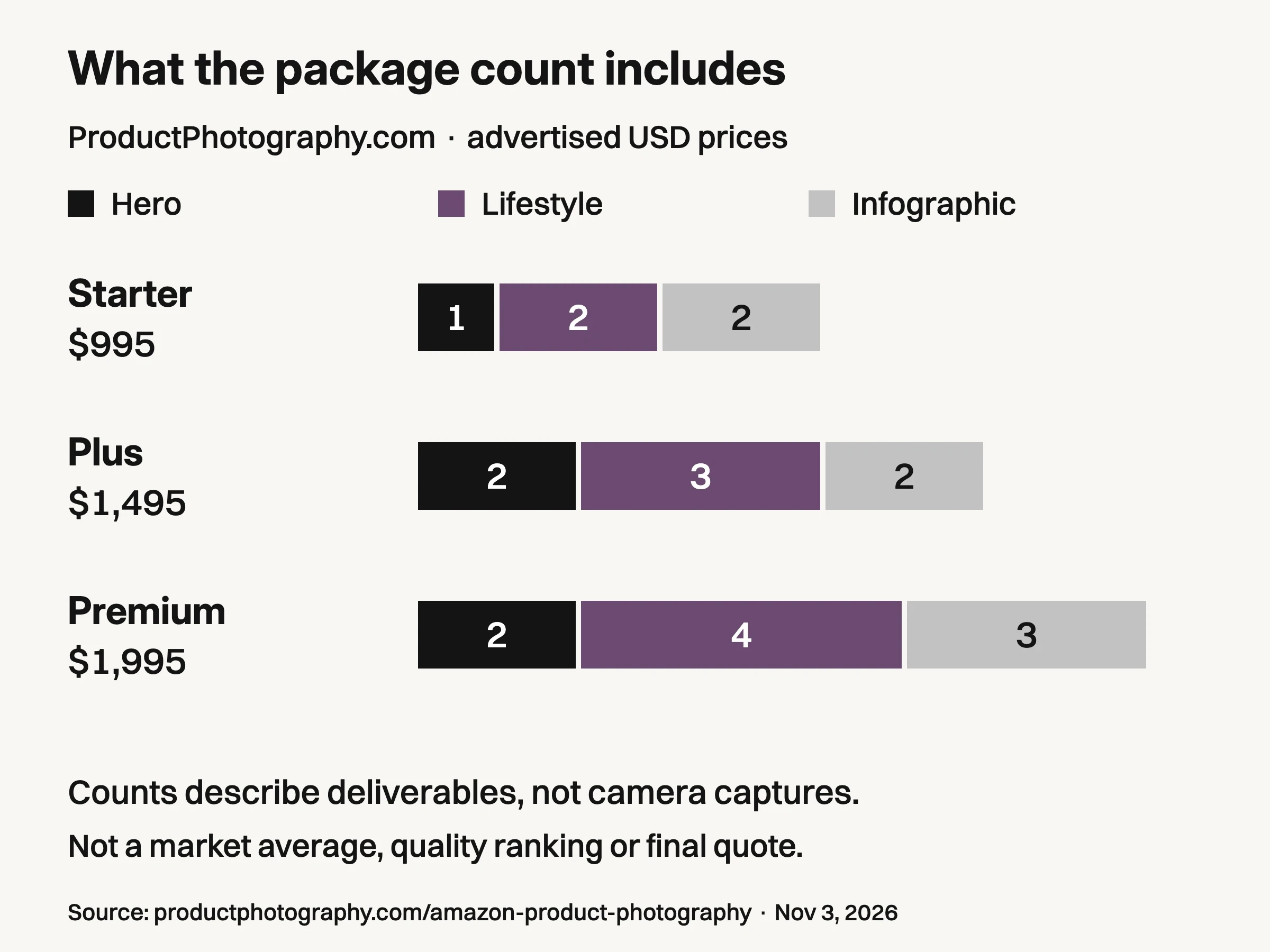
ProductPhotography.com published packages, checked November 3, 2026: US$995, US$1,495 and US$1,995. Counts are named deliverables, not underlying camera captures. Provider-specific scope, not a market average, quality ranking or final quote.
The service also says each product or ASIN needs its own package. Size and group-count limits apply, while larger groupings, props, complex requests and return shipping can affect the invoice. Treat that as this provider's policy, not an Amazon rule or an industry convention.
This is why dividing a package price by its asset count can answer the wrong question. A designed comparison panel and a new product photograph may each arrive as one image file, but they require different inputs and approvals. The division does not reveal the labor, capture count or value of either.
Before comparing suppliers, write down whether each deliverable is a photograph, a designed gallery panel or an A+ module asset. If a supplier uses a different vocabulary, ask it to map its package to those destinations. Keep portfolio and production-quality review separate from the arithmetic.
Follow one product from source photograph to finished placement
Consider a hypothetical single-ASIN food-storage container launch. The brand already has a clear product-on-white photograph and a useful lid-detail image, with permission to reuse them. It now wants a dimension panel, a kitchen-context image and A+ content. This is a scoping example, not a client project or a completed production test.
The dimension panel might use an existing photograph plus approved measurements, copy and layout. That is not necessarily another physical shoot. But a designer cannot obtain reliable dimensions from an arbitrary crop. The brand must supply the facts, and the supplier must confirm that the source has enough resolution and a suitable view.
The kitchen image is a different request. Specify whether the proposed service involves a physical scene, a composite or generated imagery. Each needs its own source and review plan. Do not let a package label silently decide how the product will be represented.

Original scoping aid: a reusable source can support different deliverables. Confirm each design task and A+ eligibility separately. Hypothetical workflow, not Amazon UI.
For A+ content, first choose the modules actually available to the account and the story they need to tell. Then identify which existing images can support those layouts and which genuinely need new production. A useful square gallery file is not automatically a suitable wide module asset; the composition, text and crop may need to change.
Ask the supplier to mark each requested placement as using an accepted source, needing a new capture, needing design, or requiring both. One source may feed several outputs, but every output still needs an explicit scope. This does not establish that reuse is free or that every source is licensed for every intended use.
Paying for A+ design does not buy access to A+ content
Amazon's current A+ Content page says the tool is free for eligible sellers. Its stated entry conditions include a Professional selling account and a qualifying Brand Representative or Reseller role for an enrolled brand, or generic products in the catalog. Check your actual account, product eligibility and available content type before commissioning layouts.
That platform access is separate from paying someone to photograph, write, design or assemble the content. Artfoxlab's pricing page, for example, lists A+ design separately from infographic design and excludes A+ from its Basic and Standard packages. A paid production service can coexist with a free platform tool.
Do not assume “A+ included” also means copywriting, new photography, localization, account upload and submission management are all included. Ask for the module plan and the division of responsibilities. If the studio delivers files while your team assembles the modules, that remaining work belongs in your production plan.
Amazon's workflow includes applying content to products and submitting it for review. A supplier's delivery milestone should therefore be described separately from platform approval. No photography or design payment guarantees acceptance, display or a sales result.
Put the destination beside the price
Use a short placement-specific request instead of asking only for a cheaper package. For the hypothetical container, the unanswered questions are whether the existing photos are usable, who supplies verified dimensions, how the kitchen scene is produced and who builds the A+ modules.
Deliverable in the quote | Confirm before approving the price |
|---|---|
Main or additional product photograph | Which actual product, view and finished file does the charge cover? |
Designed gallery panel | Is source photography supplied, newly captured or separately charged? Who provides approved facts and copy? |
Lifestyle or context image | Is it a physical shoot, composite or generated scene, and what review is included? |
A+ content set | Which available modules, images, text, languages and assembly tasks are included? |
Upload or submission service | Who performs it, and is delivery distinguished from Amazon's review outcome? |
Proposed buying aid; suppliers must confirm their own inclusions and responsibilities.
The table is a proposed buying aid, not a billing policy imposed on suppliers. A provider may bundle several rows into one fee. That can be convenient, provided both sides still know what completion means.
The existing Amazon photography service guide explains the broader service landscape. For a specific order, attach the actual product identifier and placement list. Do not assume an unused allowance in one product's package transfers to a second ASIN; get that arrangement confirmed explicitly.
Check the applicable Amazon product image guidance when briefing the work. Main images and supporting creative images serve different roles, and current category requirements still apply. A beautifully designed gallery panel should not be purchased as a substitute for the required main-image treatment.
Choose the unfinished job, not the biggest bundle
A larger package can be appropriate when the product genuinely needs more views, scenes and designed explanations. It can also include work you are not ready to commission. If the A+ module plan is unresolved, buying extra assets first may leave you with files that do not fit the eventual layout.
For the hypothetical container, approve the reusable source images and measurements first. Ask for a separately described dimension panel and kitchen scene. Commission the A+ work once eligibility, modules and responsibilities are settled. This is sequencing advice, not a claim that splitting orders always costs less.

Conceptual illustration: independent fictional product scene, not the hero container, a customer commission, a quote or evidence of a provider service.
If generated creative imagery is part of the proposal, Look Atlas can be considered for that specific production route after the factual product references are accepted. Review the container's shape, lid, included parts and material against those sources. A generated scene does not establish product dimensions or prove a use claim, and its availability does not remove design or platform-review work.
Do not compare an AI plan price with a complete studio package and describe the difference as savings. They may include different work. The useful budget question is what remains to be produced for each placement, by whom, and under which approval conditions.
Send the supplier a marked-up deliverable list: existing source accepted, new capture needed, design needed, A+ assembly needed. Request a total against that list. When the quote names the destination and the work behind every file, the price becomes something your team can actually decide on.
